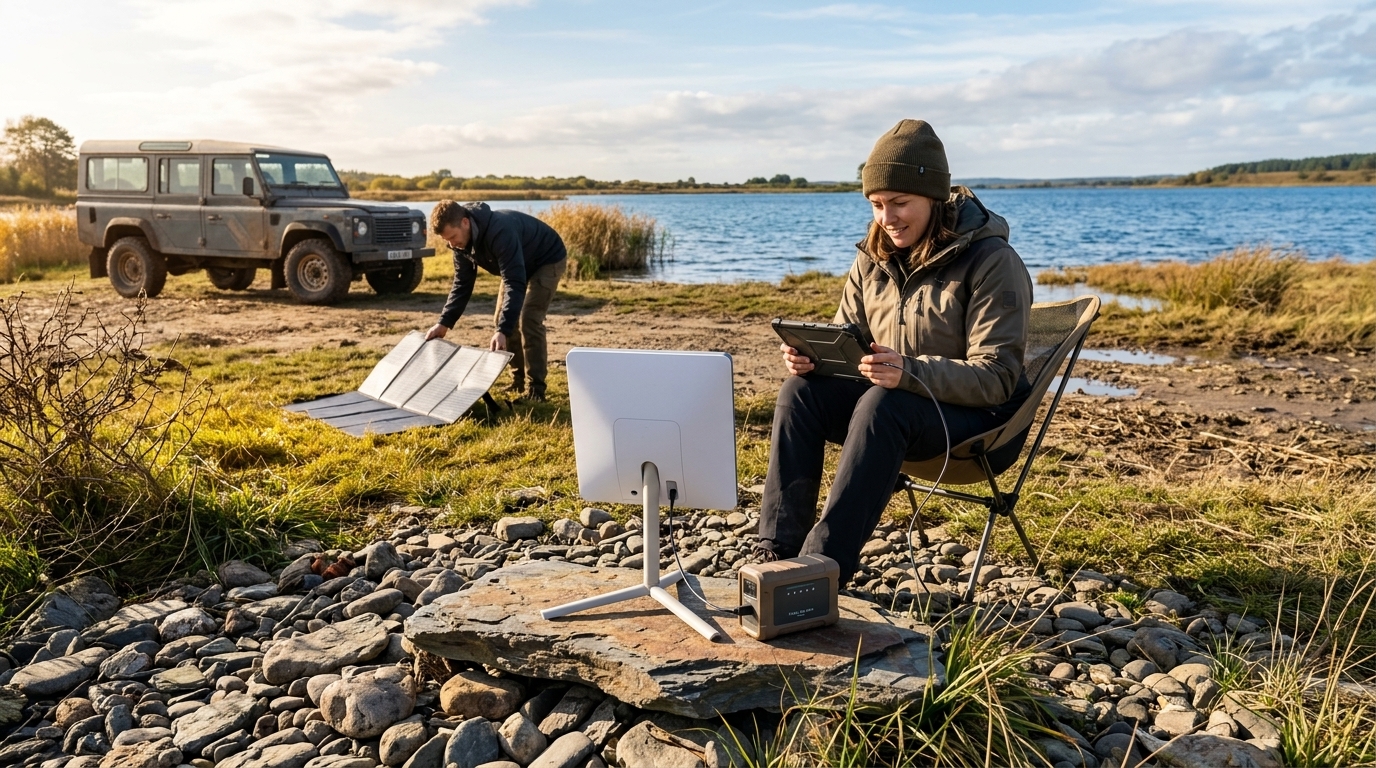
The promise of global connectivity is entering a new, more personal phase. According to recent analyses of SpaceX firmware code, Elon Musk's company appears to be preparing a version of the Starlink Mini that will feature an integrated battery. This development is not merely a technical upgrade; it is a strategic move that could redefine the concept of "mobile connection" on a global scale, severing the last cable that kept users tethered to a power source.
Anatomy of a Leak: What the Code Reveals
The rumors began when researchers and Starlink enthusiasts spotted references to "battery state" and "charging cycles" within the code that controls the device's hardware. To date, the Starlink Mini, which is roughly the size of a laptop, requires external power via USB-C PD or a dedicated DC adapter. While highly portable, the need for a high-wattage power bank or a vehicle connection remained a limiting factor for those moving through truly rugged terrain.
The addition of an internal battery would transform the Mini into an "all-in-one" tool. Imagine a hiker or a war zone correspondent simply placing the device on the ground and instantly gaining access to speeds of hundreds of Mbps, without worrying about cables that could fray or get tangled. This autonomy is the "holy grail" of telecommunications for remote areas.
Technical Challenges: Power, Heat, and Weight
However, integrating a battery into a satellite dish is no easy feat. The Starlink Mini consumes an average of 25 to 40 Watts during operation. To provide a decent autonomy of, say, four hours, it would require a battery of approximately 100Wh to 150Wh. Here arises the first major hurdle: FAA and international aviation regulations limit batteries allowed in airplane cabins to 100Wh.
Furthermore, there is the issue of thermal management. Satellite dishes heat up significantly while transmitting data to satellites in Low Earth Orbit (LEO). Lithium batteries are sensitive to heat, and placing them inside the same shell as the dish's power electronics requires advanced cooling systems, which in turn add weight and bulk. SpaceX will have to balance portability and durability, keeping the Mini light enough to fit in a backpack.
Social and Geopolitical Impact
Beyond camping enthusiasts and "digital nomads," an autonomous Starlink Mini has massive implications for humanitarian aid and emergency services. In cases of natural disasters, where mobile networks collapse and power is cut off, a battery-powered device providing internet can save lives. Rescuers will be able to coordinate in real-time from the field without the need for generators.
"Technology is no longer about bringing the world to our computer, but about having the world with us, wherever we are, without infrastructure limitations."
In regions with challenging geography, such a device could prove invaluable for border security or remote research stations, ensuring that communication with operations centers remains uninterrupted. At the same time, SpaceX's ability to provide such tools strengthens its position as a de facto global provider of critical infrastructure, something that often causes concern among national governments regarding information control.
The Future of the Starlink Lineup
This move shows that SpaceX no longer sees Starlink just as an alternative for fixed home internet, but as a direct competitor to 5G networks and traditional mobile providers. With the launch of the "Direct to Cell" service and now the potential for a battery-powered Mini, the goal is clear: the elimination of "dead zones" across the entire planet. The remaining question is cost. The current version of the Mini is already more expensive than the standard dish in some markets; a version with a high-capacity integrated battery could see the price skyrocket, making it a premium tool for professionals and serious adventurers.