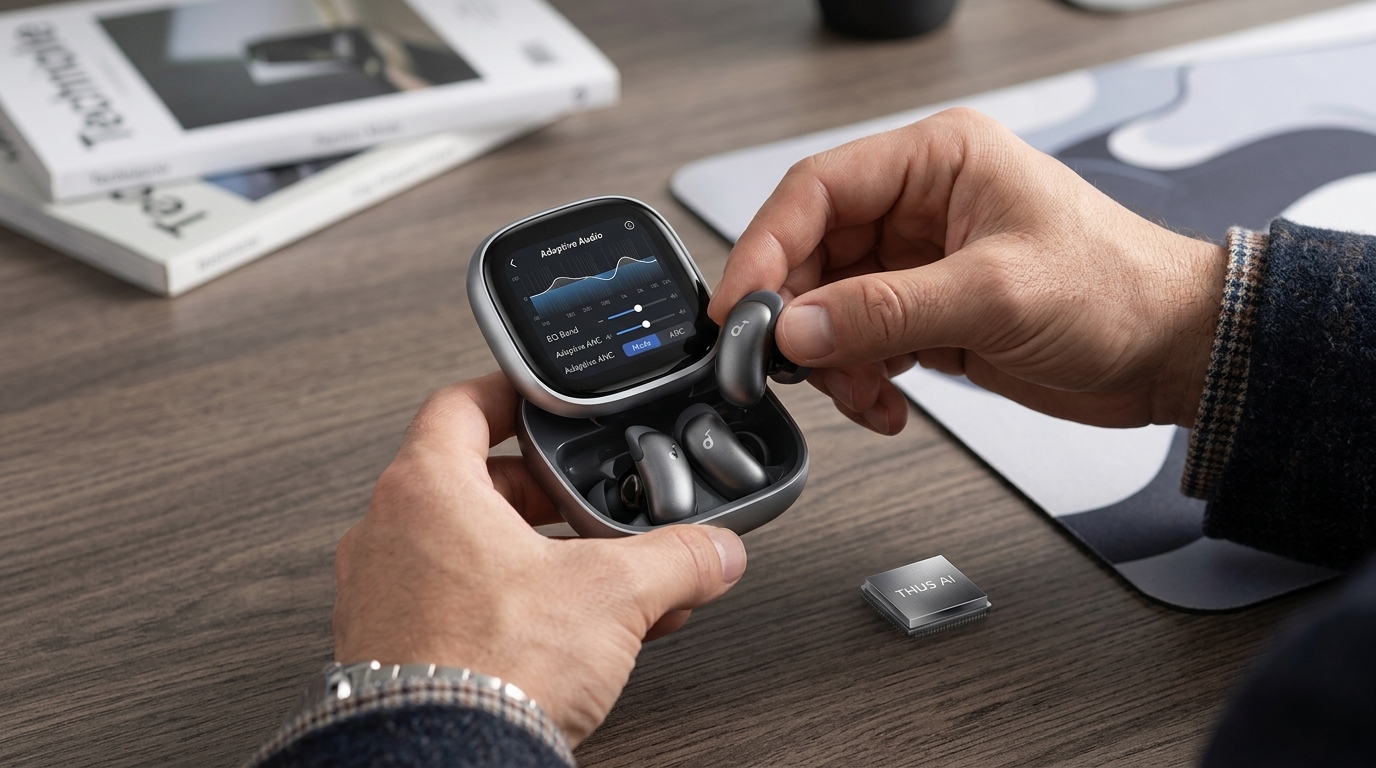
The True Wireless Stereo (TWS) market is at a critical turning point. While recent years have seen progress focused primarily on battery life and connection stability, the new decade demands something more: intelligence. Anker, through its premium Soundcore brand, has taken the next major step by announcing the Liberty 5 Pro. This is not a mere hardware refresh, but the introduction of 'Thus,' the company's first proprietary AI chip, designed exclusively for real-time audio processing.
The Architecture of the Thus Chip: Intelligence in Your Ear
The Thus chip is not a standard Digital Signal Processor (DSP). It is a specialized Neural Processing Unit (NPU) trained on millions of samples of diverse acoustic environments. The primary innovation lies in its ability to separate desired sound from noise with surgical precision that traditional filters fail to achieve. According to Anker, the chip performs billions of calculations per second, allowing the Liberty 5 Pro to adjust its Active Noise Cancellation (ANC) profile not every second, but almost instantaneously as the user’s environment shifts.
The significance of this development is immense. In traditional headphones, noise cancellation often creates a sense of 'pressure' in the ear or colors the music's frequencies. Thus uses predictive algorithms to compensate for these side effects, maintaining audio fidelity while eliminating external noise. Furthermore, the focus on human voice clarity during calls is unprecedented. The AI recognizes the unique characteristics of the owner's voice and builds a digital 'shield' around it, isolating wind, traffic, or office chatter.
Anker’s Strategic Pivot
For years, Anker was seen as the 'honest' alternative to giants like Apple, Sony, and Bose. It offered excellent quality at a lower price point. With the Liberty 5 Pro and the Thus chip, the company is changing the narrative. It is no longer following trends; it is setting them. Investing in proprietary silicon demonstrates a company that wants full control over its ecosystem, reducing reliance on third-party chip suppliers like Qualcomm.
- Adaptive Noise Cancellation 3.0: Dynamic adjustment across thousands of environmental scenarios.
- Hi-Res Audio Wireless: Support for LDAC codecs and next-gen Spatial Audio.
- Battery Life: Despite intensive AI processing, Thus's energy efficiency allows for up to 10 hours of continuous use.
- Multi-point Connectivity: Simultaneous connection to multiple devices with smart priority switching.
Beyond Music: AI as a Hearing Aid
One aspect often overlooked is the potential for these devices to function as 'smart assistants' in daily life. The Thus chip's ability to enhance voices in noisy environments (Transparency Mode) paves the way for TWS earbuds to be used as accessibility tools. While the Liberty 5 Pro is not marketed as a medical device, the technology integrated could help individuals with mild hearing difficulties participate more actively in conversations at restaurants or conferences.
"AI in audio is not just about what we hear, but how we choose to interact with the world around us," Soundcore executives stated.
In conclusion, the Liberty 5 Pro represents a milestone. They demonstrate that artificial intelligence is no longer an abstract concept in the cloud, but a tangible tool that fits inside our ears. The challenge for Anker will be to convince discerning audiophiles that AI processing does not 'pollute' pure sound, but rather protects it from the imperfections of the real world.