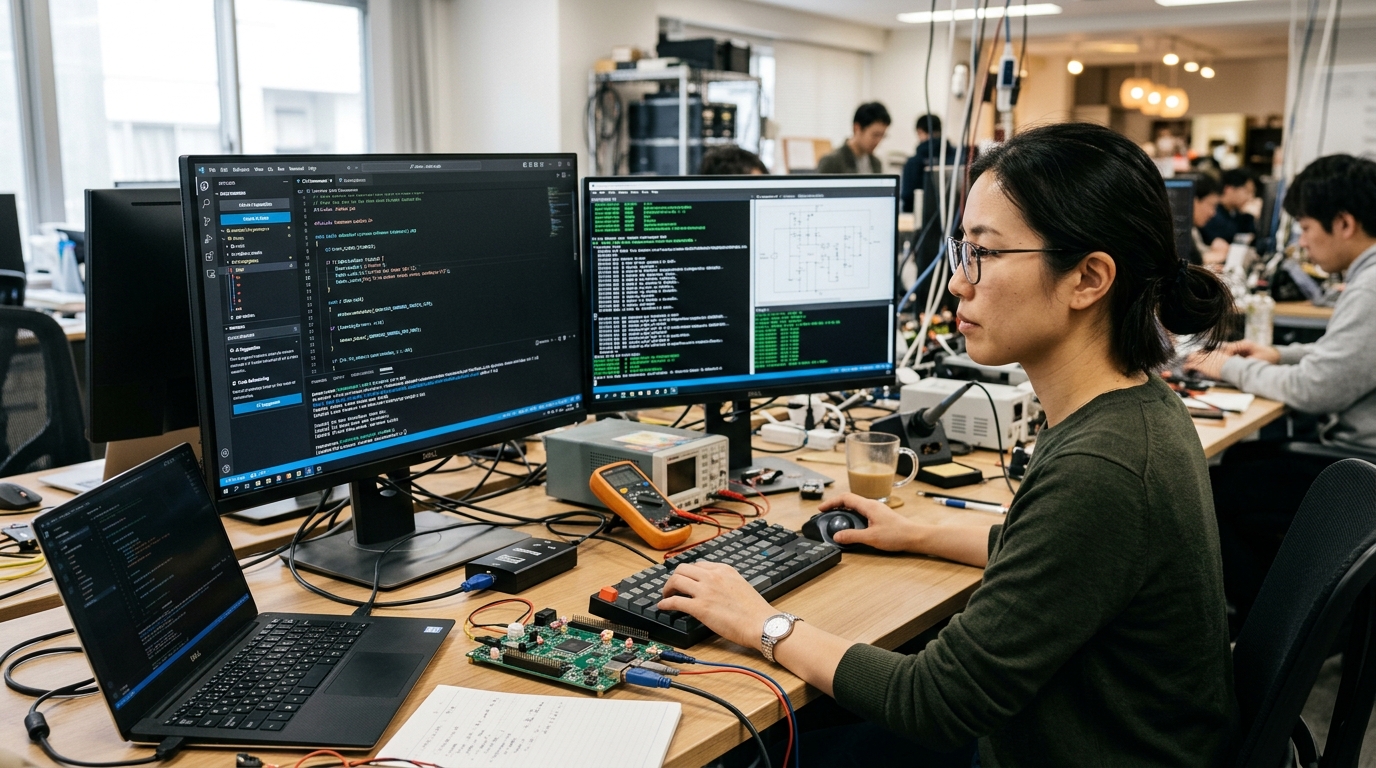
The emergence of AI coding assistants, such as GitHub Copilot, Cursor, and Claude, has triggered a seismic shift in the world of software development. However, while web and mobile application developers are already reaping significant productivity gains, the world of firmware—the software that lives inside hardware—remains a domain where the promise of AI often collides with the harsh reality of constrained resources and rigorous safety standards.
The Uniqueness of Firmware and the AI Gap
Firmware programming is not a simple exercise in logic. It is an art of balancing software and hardware. Unlike a cloud application with near-infinite memory, a firmware engineer works with microcontrollers that have minimal kilobytes of RAM. Every line of code must be optimized, not just for speed, but for power consumption and memory footprint.
The problem with current Large Language Models (LLMs) is that they have been trained primarily on high-level code found in repositories like GitHub. This means they "know" Python or Javascript very well but often struggle with the intricacies of C or Assembly required for direct communication with a processor's registers. AI frequently suggests solutions that are "syntactically correct" but "functionally disastrous" for an embedded system, such as using dynamic memory allocation (malloc) in environments where it is strictly forbidden.
Where AI Truly Helps
Despite the reservations, it would be a mistake to underestimate AI's contribution. In the firmware sector, productivity isn't necessarily increased through automatic code generation, but through the automation of secondary tasks. Specifically:
- Unit Test Generation: AI is excellent at writing test scripts for individual functions, something engineers often skip due to lack of time.
- Code Documentation: Converting cryptic low-level code into understandable documentation is an area where LLMs excel.
- Specification Analysis: The ability of AI to "read" hundreds of pages of component datasheets and summarize pin configurations or communication protocols (SPI, I2C) is revolutionary.
However, the real challenge remains verification. A firmware engineer now spends less time writing code and much more time checking if the AI-generated code will cause a race condition or a stack overflow in real-time.
Risks and the Ethics of Safety
In critical systems, such as medical devices or automotive control systems, failure is not an option. Introducing AI-generated code without a deep understanding of its internal workings can lead to catastrophic results. There is also the issue of cybersecurity: AI may inadvertently suggest code patterns that include known vulnerabilities, such as buffer overflows, which are the number one target for hackers in embedded devices.
"AI in firmware programming is like a very fast but careless assistant. It can bring you the tools in seconds, but you must check if it gave you the right wrench before you tighten the bolt."
Furthermore, there is the risk of "cognitive atrophy." If junior engineers rely exclusively on AI to solve low-level problems, they may never develop the intuition required to understand how the silicon actually functions beneath the software.
Conclusion: The Engineer as Orchestrator
The future of firmware does not belong to AI writing code alone, but to the engineer who uses AI as an advanced analysis and acceleration tool. Productivity in firmware is not measured by lines of code per hour, but by the reliability and safety of the system. AI can reduce noise and routine, but judgment, hardware understanding, and the responsibility for safety remain—and will remain—exclusively human qualities.