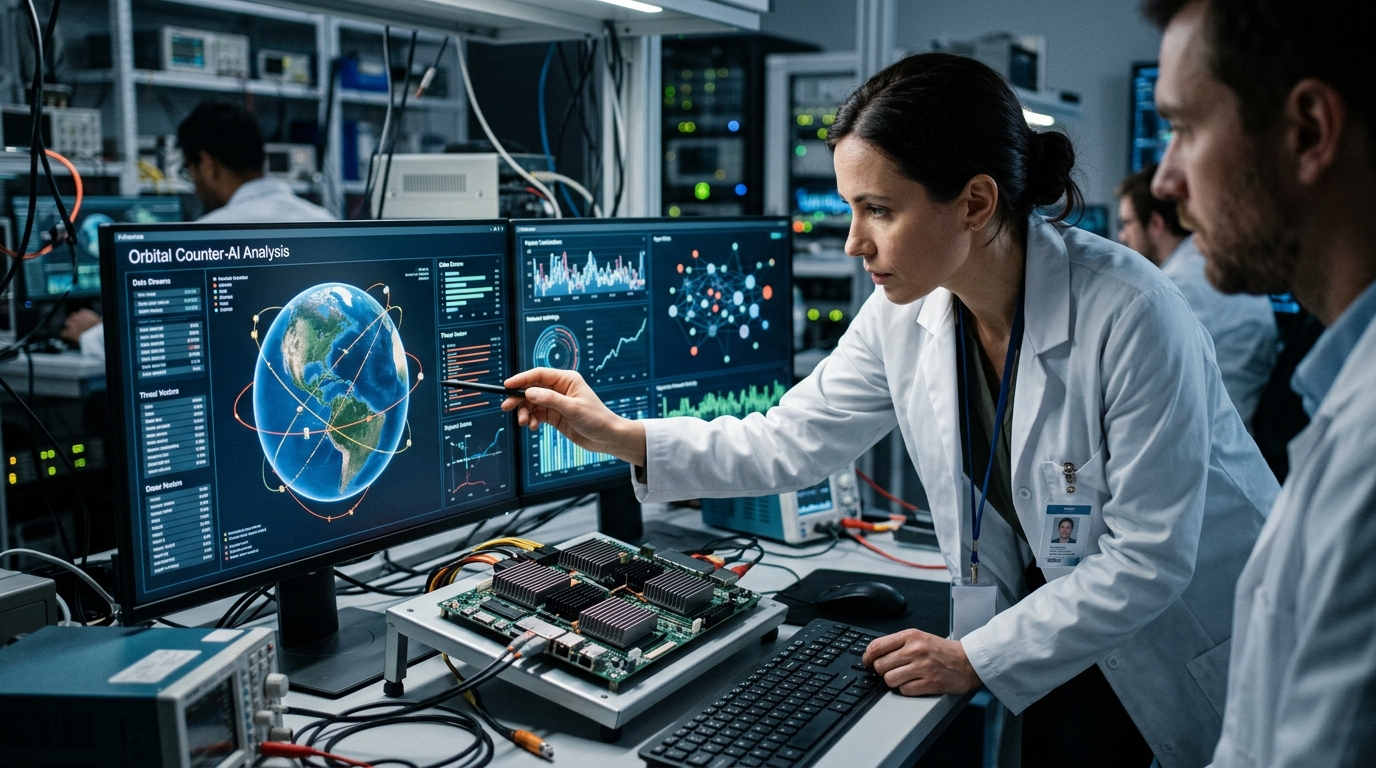
In the high-stakes arena of modern geopolitics, orbital intelligence has long been the ultimate strategic advantage. However, the sheer volume of data generated by thousands of remote sensing satellites has far outpaced human analytical capacity. The global solution has been the rapid adoption of Artificial Intelligence (AI), capable of scanning millions of square kilometers in seconds to identify missile silos, troop movements, and critical infrastructure changes. Yet, as the Bulletin of the Atomic Scientists warns, this reliance is creating a dangerous new Achilles' heel: Counter-AI threats.
The Illusion of Digital Omniscience
Automated satellite imagery analysis relies on Machine Learning models, specifically Computer Vision (CV), trained to recognize specific patterns. The speed at which these systems process data allows decision-makers to operate within an accelerated OODA loop (Observe, Orient, Decide, Act). The core issue is that AI does not "see" the world like a human does. It relies on statistical correlations of pixels that are remarkably vulnerable to targeted interference.
Counter-AI threats are not merely about traditional camouflage or concealment. They represent a new form of "digital deception" where an adversary introduces subtle perturbations into the data—often invisible to the human eye—that force the algorithm to reach entirely incorrect conclusions. A main battle tank can be rendered as a school bus, or an empty patch of desert can appear as a massive concentration of air assets.
Deception Techniques: From Pixels to the Battlefield
There are two primary ways adversaries can undermine remote sensing AI. The first is through "adversarial attacks" at the digital level. If an opponent manages to breach the data pipeline from the satellite to the ground station, they can inject "digital noise" designed to disorient the analysis model. This type of cyberattack is surgical: it doesn't destroy the system; it forces it to lie.
The second, and perhaps more alarming method, involves "physical adversarial attacks." Researchers have demonstrated that placing specific geometric patterns or materials on vehicles or buildings can exploit the mathematical blind spots of neural networks. A specially designed tarp over an aircraft hangar could trick an AI into believing the building is destroyed or non-existent, even if a human looking at the same photograph would clearly see the target.
Strategic Instability and the Risk of Nuclear Miscalculation
The most harrowing dimension of this issue concerns nuclear deterrence. Stability between major powers relies on the ability to verify an adversary's actions. If the AI used to monitor nuclear arsenals can be deceived, then trust in intelligence collapses. During a crisis, a false signal from a "blinded" AI system could lead to a catastrophic escalation.
- Misinterpretation of Intent: A Counter-AI attack that hides a mobilization could provide the advantage of surprise, prompting the other side toward preemptive strikes.
- Erosion of Verification: Arms control treaties depend on satellite data. If AI reliability is compromised, these agreements become effectively unenforceable.
- Automated Escalation: As decision-making systems become more autonomous, injecting false data at the start of the chain could trigger a reaction before a human can intervene.
The Necessity of Robust AI
Addressing these threats requires a fundamental shift in military technology development. "Robust AI" must not only be accurate in laboratory settings but also capable of detecting deception attempts. This involves "adversarial training," where models are taught to recognize their own vulnerabilities, and the use of multimodal sensing—combining different types of data (like radar and optical)—that are harder to spoof simultaneously.
Ultimately, technology cannot fully replace human judgment. The role of the imagery analyst remains critical, not as a data processor, but as a safeguard against machine hallucinations. The "invisible front" of space now demands a new form of digital diplomacy and technical hardening before algorithmic errors translate into real-world kinetic conflicts.