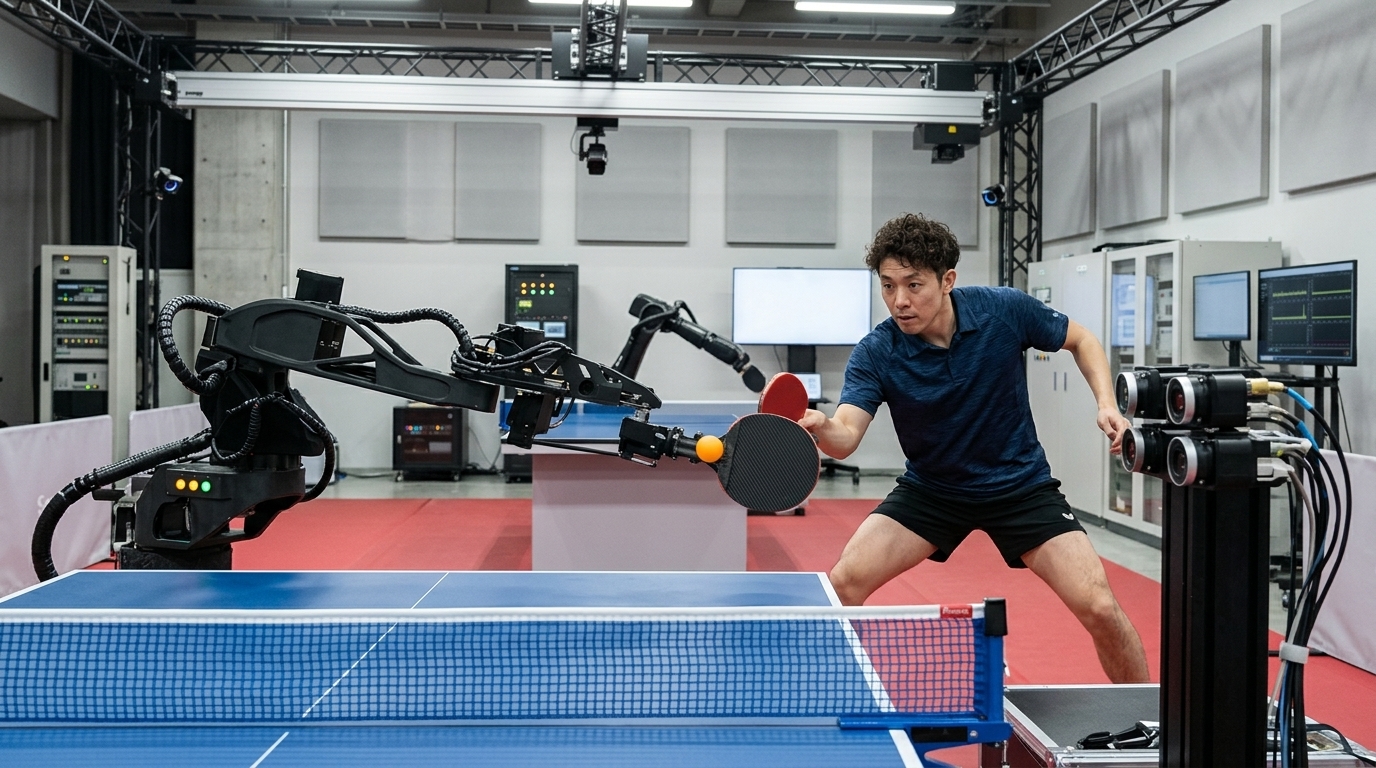
The history of man-versus-machine competitions has been marked by iconic milestones: IBM’s Deep Blue in chess in 1997, DeepMind’s AlphaGo in 2016. Yet, physical dexterity remained the last "safe" haven of human superiority. Until today. Sony AI, the research arm of the Japanese giant, has announced a groundbreaking development: a robotic system that not only plays table tennis but is capable of defeating elite-level players in real-world conditions.
The Challenge of Speed and Spin
Table tennis is considered by robotics scientists as the "Holy Grail" of motion control. Unlike chess, where the challenge is purely computational, table tennis requires a combination of lightning-fast perception, strategic foresight, and absolute kinetic precision. The ball can travel at speeds exceeding 100 kilometers per hour, while the spin applied by professional players makes its trajectory unpredictable for conventional computer vision systems.
Sony AI's system utilizes a network of high-speed cameras capturing motion at thousands of frames per second, allowing the algorithm to analyze not just the ball's position, but its rotation rate based on how light reflects off its surface. This level of real-time data analysis is what enables the robot to position its paddle with millimeter precision, neutralizing the most difficult spin shots.
From Simulation to Reality (Sim-to-Real)
The true innovation behind Sony AI's success lies not just in the hardware, but in the training methodology. The team used a technique known as "Sim-to-Real Reinforcement Learning." The robot "played" billions of virtual matches within a digital environment, learning from its mistakes without the constraints of physical wear and tear.
- Strategic Adaptation: The AI doesn't just react; it learns the opponent's style during the game, identifying weaknesses in their backhand or footwork.
- Zero Latency: Data processing occurs at the edge, ensuring that the robotic arm's response is faster than the human nervous system.
- Endurance: Unlike humans, the machine knows no fatigue or psychological pressure, maintaining consistent performance even after hours of play.
"This isn't just about a game. It's proof that Artificial Intelligence can now interact with the physical world in ways we previously thought were the exclusive privilege of biological evolution," says a lead researcher at Sony AI.
Implications Beyond Sports
Why is Sony investing so many resources into a game? The answer lies in the applications of this technology in broader industry. The algorithms that allow a robot to return a smash in table tennis are the same ones that will enable robotic surgeons to perform operations with absolute safety, or autonomous systems to avoid accidents in fractions of a second.
Furthermore, this success paves the way for a new generation of collaborative robots (cobots) in production. The ability of a machine to perceive the movement of a human standing next to it and adapt instantly is the key to the safe coexistence of humans and AI in factories and warehouses. Sony appears to be positioning itself as a leader in this new field of "Physical AI," combining its expertise in image sensors with advanced machine learning.
The Future of Human Skill
As machines conquer the field of physical sports, the question arises: what is the role of human talent? Professional players who faced the robot expressed both awe and concern. "It's like playing against a wall that thinks," one participant noted. However, the sporting community also sees an opportunity: the robot as the ultimate coach, capable of pushing athletes to performance levels they never imagined.
Sony AI's victory in table tennis is not the end of the sport, but the beginning of a new era where the boundaries between biological and artificial capability become increasingly blurred. The next step? Integrating this intelligence into humanoid robots that can move freely through space, turning our world into a vast field of "smart" interaction.