The history of human progress has always been inextricably linked to the discovery of new materials. From the Bronze Age to the silicon revolution, every major leap has been based on our ability to master the structure of matter. However, for millennia, this process relied on luck, observation, and the laborious method of "trial and error." Today, in May 2026, we stand on the threshold of a radical paradigm shift. The announcement of a new Artificial Intelligence system capable of predicting and designing millions of stable molecular structures is not just scientific news; it is the beginning of a new "computational alchemy."
The Computational Alchemy of the 21st Century
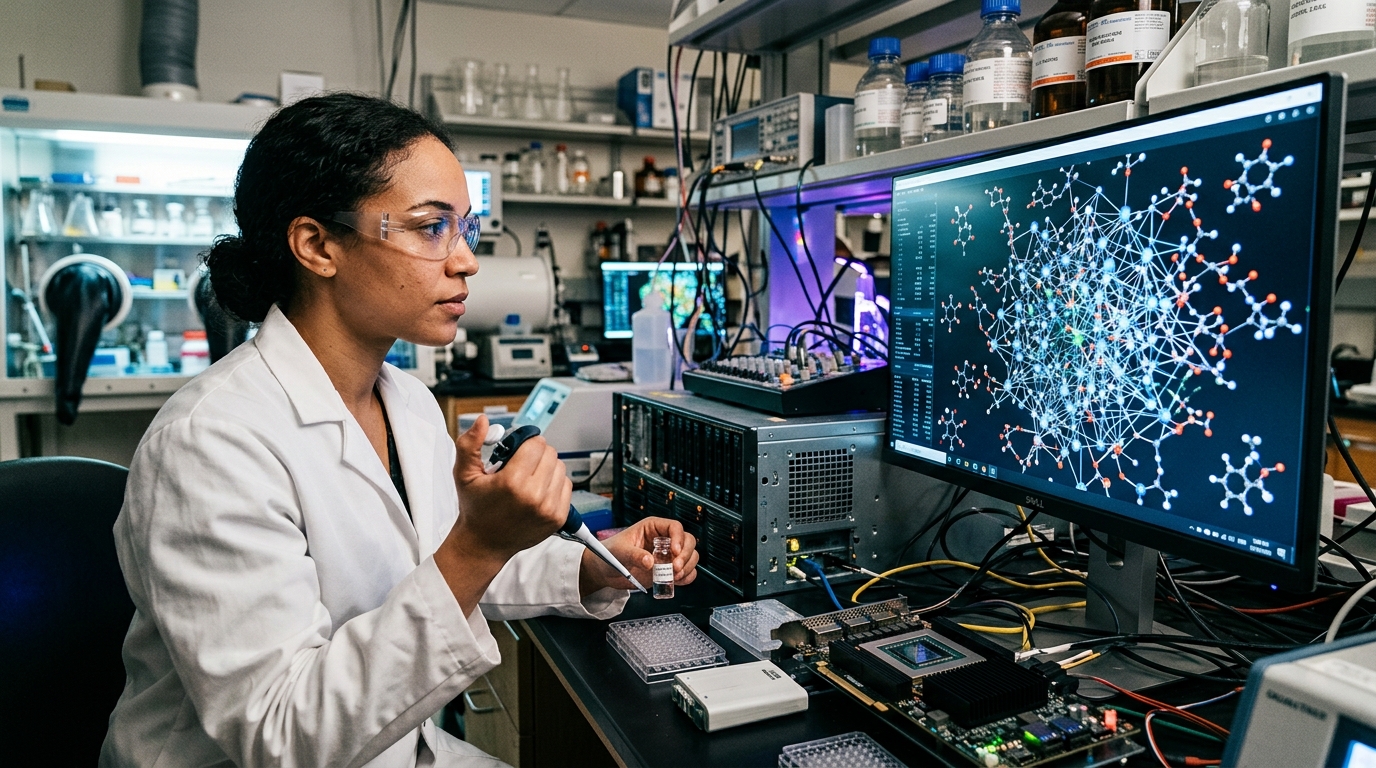
The new tool, based on advanced Graph Neural Networks (GNNs), has managed to dramatically expand the catalog of known crystalline structures and molecules. While humanity had managed to identify a few hundred thousand stable materials throughout its history, AI has managed within a few months to propose over two million new structures, many of which exhibit properties previously thought impossible.
The significance of this development lies in the concept of "stability." It is not enough to design a molecule on a computer screen; it must be able to exist in the physical world without instantaneously collapsing. The new system uses active learning techniques, where the model proposes structures, these are tested via quantum mechanical simulations, and the results are fed back into the system to make it smarter. This self-reinforcing cycle allows for the exploration of "chemical space" at speeds billions of times faster than any human laboratory.
From Batteries to Green Energy
The practical applications of this technology are already visible on the horizon. One of the greatest limitations in the transition to green energy is battery technology. We need materials that store more energy, charge faster, and do not rely on rare and environmentally damaging metals like cobalt or lithium. AI has already proposed thousands of new electrolytes and electrode materials that could lead to next-generation solid-state batteries.
- Photovoltaics: New polymers that can be printed on flexible surfaces with high efficiency.
- Carbon Capture: Porous materials (MOFs) specifically designed to "trap" carbon dioxide from the atmosphere.
- Superconductors: The search for materials that conduct electricity without loss at room temperature.
This mass production of candidate materials reduces research and development time from decades to months. As researchers in the field of astrobiology note, the ability to predict stable molecules also helps us understand what kind of chemistry could develop on other planets under extreme conditions of pressure and temperature.
Ethical Challenges and the Geopolitics of Matter
However, the ability to generate millions of new molecules brings with it serious questions. Who owns the intellectual property of a molecule designed by a machine? If a company holds the patent for a material essential for the planet's survival, how is fair access ensured? Furthermore, there is always the risk of "dual-use." The same technology that designs a new drug or a catalyst can, in the wrong hands, be used to create new, deadly chemical weapons or toxins.
"Artificial Intelligence is not just discovering new materials; it is reinventing the rules of creation itself," notes a leading scientist in the field.
The international community is now called upon to establish frameworks for control and transparency. "Open science" seems to be the only way forward, so that the wealth of new discoveries does not end up in a closed oligopoly of tech giants. The acceleration of material discovery is a gift from AI, but the proper management of this gift remains a profoundly human responsibility.