Humanity stands at the threshold of a new era in medicine, where the greatest battles for survival will not be fought on operating tables, but within the invisible realm of the nanoscale. Recent advancements in nanotechnology and microrobotics have brought to light the creation of microscopic machines, 50 times smaller than a human hair, which promise to radically alter how we confront bacterial infections.
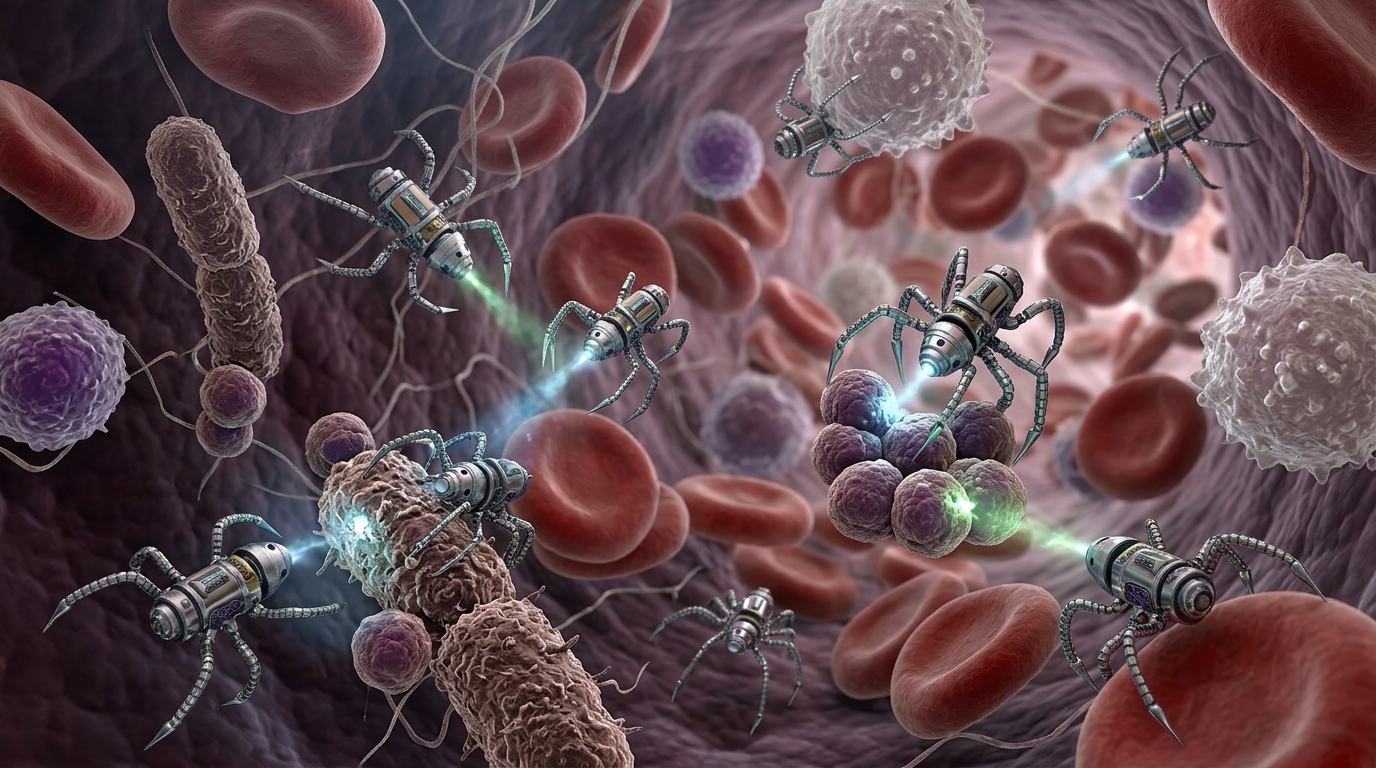
These nanorobots, powered by photons (light), represent a pinnacle of convergence between physics, biology, and engineering. Unlike traditional antibiotics, which often act as "blind" chemical weapons affecting the body's entire ecosystem, these tiny machines offer a targeted, mechanical approach to pathogen elimination.
The Mechanics of Light: How Nanorobots Move
The most striking feature of this technology is its propulsion mechanism. Using light to move microscopic objects draws on the principles of optical tweezers, a technique honored with the Nobel Prize in Physics. Researchers utilize low-intensity laser beams to guide the robots with absolute precision through fluid environments, such as blood or plasma.
These "photo-driven" robots can maneuver around healthy cells and identify specific bacteria based on their chemical signatures or surface proteins. Once the robot reaches its target, it can "capture" it or release a microscopic payload of antimicrobial agents directly onto the bacterium, minimizing collateral damage to the host's tissues.
"We are not just building machines; we are redesigning how matter interacts with life at its most fundamental level," state researchers involved in the project.
Addressing the Antimicrobial Resistance Crisis
The significance of this discovery cannot be overstated, given the global crisis of antimicrobial resistance (AMR). "Superbugs," which have developed resistance to nearly all known antibiotics, represent one of the greatest threats to public health in the 21st century. Nanorobots offer an alternative path: instead of relying on chemical reactions that a bacterium can learn to neutralize, they can use physical force or localized heat to destroy the pathogen's cell wall.
- Precision: Ability to target individual cells without affecting the microbiome.
- Speed: Immediate response and neutralization in real-time.
- Adaptability: Robots can be programmed for different types of pathogens.
Beyond Medicine: Environmental Applications
While medicine is the primary focus, the applications of these tiny workers extend to the environmental sector. Their ability to detect and isolate microorganisms makes them ideal for cleaning water of toxic bacteria or even removing microplastics. In the future, swarms of such nanorobots could patrol water systems, ensuring water quality with zero chemical usage.
Challenges and Ethical Questions
Despite the excitement, the road to clinical application remains fraught with obstacles. Biocompatibility is the primary concern: what materials should these robots be made of to avoid triggering an immune response or accumulating in organs? Furthermore, controlling thousands of such units simultaneously within a living organism requires computational power and imaging systems that are still in their infancy.
Finally, there is the question of autonomy. While current models are externally controlled via light, the prospect of autonomous nanorobots "making decisions" inside the human body raises serious ethical and philosophical questions about the limits of technological intervention in our biological existence.