The unveiling of Microsoft’s Majorana 2 quantum chip represents more than just a milestone in the race for quantum supremacy; it marks a fundamental paradigm shift in how scientific research is conducted in the 21st century. By fusing cutting-edge quantum physics with "agentic AI," Microsoft appears to be unlocking a door that has remained tightly shut for decades: the creation of a stable, fault-tolerant quantum computer.
The Quest for the Holy Grail: The Majorana Fermion
For years, quantum computing has been plagued by the extreme fragility of qubits. These basic units of quantum information are notoriously sensitive to noise and environmental interference, where even a slight temperature fluctuation or a microscopic vibration can cause "decoherence," effectively destroying the computation. Microsoft’s approach, however, doubles down on topological qubits based on Majorana fermions—quasiparticles that act as their own antiparticles.
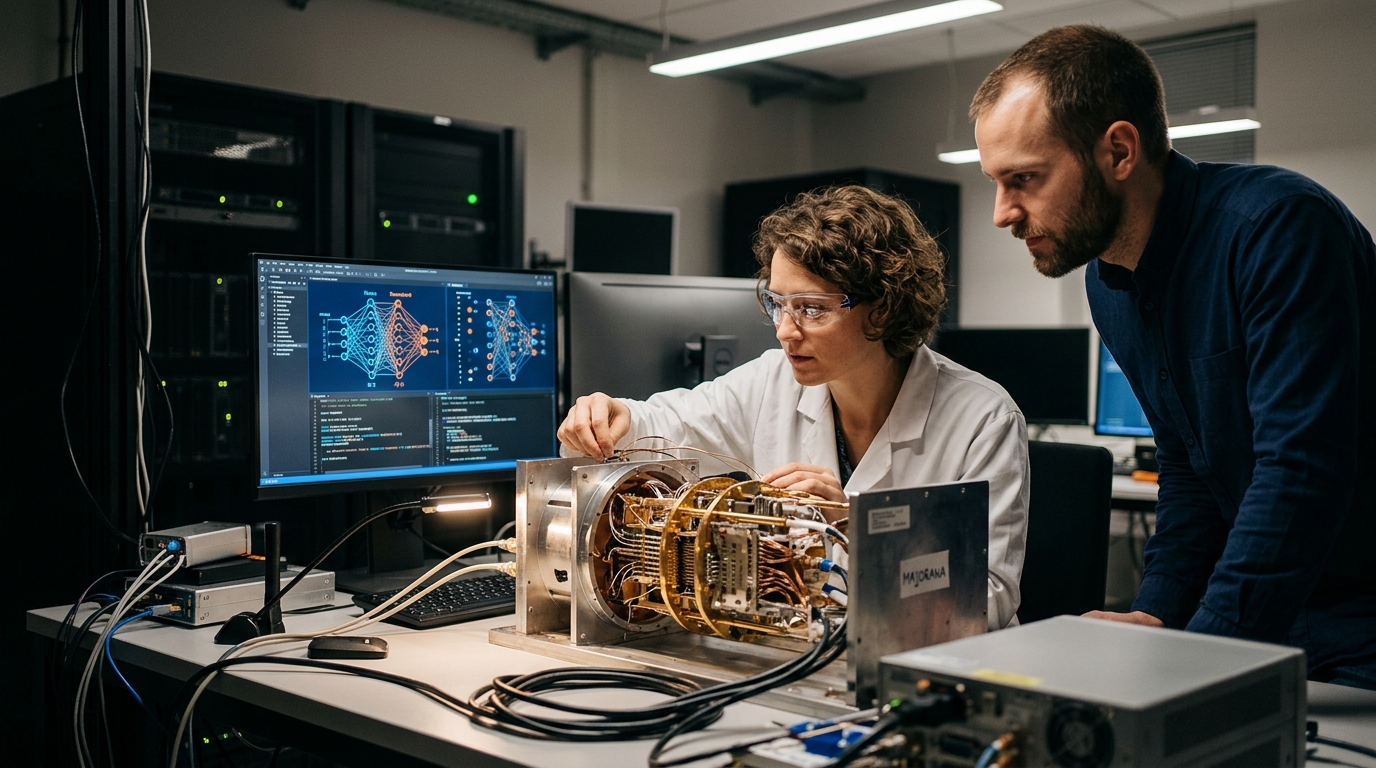
The Majorana 2 is the culmination of this topological vision. Unlike the superconducting qubits favored by Google or IBM, which are prone to errors, Microsoft’s topological qubits are theoretically far more robust. Information is not stored in a single physical location but is "braided" into the material's topology, making it immune to local disturbances. What sets Majorana 2 apart is the unprecedented scale and precision with which these elusive particles can now be manipulated and measured.
The Catalyst: Agentic AI in R&D
Perhaps the most compelling aspect of the Majorana 2 development is not the physics itself, but the methodology behind it. Microsoft utilized what is now being called "agentic AI"—autonomous artificial intelligence systems that do not merely act as assistants but as proactive agents capable of making decisions, designing experiments, and analyzing complex data in real-time.
Through the Azure Quantum Elements platform, these AI agents simulated millions of material combinations to identify the precise chemical and structural composition required for Majorana states to emerge. What would have previously taken human scientists decades of trial-and-error in a laboratory setting was achieved in a fraction of the time. These AI agents didn't just provide answers; they "reasoned" through the failures of previous simulations, adjusting their hypotheses without human intervention.
"We didn't just build a chip; we built a scientist that operates at the speed of light," a Microsoft executive noted during the technical briefing.
Strategic Implications and Global Competition
The success of Majorana 2 places Microsoft in a dominant position within the quantum ecosystem. While some in the industry had begun to doubt the topological approach—especially following high-profile retractions of earlier research papers—this latest breakthrough suggests that prioritizing qubit fidelity over sheer quantity is the viable path to true quantum utility.
Furthermore, the integration of AI into scientific discovery establishes a new blueprint for the industry. Pharmaceuticals, materials science, and climate technology are expected to be the primary beneficiaries. If an AI agent can design a quantum chip, it can just as effectively design a new catalyst for carbon capture or a novel compound for drug discovery. This synergy is creating a feedback loop where AI accelerates the development of the very hardware (quantum) that will eventually make AI exponentially more powerful.
Challenges and the Road Ahead
Despite the euphoria, the road to a full-scale, commercially viable quantum computer remains fraught with engineering hurdles. Majorana 2 is a successful case study, but interconnecting thousands of these qubits while maintaining their topological properties is a challenge of immense proportions. The question is no longer whether quantum computing is possible, but how quickly it can be scaled and democratized.
In conclusion, Majorana 2 serves as definitive proof that the convergence of AI and Quantum Physics is the most potent force in modern technology. Microsoft is no longer just a software company; it is providing the infrastructure for the next scientific revolution, one where agentic AI systems serve as our primary explorers of the physical world.