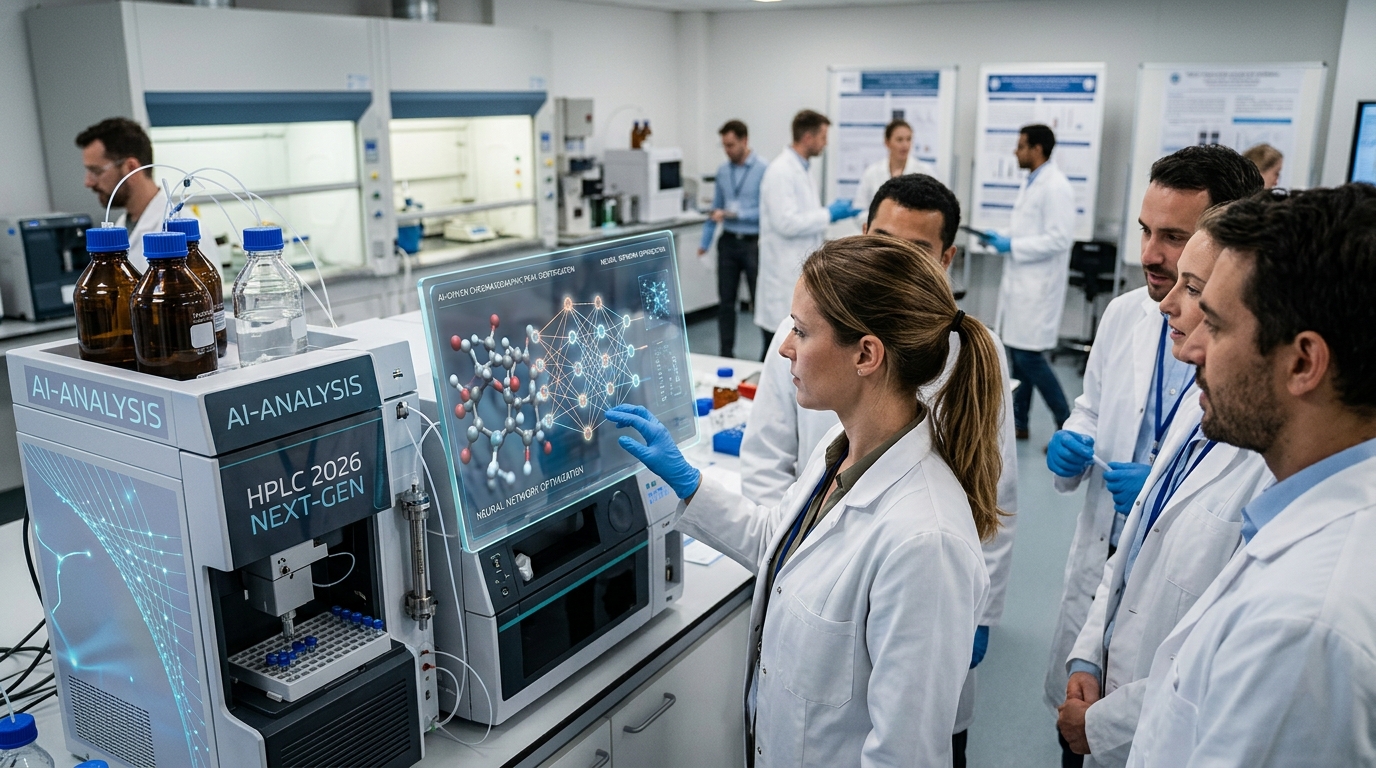
In the heart of 2026, the scientific community gathered for the annual HPLC (High Performance Liquid Phase Separations) symposium, which served as the stage for a historic turning point. Chromatography, the backbone of analytical chemistry that enables the separation and identification of complex mixtures, is no longer what it used to be. The integration of Artificial Intelligence (AI) and Machine Learning (ML) has transformed the process from a laborious laboratory "art" into a digitally driven, high-precision science.
From Empirical Approaches to Bayesian Optimization
For decades, method development in chromatography relied on the chemist's intuition and endless trial-and-error with variables: temperature, pH, mobile phase composition, and column selection. At HPLC 2026, presentations demonstrated that this era is drawing to a close. Bayesian optimization algorithms now allow scientists to predict optimal separation conditions with minimal experimental data.
Instead of hundreds of sample injections, ML models are trained on historical data and perform "virtual chromatographies." This reduces method development time from weeks to mere hours, dramatically accelerating drug discovery and food quality control. The ability of neural networks to recognize patterns in multidimensional data enables the separation of substances that were previously considered impossible to distinguish.
Automated Data Interpretation and the Elimination of Human Error
One of the most significant highlights of the conference was the advancement in automated data processing. Traditional "peak integration"—the process of measuring the area under a curve to determine the quantity of a substance—has always been prone to analyst subjectivity.
- New AI systems utilize Deep Learning to identify and deconvolve overlapping peaks, even in cases of high signal noise.
- Predictive maintenance of instruments, powered by sensors analyzed via ML, allows labs to anticipate pump failures or column clogs before they occur, minimizing downtime.
- The use of science-specific Large Language Models (LLMs) allows chemists to interact with instruments via natural language, requesting reports or parameter adjustments in real-time.
The "Autonomous Lab" and the Future of Research
The most radical concept dominating HPLC 2026 is the "Self-Driving Lab." By combining robotics with AI, these systems not only analyze samples but independently decide the next experiment based on previous results. This closed-loop discovery process promises to revolutionize environmental monitoring and biotechnology.
"We are not just seeing the improvement of a technique; we are witnessing the redefinition of the scientist's role. The chemist of the future will be more of a data architect and less of an instrument operator," noted one of the keynote speakers.
However, this transition is not without challenges. Regulatory compliance (such as FDA and EMA requirements) remains a hurdle, as authorities demand transparency in decisions made by algorithmic "black boxes." The need for "Explainable AI" in analytical science is now imperative to ensure that diagnoses and drug analyses are fully reliable and documented.