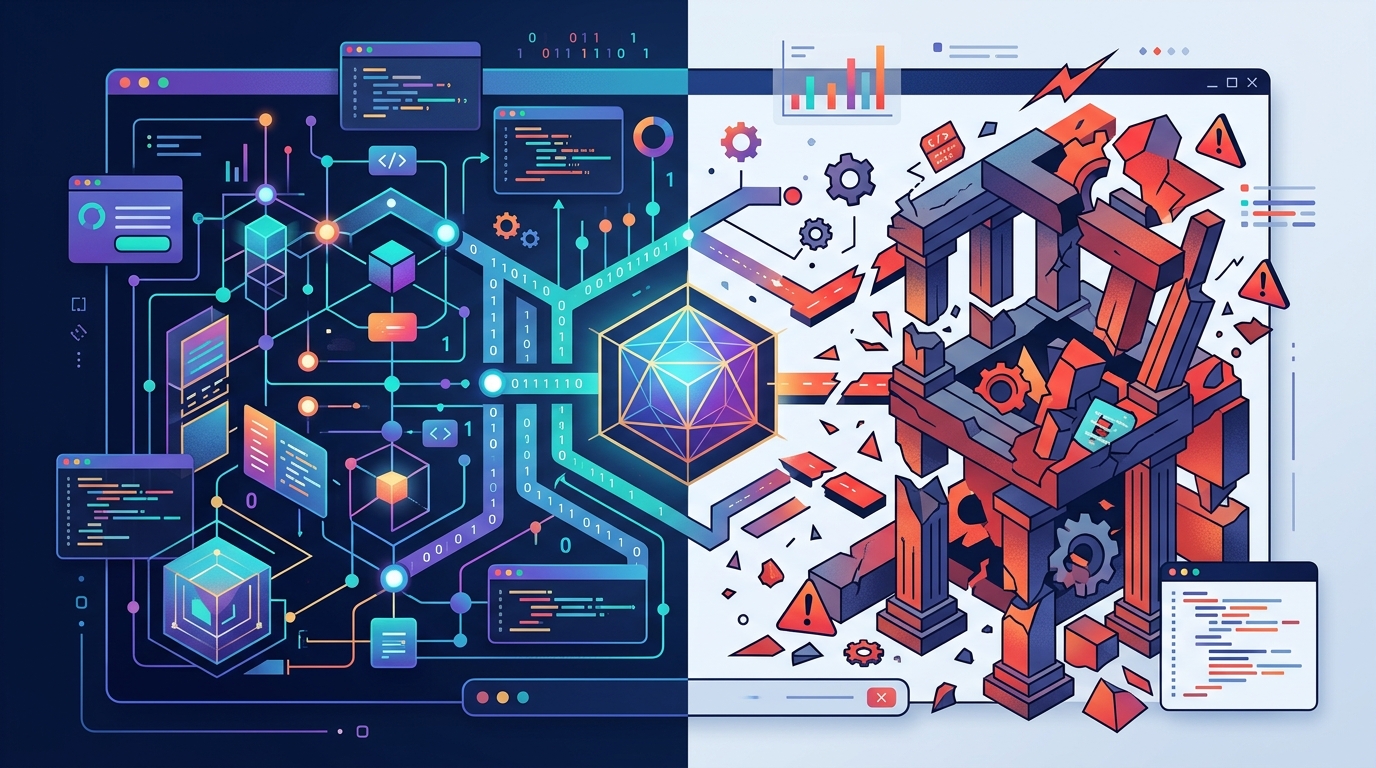
Mathematical proof has always been the ultimate fortress of human intellect. While artificial intelligence has triumphed in chess, Go, and code generation, formal mathematical logic—the kind that requires absolute precision over hundreds of pages of reasoning—remained an elusive frontier. The problem was never a lack of raw computational power, but a lack of "stamina" and coherence. Large Language Models (LLMs) can solve short lemmas with ease, but they tend to collapse when asked to run the "marathon" of a full research paper. A recent publication on ArXiv (2606.05400), titled "LeanMarathon," promises to transform this landscape by introducing a system that allows AI models to function as reliable "co-mathematicians" over long horizons.
The Trap of Drift and the Failure of Scale
To understand the significance of LeanMarathon, one must first grasp why AI has historically struggled with high-level mathematics. The process of "autoformalization"—translating mathematics written in natural language (e.g., English) into a formal programming language like Lean—is notoriously fragile. In short proofs, models perform admirably. However, as the proof expands, four critical failure modes emerge:
- Statement Drift: The model loses touch with initial definitions, subtly altering the meaning of variables as it progresses.
- Dependency Tangling: Logical dependencies become so convoluted that the system introduces circular arguments or incorrect references to previous lemmas.
- Context Decay: The model's "memory" fades, causing it to forget crucial assumptions established at the beginning of the work.
- Corrupted Repairs: When the system attempts to fix a local error on line 500, it often inadvertently destroys the logical consistency on line 50, creating a catastrophic domino effect.
These issues render standard AI incapable of completing a mathematical marathon, limiting it to short sprints that require constant, exhausting human intervention.
LeanMarathon: A Multi-Agent Architecture
The solution proposed by the research team behind LeanMarathon is based on a multi-agent harness. Instead of a single monolithic model attempting to digest an entire proof, LeanMarathon employs a hierarchy of specialized agents working within a rigorous verification framework. The system uses the Lean language not just as a translation target, but as the "court of law" that validates every step in real-time.
One agent manages high-level strategy, breaking the proof into manageable segments. Another focuses on the granular translation of mathematical concepts, while a third acts as a "consistency checker," ensuring that definitions remain stable throughout the project. The key to its success is the system's ability to perform "long-horizon repairs" without compromising the existing structure. Through a recursive verification mechanism, LeanMarathon can pinpoint exactly where a logical deviation began and reconstruct it with surgical precision.
From Theory to Practice: Impact on Science
The implications of this development extend far beyond the narrow confines of the mathematical community. The capacity for long-horizon reasoning is the holy grail of Artificial General Intelligence (AGI). If a system can remain logically consistent throughout a 10,000-line mathematical proof, it can potentially do the same for complex software architecture, drug discovery, or the management of intricate legal frameworks.
"We are not just building a calculator for mathematicians; we are constructing a partner that can see the big picture without losing sight of the details," the researchers state in their paper.
In practice, LeanMarathon allows mathematicians to focus on intuition and the generation of novel ideas, leaving the tedious and error-prone process of formal verification to the AI. This could lead to an explosion of new discoveries, as theorems once considered "too large to verify" (such as the Classification of Finite Simple Groups) become increasingly accessible to automated systems.
The Future: Toward Universal Verification
Despite this progress, LeanMarathon is not infallible. Its reliance on the quality of the initial informal description means that if a mathematician provides a fundamentally flawed core idea, the AI will struggle to "save" it. However, the shift from static models to dynamic, multi-agent systems marks a paradigm shift. The era where AI was merely a stochastic parrot is ending; the era where it becomes a rigorous logical architect has begun. The marathon of mathematics has just gained a new, tireless runner.