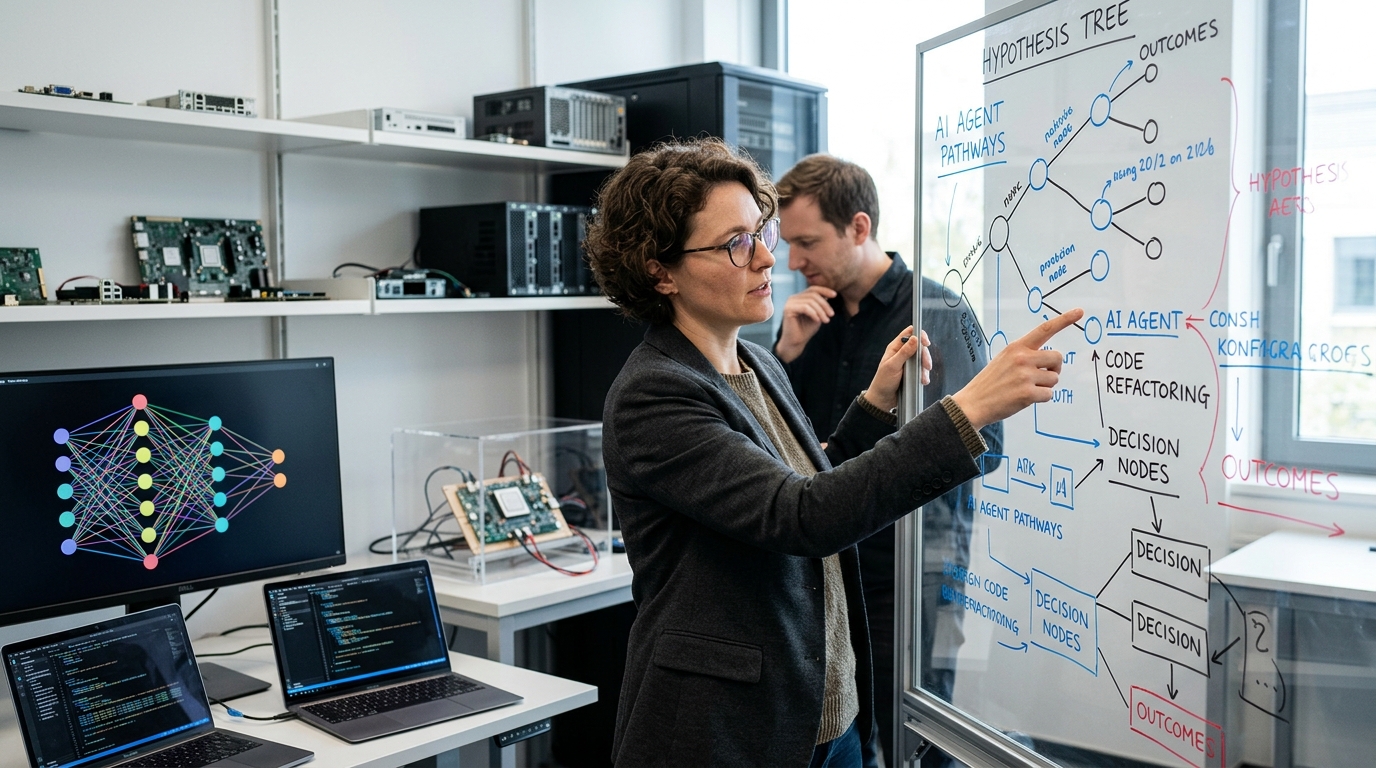
The evolution of Artificial Intelligence in software development is reaching a critical inflection point. While Large Language Models (LLMs) have demonstrated a remarkable ability to generate code snippets at breakneck speeds, their application within complex, real-world software environments has remained fraught with errors. The primary bottleneck? The linear nature of their output. When an AI agent makes a logical error early in its generation, it tends to double down on that mistake, leading to a downward spiral of broken code. A new approach known as the "Hypothesis Tree" aims to fundamentally disrupt this paradigm.
From Linear Prediction to Tree-Based Reasoning
The core concept behind the hypothesis tree is to simulate the cognitive processes of elite software engineers. A human developer rarely follows a single, straight path toward a solution. Instead, they weigh multiple strategies, test assumptions, and if a particular approach leads to a dead end, they backtrack to explore an alternative. Computer science researchers are now embedding this dynamic into AI agents.
In a hypothesis tree architecture, the AI agent starts at the root—the problem statement—and generates multiple "branches," each representing a different hypothesis for a potential solution. Each branch is evaluated in real-time within sandboxed environments and through automated testing suites. If a hypothesis fails to meet the required criteria, the agent doesn't blindly proceed; it "prunes" that path and returns to a previous node to explore a more viable direction.
- Dynamic Evaluation: Each coding step is scrutinized for logical consistency and functional correctness.
- Self-Correction: The agent identifies and rectifies errors autonomously before finalizing the output.
- Resource Optimization: Computational focus is shifted toward the most promising solution pathways.
Implications for Modern Software Engineering
The implementation of this methodology has profound implications for the global software industry. Recent data from the SWE-bench benchmark suggests that AI agents utilizing tree-based reasoning structures exhibit significantly higher success rates in resolving real-world GitHub issues compared to models relying on simple text generation. This is primarily because the hypothesis tree allows the model to manage and navigate uncertainty.
"It is no longer just about predicting the next token; it is about navigating a vast space of possible solutions," a lead researcher noted.
This approach drastically reduces "technical debt"—the long-term cost of rework caused by choosing an easy but limited solution. AI-generated code becomes more structured, modular, and verified. Furthermore, it allows human developers to ascend to the role of "hypothesis architects," focusing on high-level design while the AI handles the iterative trial-and-error process.
Challenges and the Path to True Autonomy
Despite the promise, significant hurdles remain. Growing and evaluating a hypothesis tree is computationally expensive. Every explored branch consumes tokens and processing time, making the method costly for routine, small-scale tasks. However, as the cost of compute continues to trend downward and pruning algorithms become more sophisticated, this technology is poised to become the industry standard.
In the near future, we expect to see AI agents that do not merely write code but architect entire systems, anticipating potential failures before a single line is committed. The transition from "pattern matching" to "logical hypothesis generation" marks the maturation of AI in the field of computer science.
Conclusion
The hypothesis tree is more than just a technical optimization; it represents a philosophical shift in our interaction with AI. By transforming the AI agent from a passive generator into an active explorer of solutions, we are moving closer to true autonomy in software systems. For the developer of 2026, understanding these reasoning structures will be just as vital as mastering the syntax of a programming language itself.