For decades, weather forecasting has been one of the most demanding fields of applied physics. Meteorologists relied on Numerical Weather Prediction (NWP), utilizing massive supercomputers to solve complex mathematical equations describing fluid dynamics and heat transfer in the atmosphere. However, the advent of Artificial Intelligence (AI) is causing a tectonic shift, transforming meteorology from a science based on physical laws into a science driven by data.
The Fall of Traditional Models and the Rise of Speed
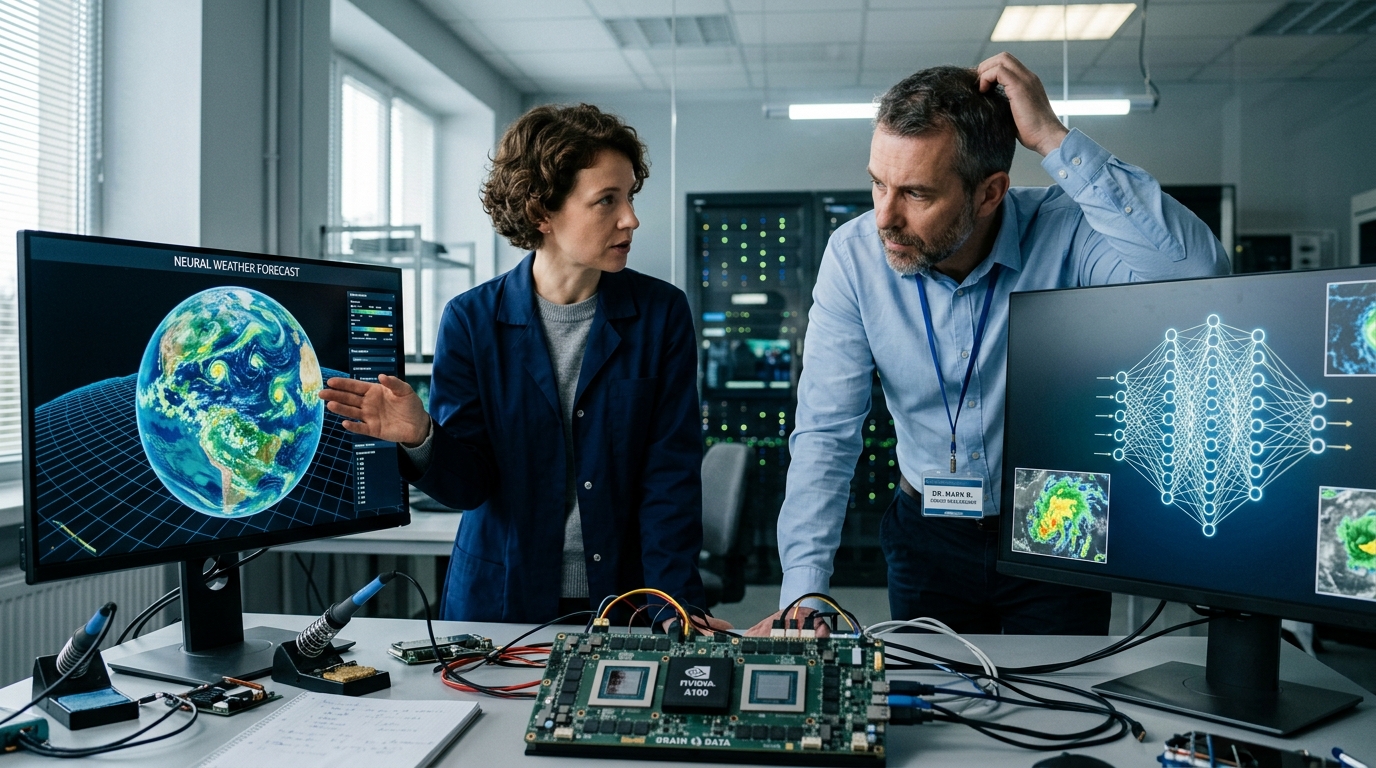
Classic models, such as the European ECMWF or the American GFS, are remarkable but cumbersome. They require hours of computational power to produce a ten-day forecast, consuming vast amounts of energy. This is where AI steps in. Models like Google DeepMind’s GraphCast, Huawei’s Pangu-Weather, and Nvidia’s FourCastNet have demonstrated that they can produce forecasts of equal or superior accuracy within seconds, using a fraction of the energy required by traditional methods.
The fundamental difference lies in the approach. While NWP attempts to simulate atmospheric physics step-by-step, AI 'learns' weather patterns by analyzing decades of historical data. Using the ERA5 archive, which contains satellite observations and station measurements dating back to 1940, neural networks identify correlations that human equations might overlook. This allows AI to predict extreme events, such as tropical cyclones or heatwaves, with a much longer lead time.
The 'Black Box' Challenge and Physical Consistency
Despite the excitement, the use of AI in meteorology is not without its flaws. One of the biggest issues is the lack of interpretability. In traditional models, if a forecast fails, scientists can trace back through the equations to understand why. In AI, the decision-making process is often a 'black box.' Furthermore, AI models sometimes produce results that are 'physically impossible,' as they are not inherently bound by the laws of conservation of mass or energy.
To address this, a new generation of models is being developed, known as Physics-Informed Neural Networks (PINNs). These systems combine the speed of machine learning with the constraints of classical physics, ensuring that the forecast is not only fast but also scientifically valid. This hybrid approach is considered the 'holy grail' of modern climatology.
- Speed: Forecasts that used to take 6 hours now finish in 60 seconds.
- Accuracy: Improved prediction of hurricane tracks and intensity.
- Efficiency: Dramatic reduction in the carbon footprint of meteorological centers.
- Democratization: Enabling developing nations to access high-quality forecasts without multimillion-dollar supercomputers.
Climate Crisis and Economic Implications
In a world increasingly battered by climate change, accurate forecasting is not a luxury but a survival tool. AI allows for better management of renewable energy sources by precisely predicting sunlight and wind intensity, which aids in grid stability. In agriculture, farmers can receive personalized alerts for frost or drought weeks in advance, safeguarding global food security.
"Artificial Intelligence is not replacing the meteorologist; it is giving them a telescope where they previously only had a magnifying glass," notes a senior official from the World Meteorological Organization.
In conclusion, the integration of AI into meteorology represents one of the most promising applications of the technology. While the full replacement of physics-based models is still far off, the collaboration between human expertise and machine speed promises a world better prepared for nature’s whims. The challenge is now shifting from generating information to effectively communicating it to citizens and policymakers.