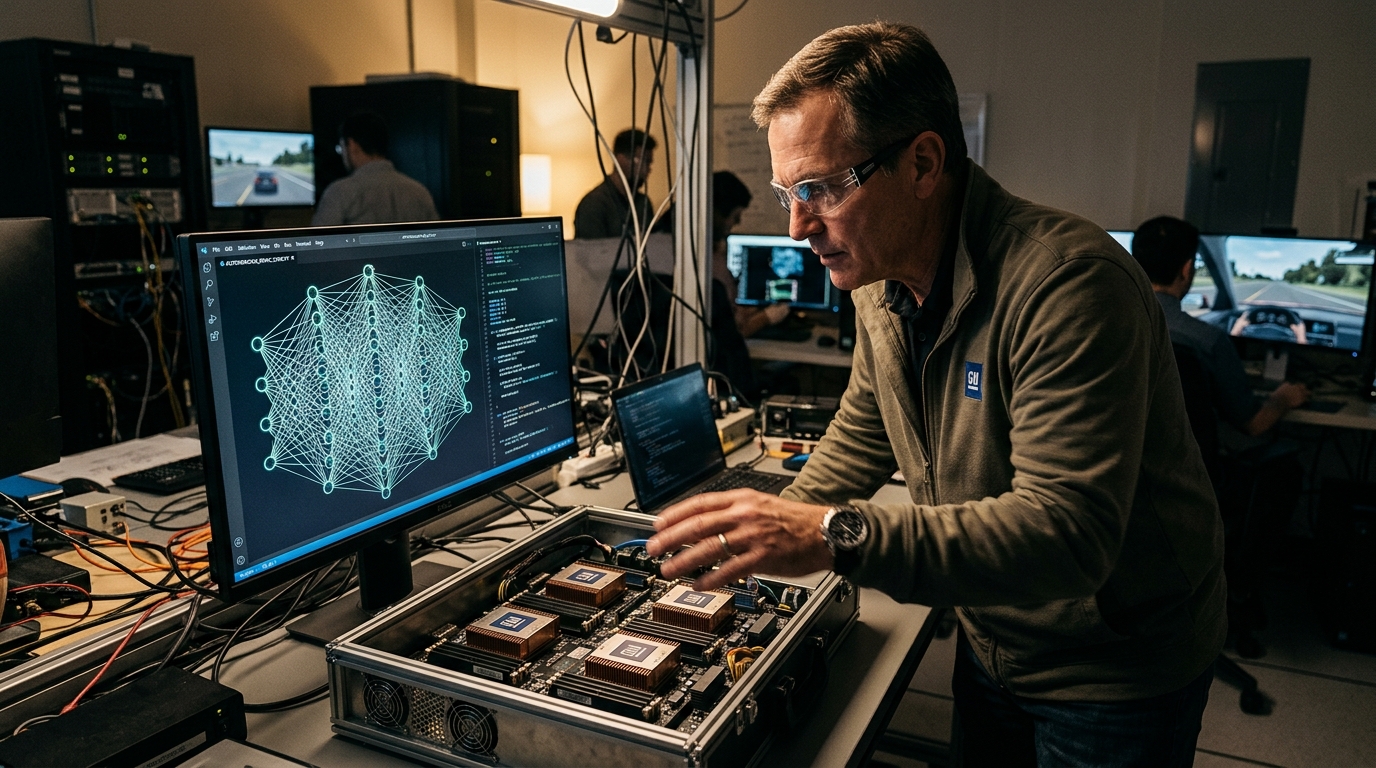
In the heart of Detroit, where the sound of presses and internal combustion engines once defined progress, a new, silent revolution is taking place. General Motors (GM), a giant that once symbolized heavy industry, is transforming into a software company at dizzying speeds. The recent revelation that 90% of the code required for the company's autonomous driving systems is now written by artificial intelligence is not just a technical detail; it is the birth certificate of a new era for the global automotive industry.
From Programmers to Algorithms: The Paradigm Shift
For decades, vehicle software development relied on a deterministic approach. Thousands of programmers wrote millions of lines of "if-then-else" code, trying to predict every possible scenario a car might encounter on the road. However, the reality of driving is chaotic and unpredictable. GM's shift toward AI-generated code means the company is moving away from trying to "teach" the car rules, and instead training it to "understand" environments.
The use of Large Language Models (LLMs) and specialized neural networks allows GM to accelerate the development cycle at rates that were unthinkable five years ago. AI doesn't just write the code that controls the steering and brakes, but also the simulation systems that test that code. This creates a self-reinforcing loop of improvement, where AI corrects and optimizes itself, dramatically reducing the human errors that often creep into manual codings of millions of lines.
The "Black Box" Challenge and Safety
Despite the excitement, this transition raises critical questions about transparency and safety. When a human writes code, there is a logical path that can be audited. When AI "generates" 90% of a vehicle's logic, we face the "black box" problem: it is extremely difficult to understand exactly why the system made a specific decision in a split second.
"The challenge is no longer writing the code, but ensuring that the code the AI produces is explainable and safe under all conditions," industry analysts note.
GM, through its subsidiary Cruise, has already faced significant challenges and accidents that led to a temporary suspension of operations. The decision to rely so heavily on AI for code writing is a high-stakes gamble. The company argues that this approach allows for faster response to rare scenarios (edge cases), which are impossible to program manually. If an AI sees ten million hours of driving, it can develop "instincts" that a human programmer could never encode.
Competition and the Geopolitical Chessboard
GM's move does not happen in a vacuum. Tesla, with its Full Self-Driving (FSD) v12, has already moved toward an "end-to-end neural network" approach, where AI handles everything from camera input to steering commands. At the same time, Chinese companies like BYD and Xiaomi are investing billions in similar technologies. For Detroit, the success of this venture is a matter of survival.
- Speed: AI can produce in hours what a team of engineers would take months to complete.
- Cost: Reducing software development costs allows GM to remain competitive against tech-first companies.
- Adaptability: AI-based systems can be updated over-the-air (OTA) with new data, improving fleet performance in real-time.
In conclusion, General Motors is no longer just building cars; it is building intelligent agents that happen to have wheels. The fact that 90% of the code is written by machines is the ultimate proof that the era of the Software-Defined Vehicle (SDV) is here, and the traditional concept of automotive engineering has changed forever. The question remains whether regulators and the consuming public are ready to trust their lives to an algorithm written by another algorithm.