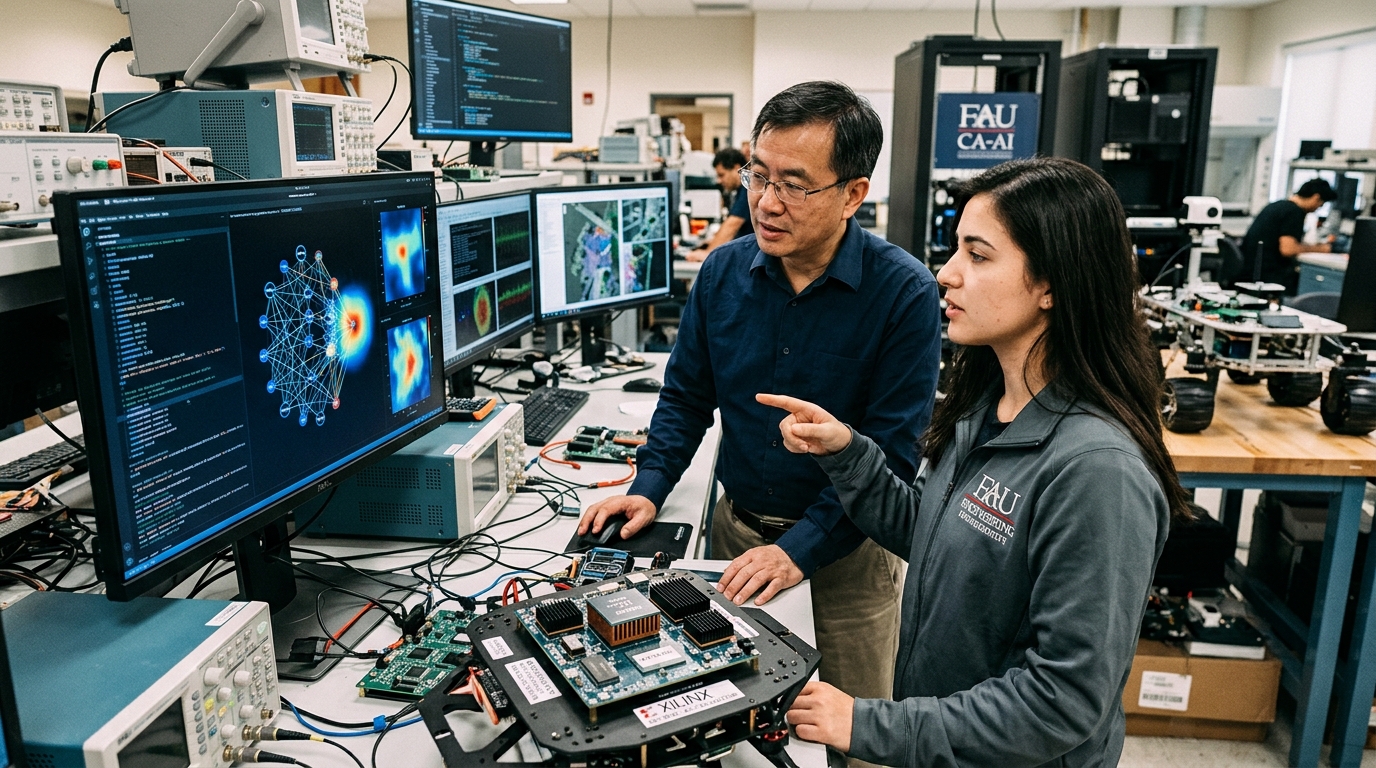
In a strategic move that underscores the pivotal role of academic research in national security and technological dominance, Florida Atlantic University’s (FAU) Center for Connected Autonomy and Artificial Intelligence (CA-AI) has announced a $2.2 million grant from the Air Force Research Laboratory (AFRL). This funding is earmarked for the advancement of next-generation autonomous systems, specifically focusing on their ability to operate in contested environments where communications are degraded or actively jammed.
The Strategic Imperative of Connected Autonomy
The concept of "connected autonomy" extends far beyond the operation of a single robot or drone. It envisions an ecosystem of autonomous agents—ranging from unmanned aerial vehicles (UAVs) to ground-based assets—that communicate, collaborate, and make collective decisions in real-time. Led by Dr. Dimitris Pados, director of CA-AI and a Charles E. Schmidt Eminent Scholar at FAU, the research will focus on developing algorithms that allow these systems to remain operational even when adversaries attempt to sever their digital lifelines.
According to Dr. Pados, the primary challenge is not just autonomy, but resilience. In a modern theater of conflict, reliance on GPS or centralized communication networks represents a significant vulnerability. CA-AI is developing solutions that allow systems to "think" locally while acting globally, utilizing cutting-edge technologies such as 5G/6G, edge machine learning, and hardware-accelerated secure data transfer.
From the Lab to the Field: Overcoming Technical Barriers
The $2.2 million grant will facilitate the creation of high-fidelity simulations and physical testing protocols. A central focus is the management of data "noise." When dozens of autonomous systems attempt to coordinate, the volume of data can be overwhelming. AI must be capable of filtering critical signals from irrelevant data, ensuring that decision-making remains near-instantaneous even under stress.
- Development of resilient waveforms for communications in jammed environments.
- Creation of federated learning protocols for multi-agent autonomous units.
- Integration of next-gen sensors for GPS-independent navigation.
- Real-world testing at FAU’s dedicated technology facilities.
The partnership with AFRL is a natural fit. The U.S. Air Force recognizes that the future of aerial warfare will likely involve "swarms" of low-cost, autonomous aircraft operating alongside manned fighters. This strategy, known as the "Collaborative Combat Aircraft" (CCA) initiative, requires the exact type of robust, interconnected autonomy currently being pioneered at FAU.
Economic Impact and Talent Development
Beyond the military applications, this investment has profound implications for the Florida economy and the broader academic community. FAU is rapidly becoming a major hub for aerospace and defense, attracting top-tier researchers and students from across the globe. By involving students in such high-stakes research, the university is preparing a workforce for a job market that is increasingly desperate for experts in AI and autonomous systems.
"This funding isn’t just about the technology; it’s about the people who will build it. We are training the next generation of engineers to understand both the code and the physical realities of autonomous operation," university officials noted.
The link between FAU and AFRL further strengthens the "Florida High Tech Corridor," an initiative aimed at transforming the state into a global leader in technology. As geopolitical tensions rise, the demand for systems that can operate independently and securely becomes more urgent, positioning CA-AI’s work as a cornerstone of future national defense strategies.
Ethical Considerations and the Road Ahead
Inevitably, the development of autonomous systems for military use brings ethical questions to the forefront. How much autonomy should a machine truly possess? FAU emphasizes that its research focuses on "human-aligned autonomy," where AI serves as a force multiplier and safety enhancer, always operating within a strategic framework defined by human operators. Ensuring these systems are immune to cyber-spoofing and unauthorized takeovers is perhaps the most significant ethical and technical challenge of our time.