The announcement of DeepSeek-V4 is not merely another technical update in the world of Large Language Models (LLMs); it is a resounding geopolitical statement. In an era where Washington seeks to contain Beijing's technological rise through stringent export controls on semiconductors, DeepSeek-V4 arrives to prove that innovation cannot be confined within geographic borders. Jordan Schneider’s analysis on ChinaTalk highlights how a Chinese team managed to reach, and in some domains surpass, models from OpenAI and Anthropic, using a fraction of the resources previously deemed necessary.
The Architecture of Efficiency
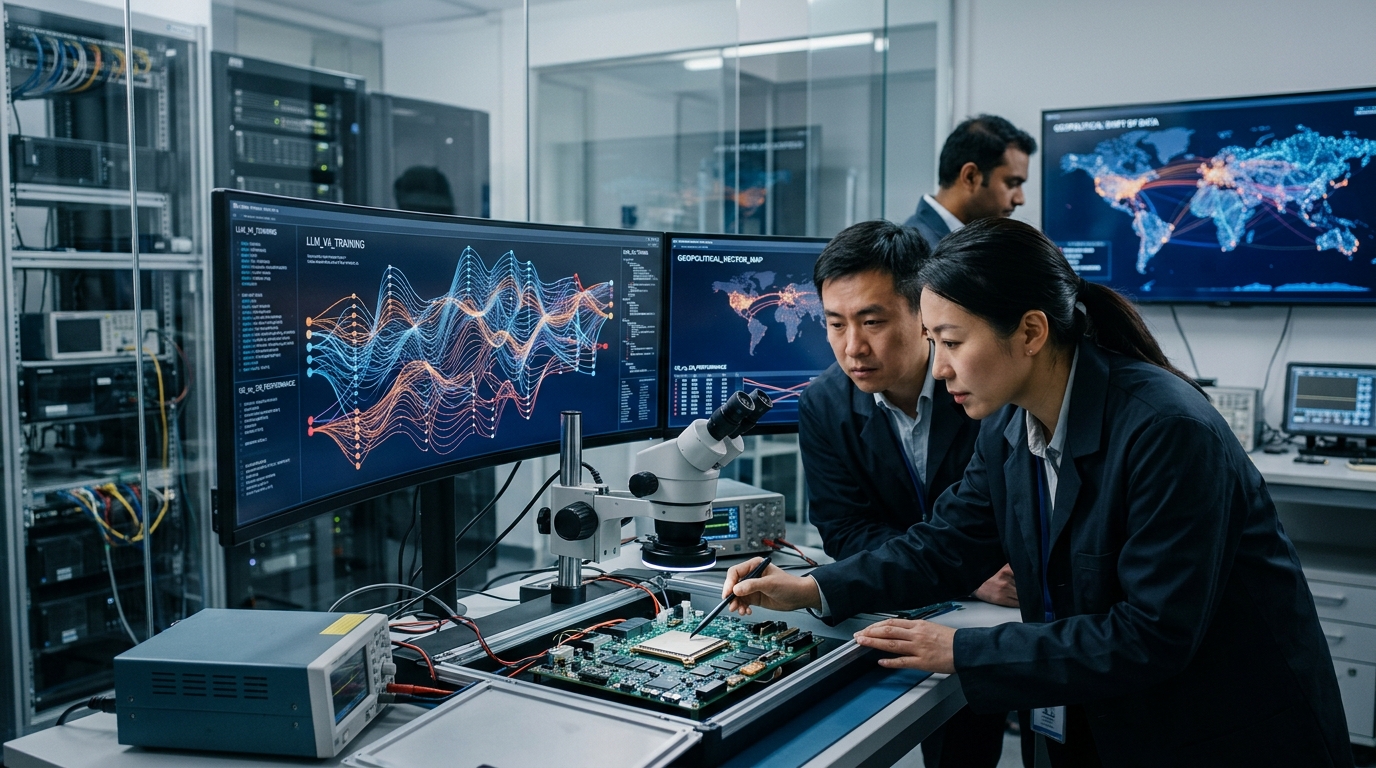
DeepSeek-V4 is built upon an evolved Mixture-of-Experts (MoE) structure, but it pushes the concept to a new level. The core philosophy of the DeepSeek team is "smart frugality." While American giants rely on Scaling Laws, believing that more data and more GPUs will solve every problem, DeepSeek-V4 focuses on architectural optimization. By utilizing Multi-head Latent Attention (MLA) and an incredibly efficient training system designed for bandwidth-constrained environments, the model achieves GPT-5 level performance with significantly lower operational costs.
What sets V4 apart is its capacity for complex reasoning. By integrating Reinforcement Learning techniques similar to OpenAI’s "o1" series, DeepSeek-V4 doesn’t just provide answers; it "thinks" before it speaks. The crucial difference is that the Chinese approach remains "open-weights," allowing the global research community to inspect the model's inner workings—a practice OpenAI has long since abandoned.
The Failure of Sanctions?
The rise of DeepSeek poses a critical question for American foreign policy: Did the Nvidia sanctions ultimately act as a catalyst for Chinese creativity? Instead of being paralyzed, Chinese engineers were forced to become the most efficient in the world. DeepSeek-V4 was trained in an environment where every processor cycle is precious. This "frugal innovation" has yielded a model that is not only powerful but also commercially viable in ways that energy-hungry American models struggle to emulate.
- Exceptional performance in coding and mathematics, outperforming Claude 3.5 Sonnet in key benchmarks.
- A 60% reduction in cost-per-token compared to the previous generation.
- Full support for multimodal functions (vision and audio) within a unified architecture.
The Future of Open Research
DeepSeek’s strategy of releasing its models with open-weights is sending shockwaves through Silicon Valley. While Google and Meta attempt to balance profit and openness, DeepSeek acts as a pure disruptor. By offering top-tier technology for free or at negligible API prices, it undermines the business model of American labs that demand billions from investors to cover astronomical training costs.
"DeepSeek-V4 is not just an algorithm; it is proof that the monopoly on AI knowledge has ended," Schneider’s analysis notes.
In conclusion, DeepSeek-V4 marks the coming-of-age of the Chinese AI scene. They are no longer followers of trends but trendsetters. For Europe and the rest of the world, this offers an alternative path away from total dependence on the American cloud, yet it simultaneously raises serious questions about data security and the ethical use of technology under an authoritarian regime. The battle for AI supremacy has just gained a new, highly formidable protagonist.