In the heart of China's technological ecosystem, a significant shift is taking place that promises to fundamentally alter the landscape of robotics and medical technology. BrainCo, a company that gained fame for developing advanced bionic limbs for people with disabilities, is now at the center of a new industrial boom. According to recent reports as of June 2026, the company expects an unprecedented surge in robotic hand sales, driven no longer solely by the medical market, but by China's rapidly expanding humanoid robotics industry.
From Rehabilitation to Mass Production
BrainCo, which spun out of the Harvard Innovation Lab, originally aimed to use brain-machine interfaces (BMI) to help amputees regain control over their movements. However, 2026 is proving to be a landmark year as technology developed for humans finds a massive new market: general-purpose humanoid robots. The challenge in building a humanoid robot lies not just in balance or locomotion, but primarily in the ability to interact with the physical world. The human hand, with its 27 joints and thousands of nerve endings, remains the most difficult part to replicate.
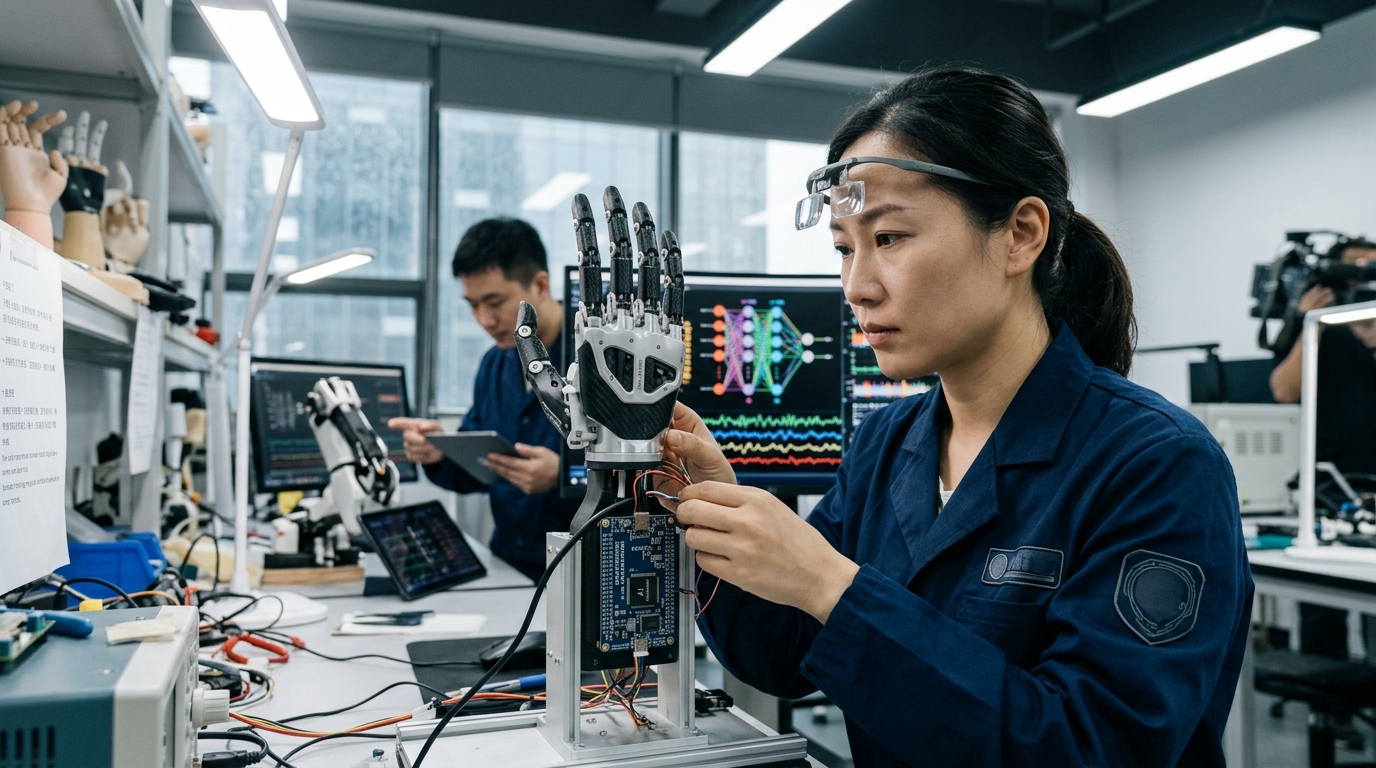
BrainCo has managed to lower the production costs of these complex mechanisms while maintaining a high degree of dexterity. This has made them the ideal supplier for dozens of Chinese robotics startups seeking to create robots capable of working in factories, warehouses, and even homes. Demand is so high that the company has been forced to expand its production lines, marking the transition from a niche medical firm to an industrial components giant.
China’s Strategy for Robotics Dominance
This rise is not accidental. The Chinese government has made dominance in the humanoid robotics sector a national priority by 2027. Supported by the Ministry of Industry and Information Technology (MIIT), the country seeks to create a complete supply chain within its borders. BrainCo's bionic hands are a critical link in this chain. Unlike competitors in the West, Chinese companies benefit from an ecosystem that allows for rapid experimentation and mass scaling.
- Vertical integration that reduces component costs.
- Immediate access to advanced tactile sensors and actuators.
- Government subsidies for R&D in AI and engineering.
- Close collaboration between academic institutions and industry.
The result is the creation of robots that, while costing hundreds of thousands of dollars just a few years ago, are now approaching price points that make them viable for industrial use. BrainCo, leveraging its expertise in electromyographic (EMG) signals, offers hands that can be trained via AI to perform delicate tasks, such as assembling electronics or handling fragile objects.
Challenges and the Future of Dexterity
Despite the optimism, challenges remain. Achieving "human-level" dexterity requires more than just good motors; it requires sophisticated tactile sensing. BrainCo is investing heavily in "electronic skin" technologies that allow robotic hands to sense pressure and temperature. This technology, originally designed to give prosthetic users a sense of feedback, is now the key to the next generation of robots operating autonomously in unstructured environments.
"We are not just building tools; we are building the interface between digital intelligence and the physical world," company executives state.
As we move into the second half of the decade, BrainCo's success underscores a broader trend: technology developed to assist people with disabilities is becoming the foundation for a new era of automation. China, with BrainCo at the forefront, is no longer just exporting cheap goods, but high technology that defines the future of work. The question remains how the global market will respond to this storm of innovation coming from the East.