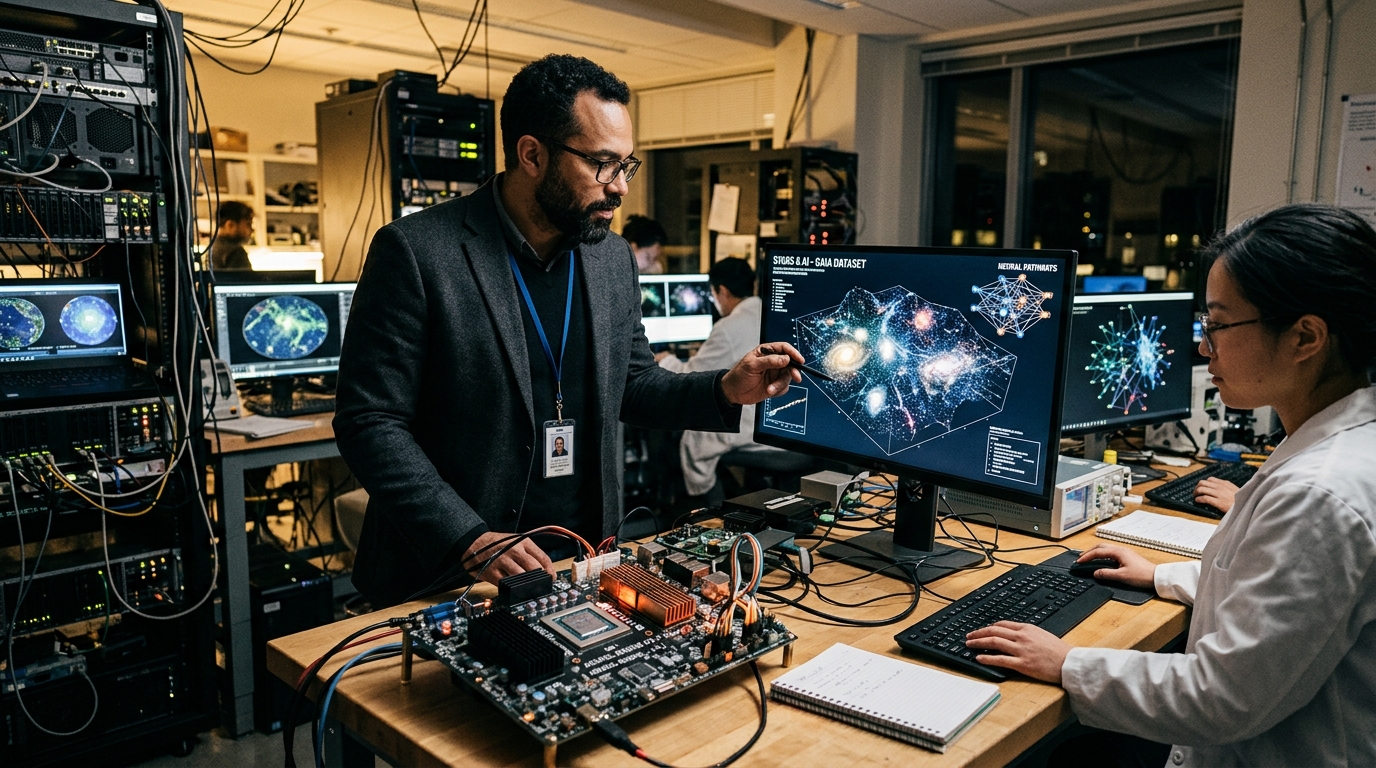
The history of Artificial Intelligence (AI) is defined by a constant struggle between performance and explainability. While deep neural networks have conquered the world through their ability to identify complex correlations in vast datasets, they remain largely "black boxes." A recent paper published on ArXiv (2604.27007) promises to shift this paradigm by proposing a formal causal analysis of Binary Spiking Neural Networks (BSNNs). This research is not merely a technical refinement but a fundamental reassessment of how machines can "think" causally, using architectures that mimic the human brain's functioning.
The Nature of Spiking Networks
Spiking Neural Networks (SNNs) differ from traditional artificial neural networks (ANNs) in how they process information. Instead of continuous numerical signals, SNNs communicate through discrete "spikes" or pulses over time. This approach is more energy-efficient and closer to the biological reality of our neurons. However, their temporal nature has historically made interpreting their internal logic extremely difficult. BSNNs, a specific category where spikes are binary (0 or 1), offer a cleaner framework for mathematical analysis.
Researchers have successfully defined a BSNN formally and represented its activity as a binary causal model. This means that each "spike" of a neuron is no longer viewed simply as a statistical event, but as a node in a structural causal graph. In this way, we can now apply the principles of Causal Inference to understand how a specific input leads to a specific output, tracing through the network's intermediate layers.
The Ladder of Causation and Interventions
According to Judea Pearl's "Ladder of Causation," understanding is divided into three levels: Association (seeing), Intervention (doing), and Counterfactuals (imagining). This new research places BSNNs on the second and third rungs. Through causal representation, scientists can perform "interventions" on the network. For example, they can ask: "What would have happened to the final decision if this specific neuron had fired a spike, when in reality it did not?"
This ability to analyze counterfactuals is the key to Explainable AI (XAI). Instead of relying on approximate methods that try to "guess" what the network saw, we can now trace the path of causality with mathematical precision. This is critical for high-stakes applications such as medical diagnosis or autonomous driving, where the "why" behind a decision is just as important as the decision itself.
Towards a Convergence of Symbolic and Connectionist AI
For decades, AI has been split into two camps: symbolism (logic, rules) and connectionism (neural networks). Representing BSNNs as causal models serves as a bridge between these two worlds. It allows neural networks to retain their ability to learn from data while acquiring a structure that can be analyzed using the rules of logic and causality.
Furthermore, the use of binary spikes makes these models ideal for neuromorphic hardware. Chips that operate with spikes consume a fraction of the energy used by traditional GPUs. If we combine this efficiency with causal transparency, we approach a form of AI that is not only powerful and green but also inherently trustworthy. This research marks a shift from the "brute force" of billions of parameters toward the elegance of causal structure.
Challenges and Future Prospects
Of course, moving from theory to practice involves difficulties. Causal analysis of networks with millions of neurons remains computationally expensive. However, the formal foundation provided by this work allows for the development of new optimization algorithms. In the future, we might see AI systems that do not need to be retrained from scratch for every new condition but can "reason" over their causal relationships to adapt to unknown environments.
In conclusion, transforming BSNNs into causal models brings us one step closer to understanding intelligence itself. If we can explain the behavior of an artificial neuron through causality, we may eventually shed light on our own internal decision-making processes. Artificial Intelligence is ceasing to be a mirror of statistics and is becoming a mechanism for understanding the world.