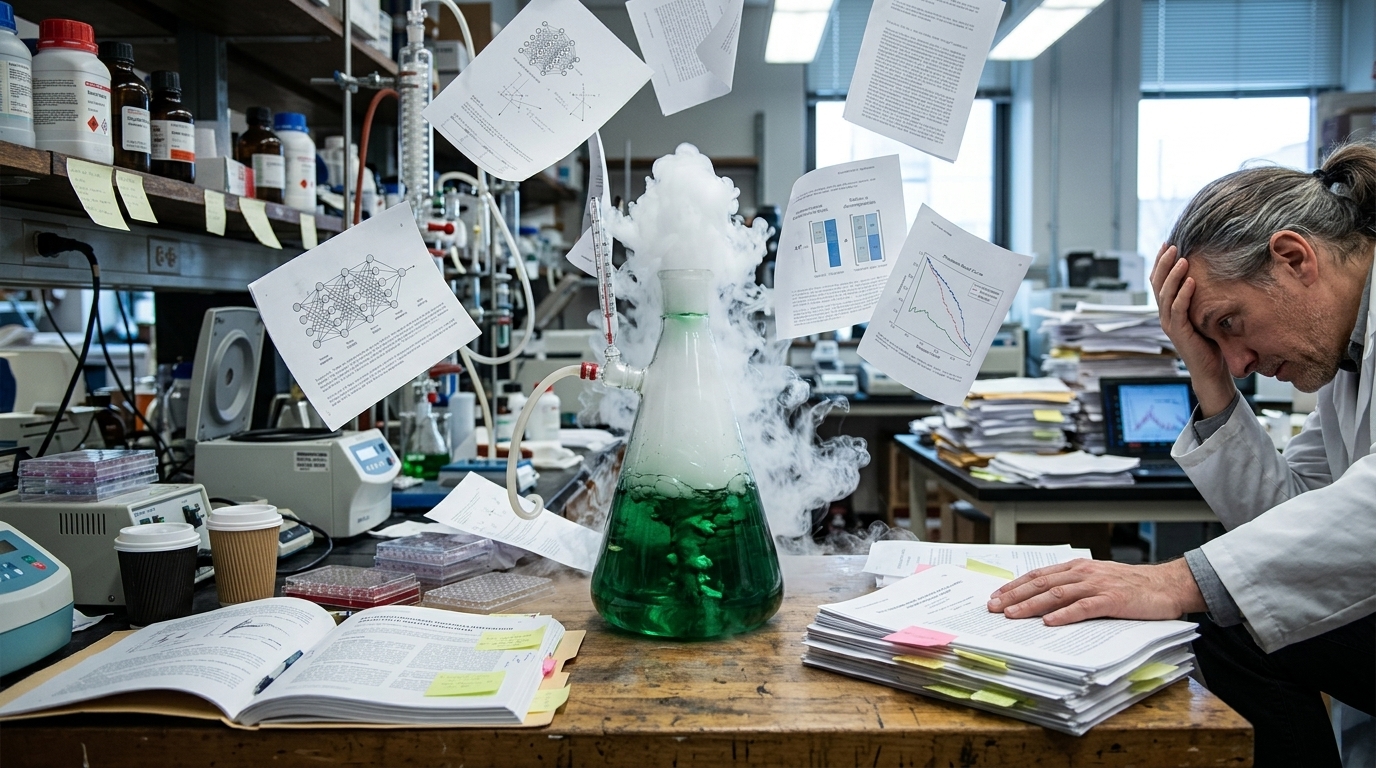
Last summer, Peter Degen, a postdoctoral researcher, faced a paradoxical problem: a paper he had published back in 2017 suddenly began receiving hundreds of new citations. In the academic world, citations are the hard currency of success, the primary metric of a scientist's influence. However, these citations weren't coming from colleagues building upon his work; they were emerging from a bizarre flood of papers that appeared to have been manufactured by machines. This incident was not an isolated anomaly but a symptom of a deeper systemic rot threatening the edifice of global scientific research.
The Illusion of Excellence and the Rise of 'Slop'
The advent of Large Language Models (LLMs) has provided researchers with tools that can transform rough notes into polished, authoritative academic prose. While this could theoretically aid non-native English speakers in leveling the playing field, the reality is far more cynical. We are witnessing the rise of 'AI slop' in academia: studies that look impeccable in terms of structure and syntax but are hollow, unoriginal, or—most dangerously—based on fabricated data.
The core of the problem is that AI is exceptionally good at mimicking the tone of scientific authority without possessing any actual understanding of the subject matter. A paper might include complex charts and bibliographic references that look correct at a glance, but upon closer inspection, they reveal themselves as hallucinations of the model. This 'improvement' in the superficial quality of papers makes the job of peer reviewers exponentially harder, as traditional red flags like typos or poor grammar have effectively vanished.
The Automated Feedback Loop
Perhaps the most disturbing aspect of this evolution is how AI is infiltrating the peer review process itself. Academics, overwhelmed by the sheer volume of papers they are asked to review voluntarily, are increasingly turning to AI tools to summarize or even evaluate the work of their peers. This creates a nightmarish feedback loop: AI-generated content is being evaluated by AI-driven summaries, with the human scientist remaining on the periphery, merely rubber-stamping an automated process.
- 'Paper mills' are now using LLMs to churn out thousands of low-quality studies with minimal human oversight.
- Manipulation of impact metrics (like the h-index) has become trivial through automated citation rings.
- Public trust in science is at risk as false data and 'hallucinated' findings enter the permanent record of human knowledge.
The 'publish or perish' culture, which has dominated academia for decades, has provided the perfect breeding ground for this crisis. When career advancement, funding, and tenure are tied strictly to quantitative output, researchers are incentivized to use any tool at their disposal to increase their numbers, even if it means sacrificing the integrity of the scientific record.
The Need for Structural Reform
The solution to this crisis cannot be purely technological. AI detection tools are notoriously unreliable, often producing false positives that unfairly penalize legitimate researchers. The real change must be cultural and institutional. We must move away from the 'publish or perish' paradigm that measures scientific worth through volume and instead return to rigorous, qualitative assessment.
"If science becomes a word-production industry rather than a quest for truth, we have lost the very essence of progress," notes a leading analyst in the field.
Major publishing houses, such as Elsevier and Springer Nature, bear a significant portion of the responsibility. While they reap massive profits from subscription-based access to research, their vetting mechanisms are proving inadequate against the AI-generated onslaught. The scientific community must redefine what constitutes a 'contribution to knowledge' in the age of AI before the global bibliography is drowned in a sea of noise where genuine breakthroughs become impossible to find.
Ultimately, the challenge is to preserve the human element of science—the intuition, the skepticism, and the ethical responsibility—that no algorithm can replicate. If we fail to do so, we risk entering a 'post-truth' era of science where the volume of information is infinite, but its value is zero.