For decades, materials science has grappled with one of the most enigmatic questions in solid-state physics: what makes certain metallic mixtures capable of forming a "glass" rather than their traditional crystalline form? Metallic glasses, or amorphous metals, possess a disordered atomic structure that grants them extraordinary properties, including incredible strength, elasticity, and corrosion resistance. However, identifying compositions that remain stable without crystallizing has always been a process of trial and error. Until now.
A new study from the University of Michigan, recently published, shifts the paradigm by utilizing advanced machine learning algorithms. Researchers have managed to "see" through the chaos of the amorphous structure and identify the specific atomic patterns that guarantee stability. This discovery is not merely a theoretical victory but the key to a new generation of materials that could transform everything from consumer electronics to aerospace engineering.
The Challenge of Disorder
In most metals, atoms arrange themselves in strictly repeating geometric patterns known as crystal lattices. In contrast, in metallic glasses, cooling from the liquid phase occurs so rapidly that the atoms "freeze" in a disordered arrangement, similar to that of liquids. This absence of grain boundaries is precisely what makes these materials so potent.
The problem is that nature abhors disorder at low temperatures. Most metallic glasses tend to revert to their crystalline state, losing their unique properties. Predicting "Glass-Forming Ability" (GFA) has traditionally been an immense computational challenge, as the lack of periodicity renders traditional simulation methods inadequate.
The Role of Graph Neural Networks
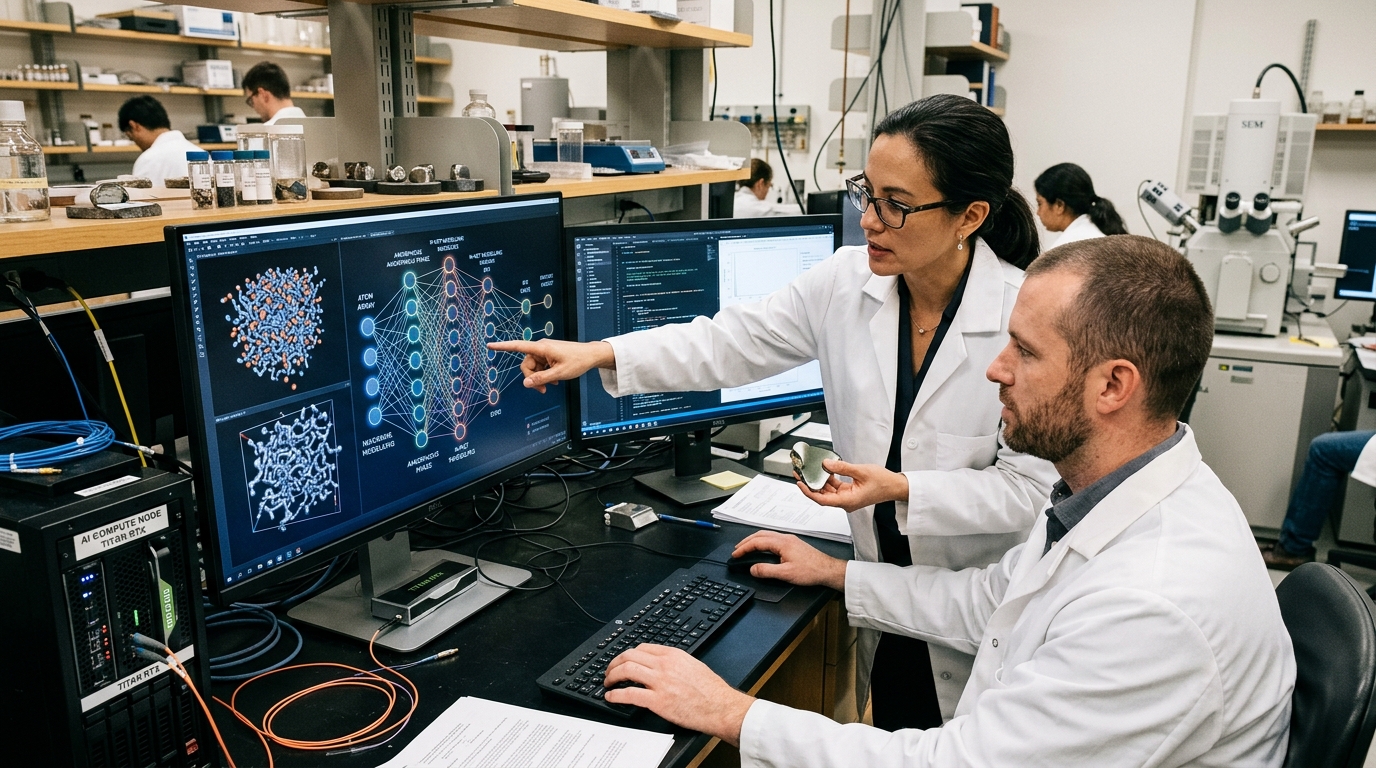
The Michigan team employed Graph Neural Networks (GNNs), a form of AI that excels at analyzing relationships between objects in unstructured spaces. Instead of treating atoms as isolated points, the model treats them as nodes in a network, analyzing how each atom influences its neighbors.
- Short-Range Order (SRO): The model identified local clusters of atoms, such as icosahedra, that act as "anchors" of stability.
- Medium-Range Order (MRO): The AI revealed how these local structures connect over longer distances, preventing crystallization.
- Predictive Power: The system can now predict the stability of a new alloy in fractions of a second, a process that previously required months of laboratory experimentation.
"Machine learning has allowed us to find the needle in the haystack," the researchers noted. "It is no longer about luck, but pure, data-driven materials design."
Industrial and Economic Implications
The applications of this research are vast. Metallic glasses are already used in specialized components, such as high-durability smartphone casings and medical implants. However, the high cost of discovering new alloys has limited their widespread use. With the help of AI, industry can develop materials with specific properties: metals as light as aluminum but as strong as steel, or materials with exceptional magnetic performance for more efficient electric motors.
Furthermore, the ability to predict stability allows for the use of more common and inexpensive metals in glass formation, reducing reliance on rare earth elements. This carries geopolitical implications, as the supply chain for strategic materials could be radically reshaped.
The Future of "AI Alchemy"
The Michigan study is part of a broader movement called "Autonomous Materials Discovery." In the future, we will not just design materials based on what we know; we will ask AI to "invent" compositions that do not exist in nature to solve specific problems, such as energy storage or radiation shielding for spacecraft. Metallic glass was only the beginning; decoding disorder is the next great frontier of science.