For decades, Artificial Intelligence (AI) was viewed as an intangible entity—a 'brain in a vat' processing data and generating text or images without any contact with the physical world. However, the recent shift toward 'embodied AI' is overturning this perception, bringing to the fore a crucial question: can intelligence truly exist without a body? This debate, ranging from Silicon Valley laboratories to the pages of theological journals like Patheos, is not just about technology; it concerns the very ontology of existence.
The Philosophical Challenge: From Descartes to Robotics
Western thought has been deeply influenced by Cartesian dualism—the separation of mind from body. In the case of AI, this separation was absolute. Large Language Models (LLMs) are trained on static data, lacking the experience of gravity, touch, or pain. Critics of this approach argue that the 'understanding' of these models is superficial. To truly understand what 'heavy' means, one must have felt the weight of an object in their hand.
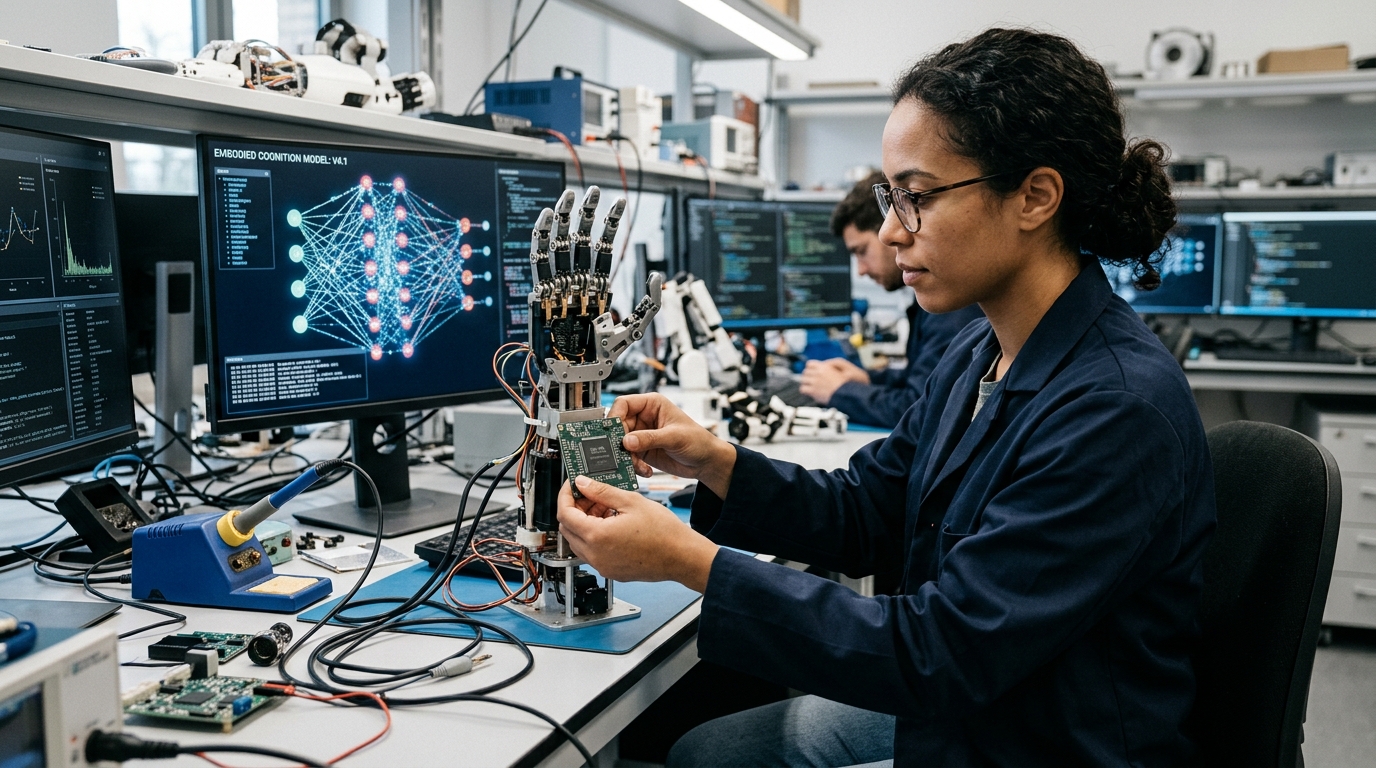
Embodied AI seeks to bridge this gap. Through robotics, algorithms acquire sensors and actuators, allowing them to interact with the environment. This interaction is not merely a technical addition; it is, according to many researchers, a prerequisite for the emergence of an intelligence that approaches human levels. Without a body, AI remains a sophisticated parrot; with a body, it begins to become an agent.
Theological and Ethical Implications
The discussion about AI embodiment takes on a unique flavor when viewed through the lens of religion and spirituality. In the Christian tradition, for example, 'incarnation' is a central concept. The body is not just a vehicle but a sacred temple that enables a relationship with the Divine and one's neighbor. If AI acquires a body, does it move dangerously close to 'personhood'?
- Moral Agency: An intangible program cannot face physical consequences. A robot moving among us, however, raises issues of physical safety and legal liability.
- The Concept of Pain: Can an embodied AI develop empathy if it cannot experience physical vulnerability?
- The Sacredness of Matter: The attempt to breathe 'life' into metal and silicon echoes the myth of the Golem or Frankenstein, evoking both awe and fear.
Many theologians argue that the human experience is inextricably linked to mortality and the limitations of the body. An AI, even an embodied one, that can replace its parts and live 'forever,' might never grasp the essence of the human condition, which is defined by the ephemeral.
Technological Reality: From GPT to Figure 01
In the field of research, companies like OpenAI and Figure AI are working feverishly to give their models physical form. The Figure 01 robot, utilizing OpenAI technology, is capable of conversing with humans while simultaneously performing delicate manual tasks, such as picking up trash or making coffee. This convergence of vision, speech, and motion represents the next great frontier.
"Intelligence is not something that happens only inside the head; it is something that emerges from the dynamic interaction between brain, body, and world."
This realization is changing how we design AI systems. Instead of massive databases, the focus is now on 'learning by doing' (reinforcement learning). Robots learn to walk or grasp objects through trial and error, much like a toddler. This process grants AI a form of 'common sense' that was missing from purely linguistic models.
Conclusion: Toward a New Symbiosis
The embodiment of AI forces us to re-evaluate what it means to be human. If intelligence is not the exclusive privilege of biological matter, then our relationship with machines will inevitably become more personal and complex. As the lines between the digital and physical blur, we are called to decide whether we will welcome these new entities as tools, as companions, or as a new form of existence that, while possessing a body, will always lack the soul that springs from our biological fragility.