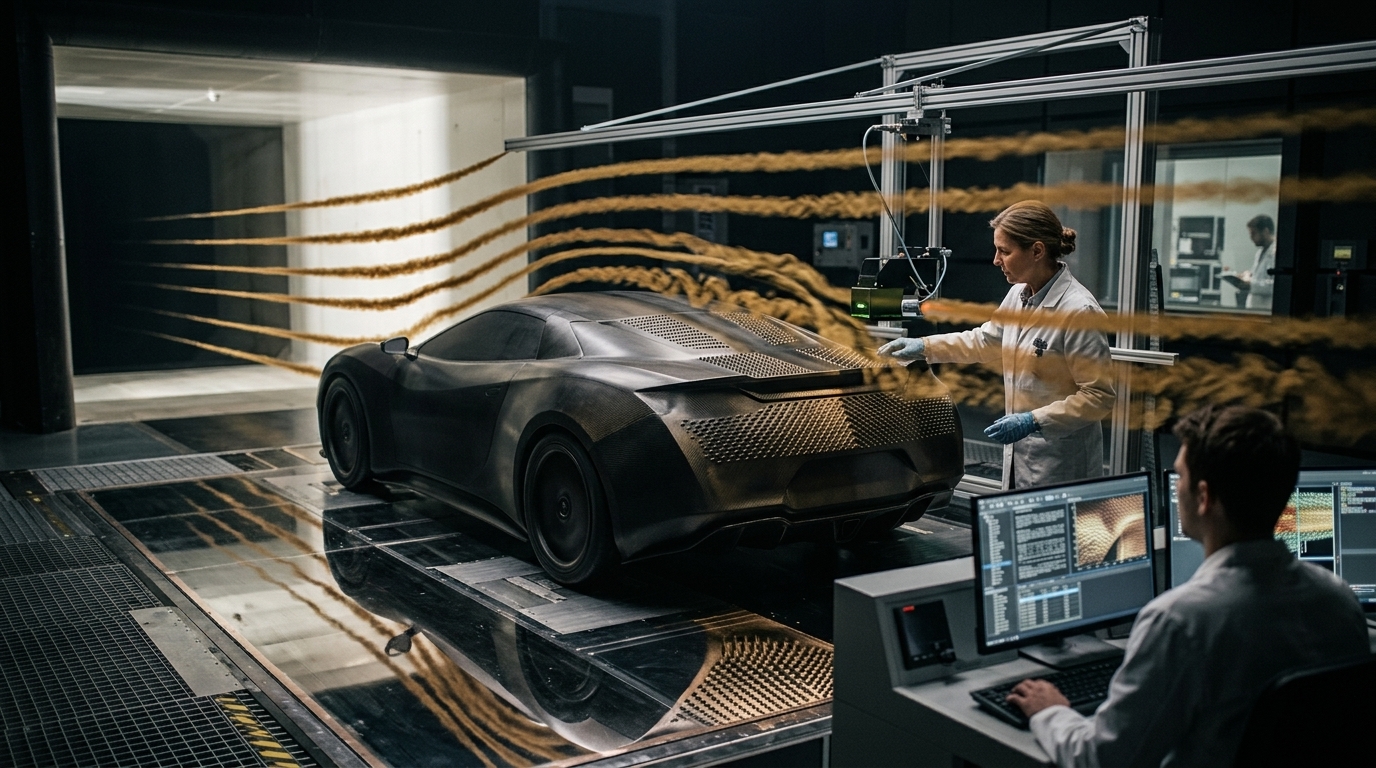
In the world of aeronautical engineering, one rule was long considered nearly sacred: the smoother the surface, the lower the aerodynamic drag. From the polished fuselages of modern jets to the high-performance helmets of Olympic cyclists, the pursuit of absolute smoothness has been the cornerstone of design. However, a recent scientific breakthrough, highlighted by research in leading aerospace laboratories, is overturning this long-held belief, proving that controlled "roughness" can actually be more efficient.
Traditional fluid dynamics suggested that surface irregularities cause turbulence in the "boundary layer"—the thin layer of air directly in contact with the object. This turbulence increases skin friction, which accounts for the majority of total drag for aircraft and ships. The new research, however, demonstrates that specific patterns of microscopic roughness can "trap" air or water in a way that reduces overall friction more effectively than a perfectly smooth surface.
The Physics of the Overturn: Beyond the Boundary Layer
The key to understanding this discovery lies in how air interacts with matter at a microscopic scale. In classical mechanics, the "no-slip condition" dictates that the fluid in contact with a solid surface has zero velocity relative to it. This creates a velocity gradient that leads to friction. Researchers experimented with surfaces featuring microscopic grooves or structures resembling shark scales (riblets), which alter the structure of turbulence near the wall.
What they found is that these patterns can align vortices, preventing them from transferring momentum toward the surface. In other words, the roughness acts as an "insulator" that keeps the turbulent flow away from the aircraft's body. This approach isn't entirely new to nature—sharks have evolved over millions of years with skin featuring microscopic denticles to swim faster—but aeronautical engineering has struggled to apply this effectively and durably on an industrial scale.
From Lab to Production: Challenges and Prospects
Applying this principle in real-life conditions is not without hurdles. Creating and maintaining these microscopic structures on an aircraft flying at extreme temperatures and speeds is a massive technical challenge. Dust, ice, or even insect remains can fill the microscopic grooves, nullifying their benefits and dramatically increasing drag.
However, the advent of nanotechnology and advanced 3D printing methods is changing the game. Scientists are now developing "self-cleaning" surfaces that maintain their geometry. If this technology is adopted on a large scale, fuel consumption reduction could reach 5% to 10%. In a global industry struggling with fuel costs and the pressure to reduce carbon emissions, these percentages are not just improvements—they represent an economic and environmental revolution.
Significance for the Future of Transport
The overturning of this fundamental dogma teaches us something vital about scientific progress: often, the greatest breakthroughs come not from adding new elements, but from re-examining the things we took for granted. The idea that roughness can be an ally rather than an enemy opens new paths not only for aviation but also for shipping, energy pipeline design, and even the construction of more efficient wind turbines.
In the future, we might look back at today's "smooth" aircraft as primitive and inefficient. Biomimicry—copying nature's solutions—combined with computational fluid dynamics, is leading us into a new era where the "perfect" surface will not be the one that looks cleanest to the eye, but the one designed with the wisdom of complexity.