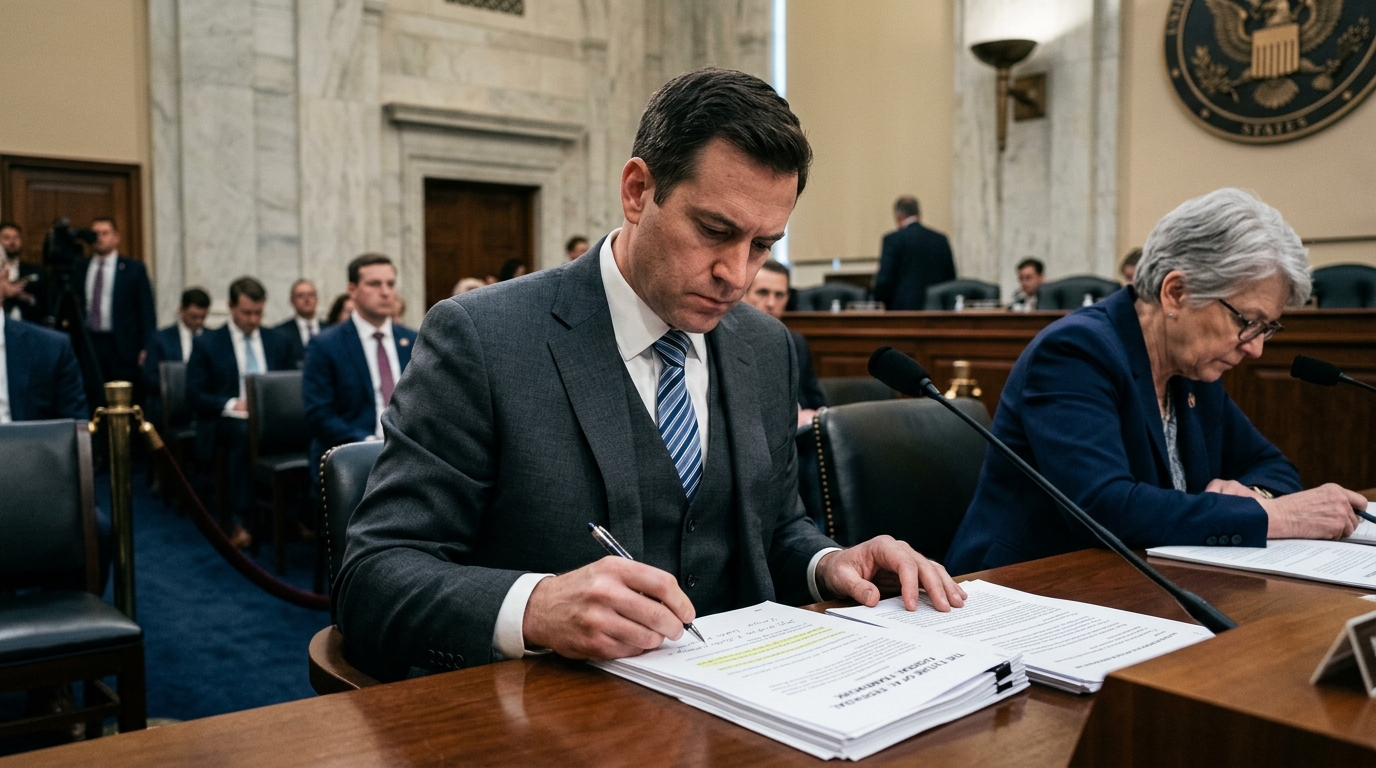
The battle for regulatory supremacy over Artificial Intelligence (AI) in the United States has entered a high-stakes chapter. House lawmakers recently unveiled a draft bill designed to establish a single federal standard for AI, effectively stripping individual states of their power to enact local AI laws. This move, framed as an essential step to prevent a fragmented "regulatory patchwork," marks a significant escalation in the tug-of-war between federal authority and state sovereignty, underscored by the immense lobbying power of Silicon Valley.
The End of the "Regulatory Patchwork" or an Erosion of Safety?
Proponents of the bill, including major technology corporations, argue that the current trajectory is untenable. As states like California, Colorado, and Utah advance their own legislative frameworks—most notably California’s controversial SB 1047—AI developers face the daunting prospect of complying with 50 disparate sets of rules. Industry representatives warn that this complexity could stifle innovation, inflate compliance costs, and undermine America’s competitive edge against global rivals, particularly China.
However, critics view the move as a strategic attempt to weaken consumer protections. States have historically served as "laboratories of democracy," pioneering rigorous standards that often set the stage for national policy. Opponents of federal preemption argue that a national standard might settle on a "lowest common denominator," leaving the public vulnerable to algorithmic bias, privacy breaches, and the unchecked spread of misinformation.
The Political Economy of Preemption
The legal doctrine of preemption allows federal law to override state law when the two conflict. In the realm of AI, the stakes are unprecedented. If Congress passes legislation that explicitly prohibits states from regulating foundation models, authority shifts entirely to Washington D.C. This outcome is a primary objective for tech lobbyists, who find it far more efficient to influence a single federal body than to navigate dozens of state legislatures with varying political climates.
- Tech firms fear the "California Effect," where the regulations of a massive state market become de facto national standards.
- Civil rights organizations warn that the draft bill lacks robust enforcement mechanisms compared to proposed state laws.
- A core debate persists over whether AI should be regulated based on its end-use or its raw computational power.
The timing of this draft is no coincidence. With a major election cycle looming and the European Union’s AI Act already setting a global benchmark, US lawmakers are under pressure to demonstrate leadership. Yet, the deep ideological divide between Democrats and Republicans regarding the intensity of oversight remains a formidable barrier to achieving a bipartisan consensus.
The Clash with California and the Future of Governance
The draft bill is a direct challenge to measures like California’s, which would require developers of large-scale AI models to conduct safety testing and implement "kill switches" for potentially dangerous systems. Federal lawmakers backing the preemption bill argue that such requirements are technically impractical and could jeopardize the open-source community. This conflict highlights a fundamental philosophical divide: should technology be regulated ex-ante (preventatively) to mitigate catastrophic risks, or ex-post (after the fact) once harm has been demonstrated?
Ultimately, the House draft bill is more than a technical adjustment; it is a declaration of power. Its success or failure will determine whether AI governance remains centralized and potentially more business-friendly, or whether citizens can demand more stringent protections through their local representatives. One thing is certain: the conversation has shifted from *whether* to regulate AI to *who* holds the ultimate authority to do so.