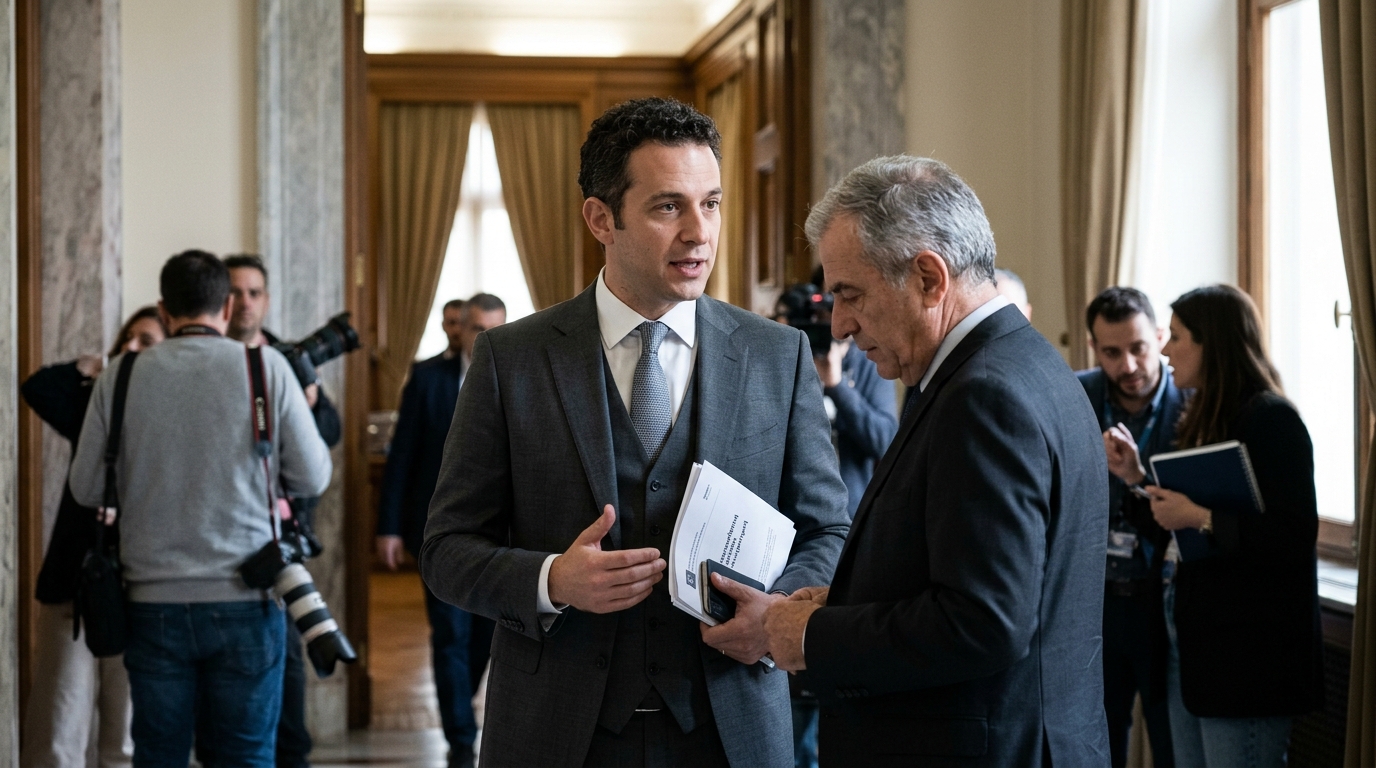
As of June 2026, the Greek political landscape is witnessing a significant organizational pivot. Prime Minister Kyriakos Mitsotakis’ decision to propose Konstantinos Kyranakis for the position of General Secretary of the New Democracy (ND) Political Committee is far more than a mere internal reshuffle. It is a move laden with symbolism, aimed at modernizing the party apparatus and aligning it with the demands of the digital era and the evolving social strata of the mid-2020s.
From Digital Governance to the Heart of the Party
Konstantinos Kyranakis, a politician whose name has become synonymous with "digital reform" and direct communication, is now tasked with injecting this expertise into the hard core of the party headquarters at Piraeus Street. His tenure at the Ministry of Digital Governance, particularly his work on the National Land Registry (Ktimatologio) and the simplification of bureaucratic hurdles, earned him the profile of an effective technocrat unafraid of institutional friction. This is precisely the quality Mitsotakis seeks for New Democracy: a mechanism that functions on 21st-century terms, distancing itself from the traditional clientelist structures of the past.
Kyranakis’ nomination comes at a time when the government is seeking to revitalize its relationship with the middle class and the youth. Having previously served as the President of the Youth of the European People's Party (YEPP), he possesses the networking and the vocabulary necessary to reach an audience that often feels alienated from traditional politics. Appointing a member of the younger generation to the Secretaryship is a clear signal of renewal, especially during a period where the fatigue of long-term governance is starting to manifest.
The Strategy of "Permanent Renewal"
Why did Kyriakos Mitsotakis choose Kyranakis at this specific juncture? The answer lies in the strategy of "permanent renewal" that the Prime Minister has pursued since his election to the party leadership. The role of the General Secretary is pivotal: they are the coordinator of local branches across the country, the one who monitors the grassroots' reactions, and the architect of the party’s readiness for future electoral battles. With Kyranakis at the helm, ND aims to transform into a "data-driven" party, utilizing technology for social trend analysis and more effective communication of government achievements.
- Digitizing the Grassroots: A total digitization of the party membership and the use of new participatory democracy tools are expected.
- Youth Focus: Kyranakis has proven his ability to mobilize young audiences via social media, a demographic ND considers vital for its longevity.
- Internal Cohesion: The challenge will be balancing the "modernizers" with the "traditionalist" cadres who might view the rapid change in style with skepticism.
Challenges and Internal Balances
However, the road ahead for the new Secretary will not be without obstacles. New Democracy is a party with deep roots and powerful local organizations that often resist central directives. Kyranakis will have to prove that he can blend his "digital flair" with respect for the traditions and the veteran cadres who have been the party’s backbone for decades. Managing the discontent arising from the natural wear and tear of governance will be the first major "crash test" for his leadership skills.
"New Democracy must be a living organism that evolves alongside society. It is not enough to govern well; we must communicate and inspire," sources close to the Prime Minister note, explaining the rationale behind the choice.
In an era where political dominance is decided by nuances and the capacity for adaptation, the placement of Konstantinos Kyranakis in the ND Secretaryship is a bold experiment. If successful, it will create a party model for the European center-right to emulate. If it fails, it will suggest that the technocratic approach has limits when faced with the traditional political geography of Greece. What is certain is that this choice marks the end of one era and the beginning of a new, more digital, and communicative phase for the historic party.