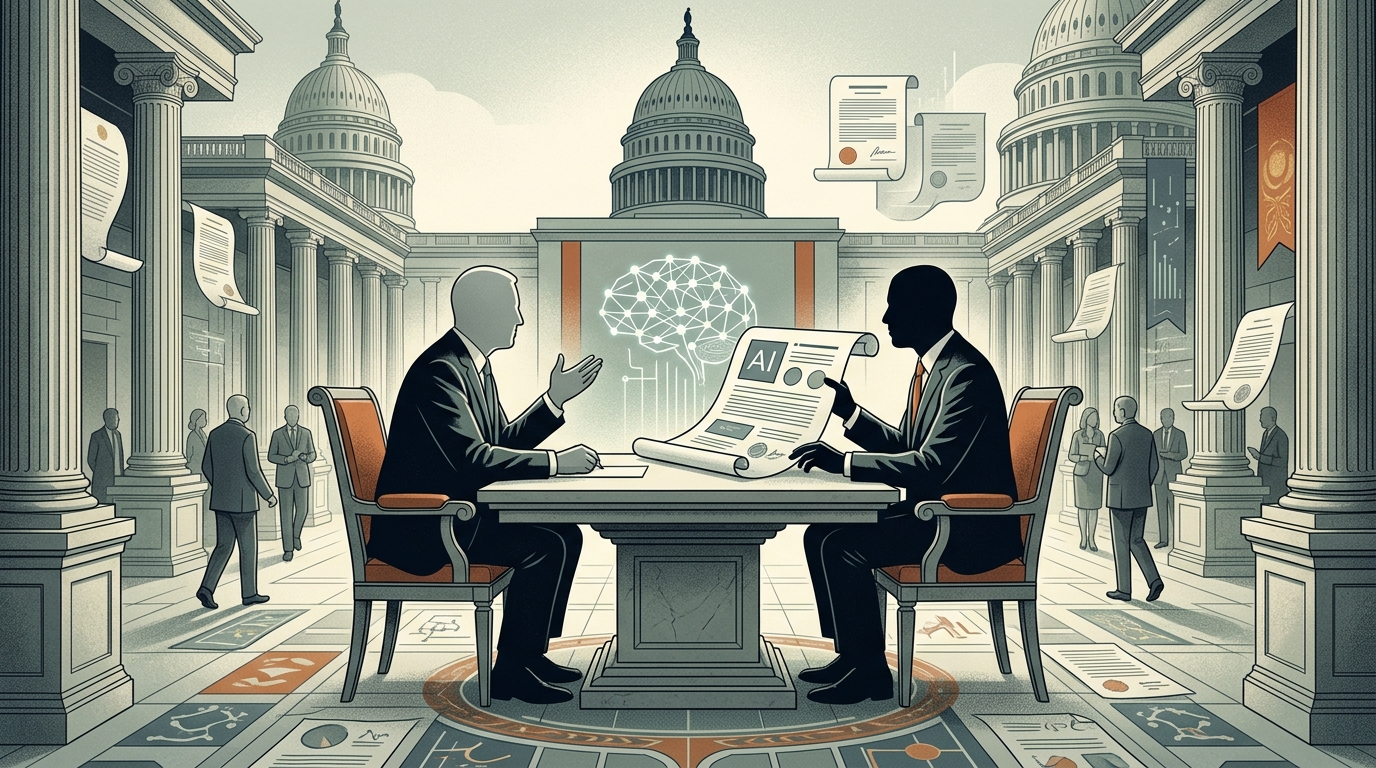
In the volatile political landscape of 2026, technology has a knack for creating the strangest of bedfellows. Donald Trump’s recent remarks, suggesting a form of "partnership" or even partial government ownership of major Artificial Intelligence (AI) firms, have sent shockwaves through both Washington and Silicon Valley. Despite the fact that his MAGA (Make America Great Again) base often views AI with deep suspicion—frequently labeling it a "woke" tool of elite control—the former President appears to be aligning with his sworn ideological rival, Bernie Sanders, on the notion that the public sector should have a stake in the intelligence revolution.
The Shift Toward AI "State Capitalism"
On Friday, speaking to reporters, Trump used a phrase few would expect from a traditional Republican: "You make them a partnership in this revolution... It would be a beautiful thing." His reference was directed at companies like OpenAI, Anthropic, and Elon Musk’s xAI. The logic behind this pivot isn't social welfare, but national power. Trump perceives AI not as a mere commercial product, but as a strategic asset comparable to oil or nuclear weapons.
This approach strongly echoes the long-standing proposals of Bernie Sanders, who has argued for years that if taxpayers fund the research and infrastructure (through chip subsidies and energy grid support), then the public should own a share of the profits and control of these technologies. This convergence, while starting from different points—Sanders from social justice and Trump from nationalism—leads to the same conclusion: the end of laissez-faire capitalism in the high-tech sector.
From "Woke AI" to National Might
For Trump’s base, AI is often a red flag. MAGA supporters have repeatedly denounced large language models for perceived biases against conservative values. However, Trump is attempting to flip the narrative. Instead of fighting AI, he suggests "capturing" it for the state to ensure it serves American interests rather than the agenda of a liberal Silicon Valley elite.
- Geopolitical Competition: The imperative to win the race against China overrides ideological hesitations about state intervention.
- Energy Infrastructure: AI’s massive demand for electricity requires state cooperation, giving the government significant leverage.
- Economic Sovereignty: The government’s ability to collect royalties from AI intellectual property could provide a massive new revenue stream.
Silicon Valley’s Reaction and the Sanders Model
The prospect of a state "partnership" evokes mixed feelings among tech CEOs. On one hand, OpenAI’s Sam Altman has repeatedly called for government intervention in safety regulation. On the other, the idea of state ownership—even partial—is a nightmare for venture capitalists (VCs).
"If the state becomes a shareholder, then innovation dies," market circles argue. Yet, Sanders would counter that innovation benefiting only the 1% is a failed innovation.
Trump seems to be adopting a "Military-Industrial Complex 2.0" model. Much like the government partnered with Boeing and Lockheed Martin during the Cold War, Trump envisions an America where OpenAI’s algorithms are part of the national infrastructure, under the direct or indirect control of the White House.
Conclusion: A New Era for Tech Policy
Whether this is populism or strategic realism, the Trump-Sanders convergence marks the end of an era where AI companies operated in a legal and ownership vacuum. The discussion regarding state participation in AI is no longer a fringe socialist idea but a mainstream proposal that could define elections and the future of the global economy. The question is no longer if the state will intervene, but under what terms this "beautiful partnership" will be forged.