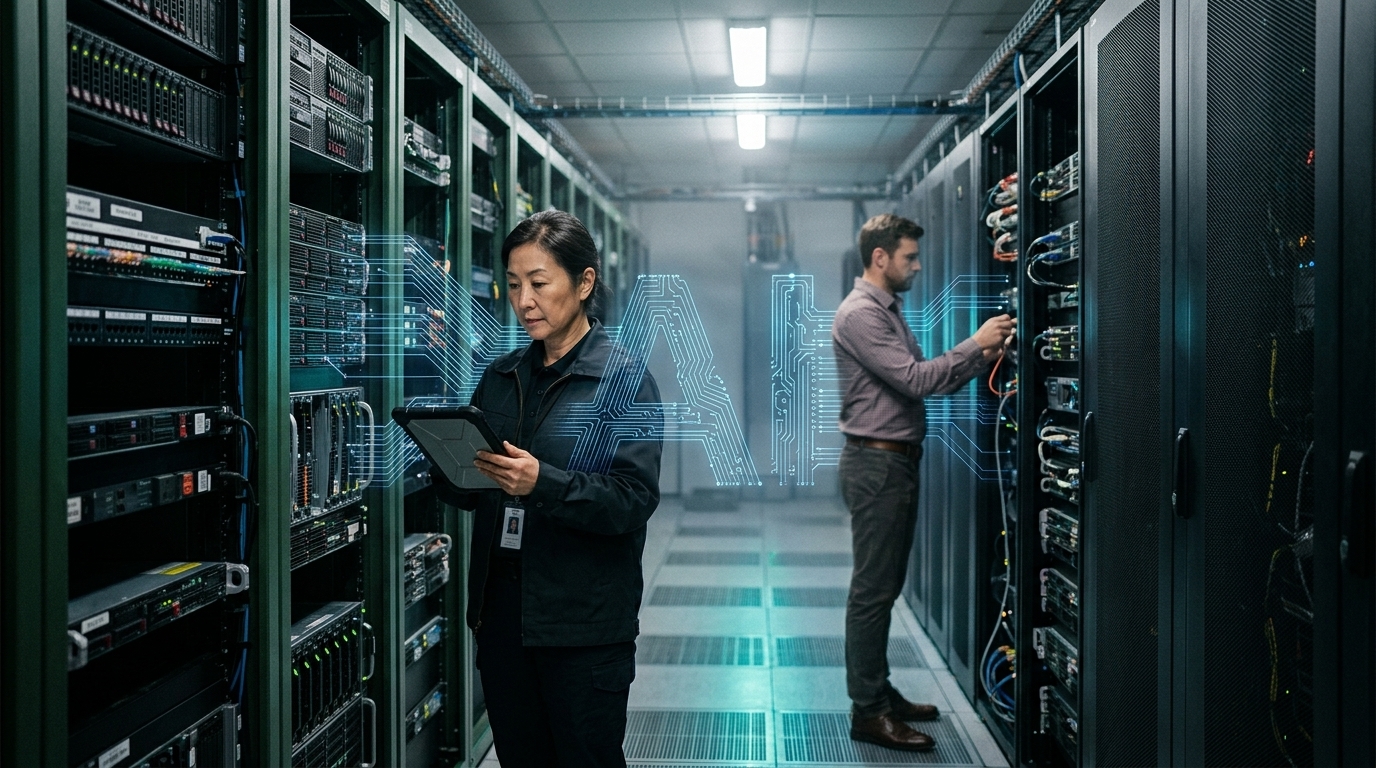
In the geopolitical chessboard of the 21st century, the concept of 'decoupling' has become the holy grail of both American and Chinese foreign policy. However, beneath the surface of trade tariffs and semiconductor export restrictions, a paradoxical reality is emerging: Artificial Intelligence (AI), the very technology supposed to determine the winner of this new cold war, is acting as a powerful connective tissue that makes a total separation nearly impossible.
The recent explosion of investment in data centers, computing infrastructure, and next-generation models has created a symbiotic relationship that defies borders. While Washington attempts to throttle Beijing's access to advanced chips, the global supply chain required to manufacture these chips remains desperately dependent on Chinese raw materials and lower-tech components.
The Supply Chain Trap and the Semiconductor Paradox
The U.S. effort to 'strangle' Chinese growth in the semiconductor sector through controls on NVIDIA and ASML has yielded results, but at a heavy price. China, in response, has invested billions in 'legacy chip' production—the foundational components necessary for the everyday devices and infrastructure that support AI networks. The result? American tech giants find themselves in a position where their most sophisticated software runs on hardware that, to a large extent, depends on Chinese-made parts.
Furthermore, China’s dominance in rare earth elements and the processing of metals like gallium and germanium—critical for semiconductor fabrication—means that any attempt at full decoupling would likely derail the American AI industry. As analysts point out, 'You cannot build the future of intelligence if you do not control the matter, and China controls the matter.'
Capital Flows and Human Capital
Beyond hardware, the interconnection is deeply rooted in capital and knowledge. Despite restrictions on direct foreign investment, American venture capital continues to find pathways into Chinese startups through third countries or joint ventures. AI does not develop in a vacuum; it is the product of a global scientific community. The world’s top AI researchers often study in the U.S. and work for American firms while maintaining deep ties with Chinese academia.
"Artificial intelligence is a global language. You can ban the sale of a machine, but you cannot ban the flow of a mathematical idea published in an open-source repository," says a Silicon Valley executive.
Data Centers: The New Geopolitics of Energy
Another area where the two economies 'clash' yet 'converge' is energy. Training Large Language Models (LLMs) requires gargantuan amounts of electricity. China, as the world’s largest producer of renewable energy equipment and batteries, holds the keys to the green transition of data centers—even those on American soil. The irony is stark: for the U.S. to achieve AI dominance sustainably, it may need to purchase the underlying infrastructure technology from its primary rival.
Conclusions for the Future
The rhetoric of decoupling serves political purposes and domestic audiences, but the economic reality of AI points toward a 'forced symbiosis.' Competition will remain fierce, but the ties created by AI are so complex that a violent attempt to sever them could trigger global economic paralysis. The challenge for 2026 and beyond is not how these two powers will separate, but how they will manage an interdependence that neither seems to want, but both desperately need.