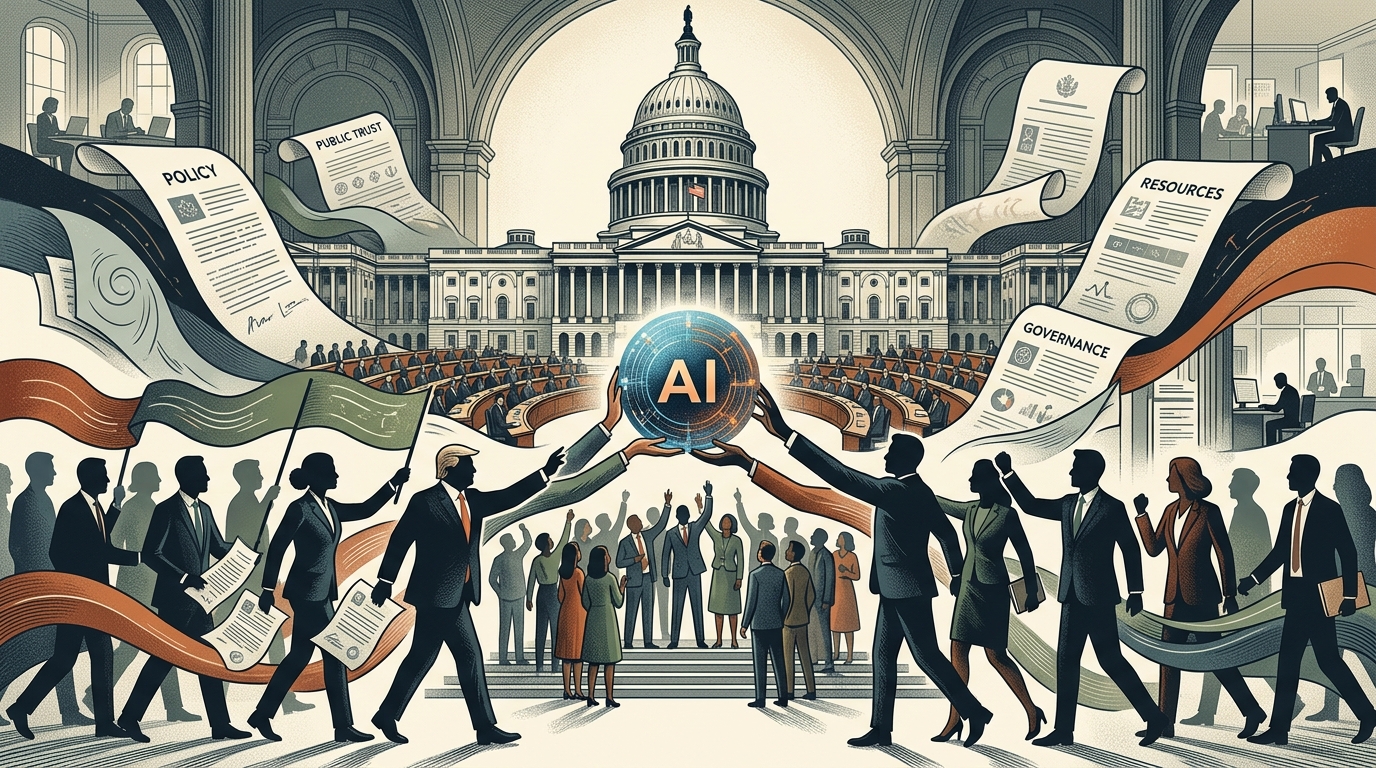
In an era of intense political polarization, the emergence of common ground between Donald Trump, Bernie Sanders, and Sam Altman feels almost like a political paradox. Yet, Washington and Silicon Valley appear to be converging on a radical conclusion: Artificial Intelligence (AI) is so transformative that traditional private ownership may no longer suffice to maintain social cohesion. The discussion regarding "public ownership" or "public equity" in AI is no longer a fringe socialist theory; it is a central strategic proposal being vetted at the highest echelons of power.
The Convergence of Opposites
The core concept is simple yet revolutionary: if AI is set to displace millions of jobs and generate trillions of dollars in wealth, then the fruits of this technology must, in part, belong to society as a whole. Bernie Sanders, the iconic representative of the American left, has long argued that automation should benefit workers rather than just corporate shareholders. His proposal for a "robot tax" is now evolving into a broader conversation about public equity stakes in AI companies that receive government subsidies or infrastructure support.
On the opposite end of the spectrum, Donald Trump approaches the issue through the lens of nationalism and competition with China. His advisors are exploring the creation of a "Sovereign Wealth Fund" that could hold stakes in critical AI infrastructure. For Trump, public ownership isn't about redistribution in the classical sense, but about ensuring that American power remains undisputed and that the profits of technology bolster the national treasury.
Sam Altman’s Vision: Universal Basic Compute
Sam Altman, CEO of OpenAI, has introduced his own version of this idea, which he calls "Universal Basic Compute" or the "American Equity Fund." Altman proposes that every citizen could have a stake in the GDP generated by AI. Instead of a simple welfare check, citizens could hold shares in a fund that invests in leading AI companies, or even have guaranteed access to computing power (compute) as a public utility.
"AI will create so much wealth that we will have to find new ways to distribute it so that everyone feels they have a stake in its success," Altman has stated in various forums.
This approach reflects an admission from Silicon Valley: the social backlash against AI will be so potent if inequality skyrockets that the very survival of tech companies will be threatened. Public ownership serves here as a form of "insurance" for the capitalist system itself.
Geopolitics and National Security
The shift toward public ownership is also driven by the need for massive infrastructure. Building data centers and manufacturing semiconductors requires capital that often exceeds the capabilities of the private sector alone. The Biden administration, through the CHIPS Act, has already begun imposing conditions on companies receiving subsidies, such as limiting stock buybacks and sharing "excess profits" with the government. This serves as a precursor to the public participation envisioned by both Trump and Sanders.
In Europe, the conversation is moving toward "Sovereign AI." France and Germany are investing in national AI models to avoid total dependence on American Big Tech. If the state funds the research, development, and energy consumed by AI, then the argument that the state—and by extension, the citizen—should own part of the intellectual capital becomes increasingly persuasive.
Challenges and Risks
Naturally, implementing such a model carries immense risks. Who will manage these sovereign funds? How can we ensure that public ownership doesn't lead to state control of information and censorship? Furthermore, there is the risk of bureaucratic inefficiency stifling innovation. Critics argue that the government is a poor manager of capital and that the free market remains the best mechanism for technological advancement.
However, the reality of AI is different from any previous industrial revolution. The speed of its evolution and the scale of potential labor market disruption make traditional solutions inadequate. The convergence of Trump, Sanders, and Altman signals the end of the "laissez-faire" era in technology and the beginning of a new epoch where the state and society demand a seat at the profit-sharing table.