Artificial Intelligence (AI) is no longer a science fiction scenario or a tool confined to the laboratories of tech giants. According to the Greek Minister of Environment and Energy, Theodoros Skylakakis, it represents an imminent social and economic revolution that will overturn the foundations of the middle class. In a confessional and simultaneously analytical intervention, Mr. Skylakakis connected global technological evolution with his personal odyssey, highlighting how AI can become both an ally in human survival and a threat to the economic stability of traditional professions.
Personal Experience as a Catalyst for Knowledge
Mr. Skylakakis's involvement with AI did not stem from official duty, but from a profound personal need. His wife, Galateia Alexopoulou, was diagnosed with the incurable disease ALS (Amyotrophic Lateral Sclerosis). As he revealed, the inability of traditional medicine to offer immediate solutions prompted him to use advanced AI models to research international literature, clinical trials, and potential therapeutic paths.
"AI allowed me to process a volume of data that no human, no matter how expert, could manage in such a short period of time," he noted characteristically.
This experience led him to a critical realization: AI does not only replace manual labor but also complex intellectual work. When a system can analyze medical tests or draft legal documents with greater precision than a seasoned professional, then the value of human expertise is called into question.
The Threat to the Middle Class and Incomes
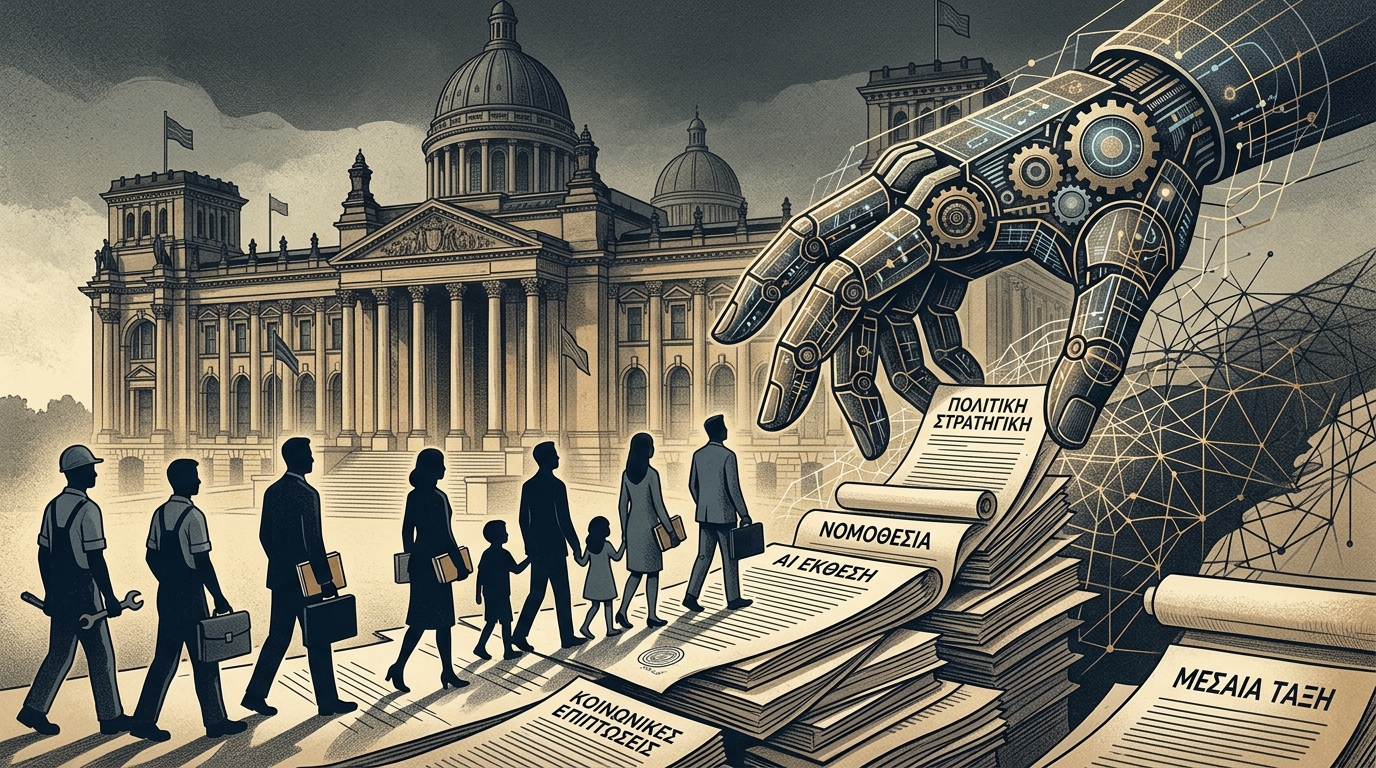
Mr. Skylakakis's central thesis is that AI will disproportionately affect the middle class—doctors, lawyers, engineers, and analysts. In the past, technological progress automated factory "routines." Today, AI automates "thought." This creates unprecedented pressure on the incomes of scientific sectors.
- De-skilling: Tasks that required years of study can now be performed by less specialized personnel with the help of AI.
- Wealth Concentration: The productivity gains offered by AI tend to shift toward the owners of technology and capital, rather than the workers.
- Wage Pressure: The increased supply of "smart" labor through algorithms could lead to a decrease in the market value of human labor.
The Minister warns that if timely adaptation does not occur, social cohesion could fracture. The middle class, which forms the backbone of democracy and economic stability, risks finding itself in a whirlwind of "digital proletarianization."
Policy Challenges and the Path Forward
How should the state react? Mr. Skylakakis does not limit himself to identifying the problem but sets the framework for a new public policy. Education must shift from the accumulation of knowledge to the cultivation of skills that AI cannot (yet) mimic: critical thinking, creativity, and emotional intelligence.
Furthermore, the issue of redistribution arises. If AI generates wealth without commensurate employment, tax systems must be reconsidered. Greece, with an economy heavily reliant on services and small-to-medium enterprises, stands at a critical crossroads. The adoption of AI can enhance competitiveness, but a lack of strategy could lead to mass unemployment in high-skill sectors.
The case of Theodoros Skylakakis highlights a rare moment of political honesty. Using his personal pain as an analytical tool, he calls on us to view AI not as a distant threat, but as a reality already reshaping our lives. The bet for the government and society is whether we can harness this power for the benefit of the many, or if we will allow it to become the catalyst for a new era of inequality.