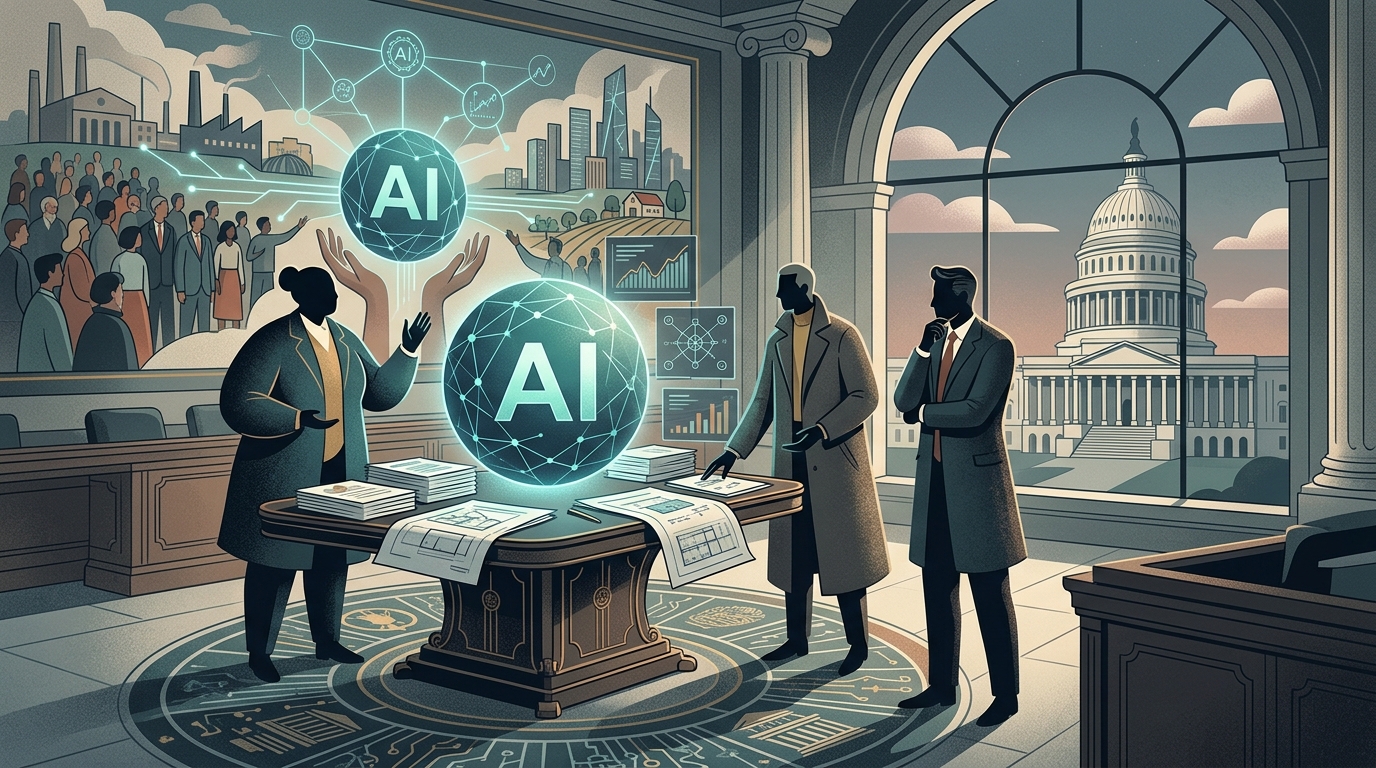
In an era where artificial intelligence (AI) is no longer a futuristic promise but a present disruptive force, Washington is attempting to illuminate the 'black box' of its impact on employment. A group of U.S. Senators, led by Laphonza Butler, has introduced a proposal to create a national database under the auspices of the Department of Labor (DOL), which would precisely track how algorithms are displacing, augmenting, or transforming jobs across the nation.
The Need for Empirical Evidence
To date, the conversation regarding AI and labor has largely relied on anecdotal evidence or projections from think tanks and private consulting firms. The proposed legislation, known as the 'AI Workforce Data Act,' seeks to change this paradigm by positioning the government as the primary data collector and analyst. The database would not merely record job losses; it would examine shifts in required skills, wage fluctuations, and the emergence of new professional categories that did not exist five years ago.
This initiative reflects a deeper concern: the speed of technological evolution has far outpaced the ability of regulators to grasp the magnitude of the change. Without accurate data, policies for worker retraining risk being misguided and costly. Senators argue that transparency is the first step toward protecting the middle class from potential 'digital marginalization.'
Beyond Replacement: The Augmentation Challenge
One of the most critical elements of the proposal is the focus on labor 'augmentation.' AI rarely replaces entire occupations; more commonly, it automates specific tasks within them. The new database will seek to analyze how the daily lives of accountants, programmers, or assembly line workers change when Generative AI tools are integrated. This granular analysis is essential for redesigning educational curricula and lifelong learning programs.
- Identifying sectors with the highest exposure to automation.
- Monitoring wage gaps resulting from AI adoption.
- Evaluating the effectiveness of retraining programs.
- Creating an early warning system for industries at risk of sudden collapse.
The Geopolitical and Economic Dimension
This move does not occur in a vacuum. As the U.S. competes with China and the European Union for AI supremacy, maintaining a stable and skilled workforce is a matter of national security. The European Union, through the AI Act, has already established strict frameworks for protecting workers' rights. The American approach, while initially less regulatory, seems to choose the path of 'informational sovereignty' to guide future interventions.
"We cannot manage what we cannot measure," said a staffer involved in drafting the proposal. "AI is a hurricane approaching the coast, and right now, we don't even have weather stations to measure the wind speed."
In conclusion, the creation of a database by the U.S. Department of Labor is an admission that the labor market has entered a phase of permanent volatility. For workers, this could mean more targeted support. For businesses, it may mean increased accountability for how they implement new technologies. In any case, the era of ignorance regarding AI's impact on work appears to be coming to an end.