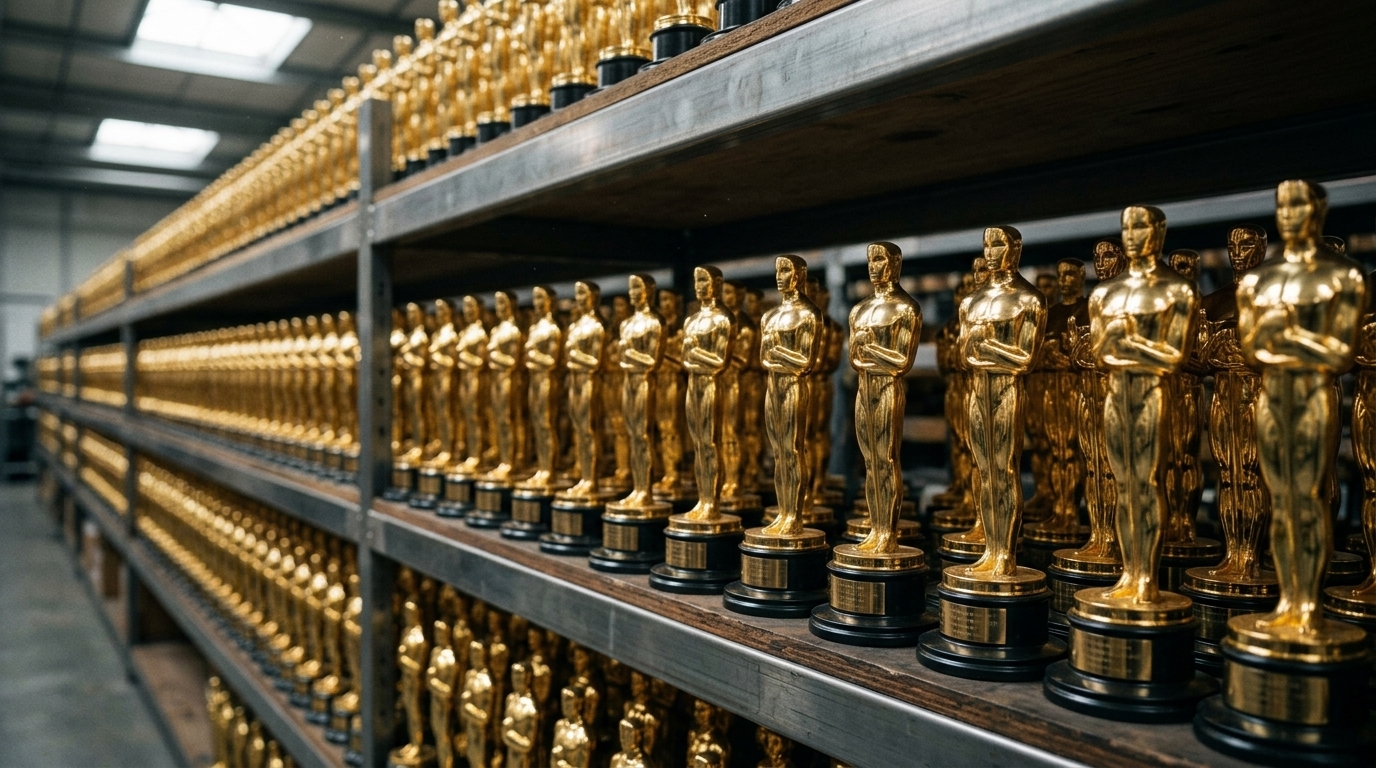
The seventh art is navigating one of the most turbulent periods in its history, as the rapid evolution of Artificial Intelligence (AI) threatens to upend fundamental assumptions about creativity and performance. In a move described as "existential fortification," the Academy of Motion Picture Arts and Sciences (AMPAS) has announced a series of new rules that will take effect starting with the 99th Oscars ceremony in 2027. This decision is not merely a bureaucratic adjustment but a statement of principles: the golden statuette belongs exclusively to humans.
The Human Condition as a Prerequisite for Creation
According to the new regulations, for a film to be eligible in the acting and screenwriting categories, the contribution must originate from natural persons. This means that "digital actors" (AI-generated avatars) or scripts produced entirely by Large Language Models (LLMs) will not be eligible for nomination. The Academy clarifies that AI can only be used as a supportive tool, provided that control and the final creative decision remain in the hands of the human creator.
This move comes as a direct response to the intense concerns expressed by the actors' union (SAG-AFTRA) and the writers' union (WGA) during the historic strikes of 2023. Hollywood workers viewed AI not as a promise of efficiency, but as a threat of replacement and devaluation of human labor. The Academy, acting as the ultimate arbiter of quality in the industry, decided to align itself with demands for the protection of intellectual property and artistic integrity.
The Fine Line Between Tool and Creator
The major question arising is where the use of technology as a tool ends and where its autonomy begins. The Academy does not ban the use of AI in visual effects (VFX) or post-production, fields where technology has been used for decades for de-aging actors or creating digital crowds. However, the red line is drawn where AI attempts to substitute the "soul" of the film: the performance and the narrative.
- Acting: A digital character can only be awarded if it is based on the performance capture of a human actor, who retains ownership of the emotional expressions.
- Screenwriting: A script that has been "refined" by AI remains eligible, but a script that started from a prompt and was only minimally "humanized" risks disqualification.
- Transparency: Producers will now be required to disclose the use of Generative AI tools during the nomination submission process.
This need for transparency is expected to create new challenges for the Academy's oversight mechanisms. How will "human origin" be proven in a world where AI can perfectly mimic the style of an established writer? The Academy seems to be betting on the ethical responsibility of its members and the strict supervision of the branches that evaluate nominations.
Economic and Cultural Implications
The Academy's decision also has a strong economic dimension. The Oscars are the most significant marketing tool for prestige films. If AI is excluded from them, major studios will hesitate to invest massive amounts in productions based solely on AI, as they would lack the possibility of the "golden seal" that boosts box office revenue and streaming numbers. In this way, the Academy indirectly directs industry investment back toward human talent.
On a cultural level, this move reignites the debate over what we consider "art." For many, art is the communication of human experience—of pain, joy, and mortality. A machine, no matter how advanced, lacks lived experience. The Academy chooses to remain the guardian of this anthropocentric approach, ensuring that cinema remains a mirror of the human condition rather than a product of algorithmic optimization.
The Future of Technology in Hollywood
Despite the "blockade," Artificial Intelligence will not disappear from Hollywood. On the contrary, it will be integrated in ways that do not directly affect Oscar categories, such as in production scheduling, distribution, and audience data analysis. The challenge for creators will be to use these tools to enhance their vision without handing over the reins to automation. The Academy has set the framework, but the real battle for the heart of cinema will be fought on sets and in writers' rooms in the coming years.