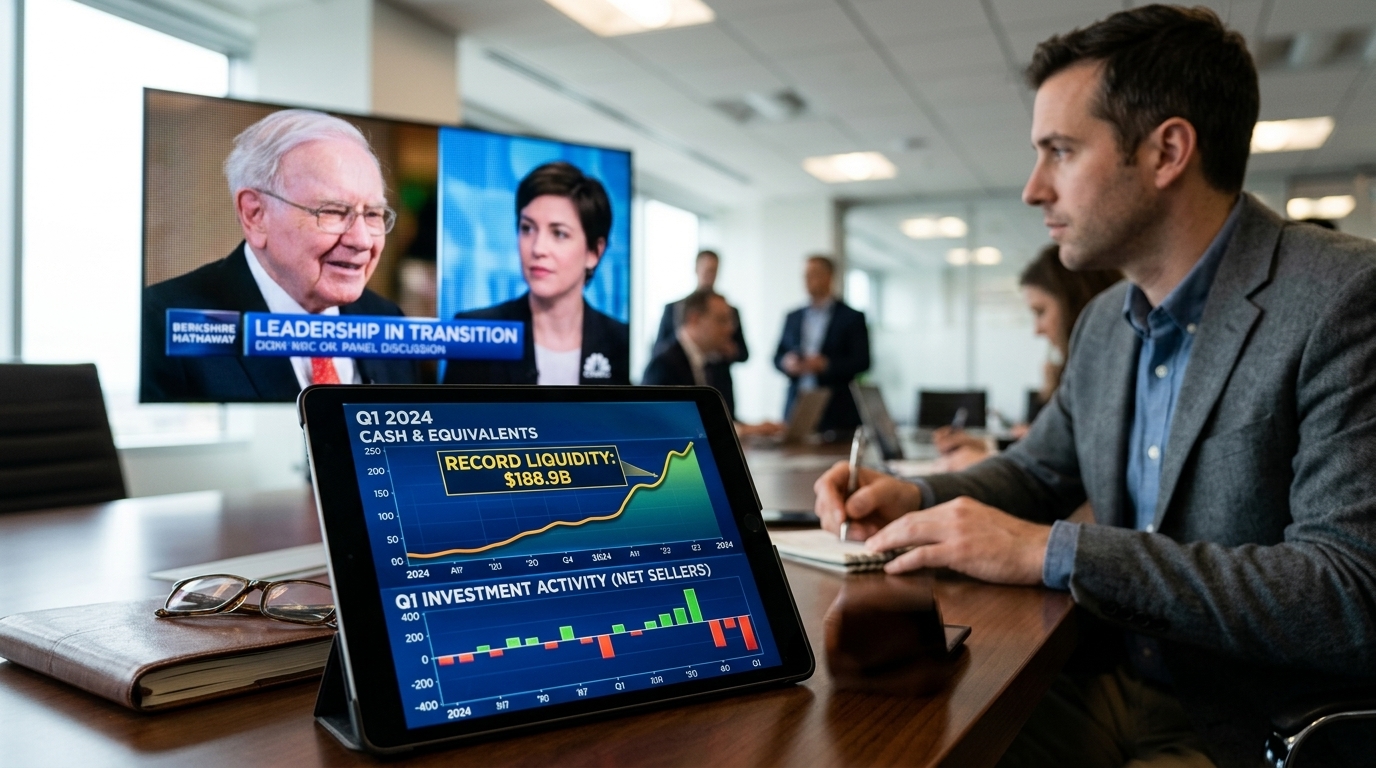
May 2, 2026, will go down in financial history as the moment Berkshire Hathaway proved that the machine built by Warren Buffett can operate with absolute precision, even as the "Oracle of Omaha" has stepped back from daily decision-making. The first-quarter results for 2026, announced today, reveal an empire that is not just stable but more liquid than ever, amassing an astronomical $200 billion in cash reserves.
The Strategy of Patience in an Uncertain World
The surge in liquidity is no accident. Under the guidance of Greg Abel, who has taken the reins of operational management, Berkshire appears to be adopting an even more conservative stance than in the past. In an environment where interest rates remain stubbornly high and geopolitical tensions strain global supply chains, holding cash is no longer seen as "dead capital" but as a formidable weapon.
Wall Street analysts note that Berkshire Hathaway is significantly benefiting from yields on U.S. Treasury bills, which offer a rare combination of safety and satisfactory returns. "The core strategy hasn't changed," says a source close to the company. "It's just that now, the discipline to avoid overpaying for assets is more visible than ever."
The Transition: From Charismatic Leader to Institutional Giant
The big question hanging over Omaha for years was whether Berkshire could maintain its identity without Buffett's active presence. The Q1 data shows that the transition has been executed with surgical precision. Greg Abel and Ajit Jain have managed to solidify a culture of institutional consistency, where decisions are based on rigorous mathematical models rather than the "gut feeling" that often characterized Buffett's legendary moves.
"Berkshire Hathaway is no longer a company dependent on one man, but an ecosystem that feeds off its own efficiency," said a prominent investor during the annual meeting.
The company's operating businesses, from BNSF railways to Geico insurance, showed increased profit margins. Geico, in particular, after a period of adjusting to new AI-driven risk assessment technologies, managed to reduce its operating expenses by 12% year-on-year.
The Equity Portfolio and the Apple Relationship
One of the most notable moves of the quarter was the further reduction of Berkshire's position in Apple. While Apple remains the group's largest investment holding, the liquidation of a portion of its shares indicates a desire for diversification. Berkshire appears to be pivoting toward the energy and infrastructure sectors, increasing its stake in Occidental Petroleum and renewable energy projects across the U.S. Midwest.
This shift is interpreted as an effort to align with the new needs of the American economy, which emphasizes energy autonomy. At the same time, Berkshire maintains massive firepower for a potential major acquisition, which many believe will target a player in the logistics or industrial manufacturing sectors.
Conclusion: The Legacy is the Method
Closing the first quarter of 2026, Berkshire Hathaway sends a clear message: the method of value investing is alive and well. The emphasis on cash, risk avoidance, and adherence to core business values remain the pillars of the organization. For shareholders, Buffett's absence from the helm may evoke nostalgia, but the financial results provide ultimate reassurance. The empire is in good hands, and the "mountain of cash" stands ready to be deployed when the market offers the right opportunity.