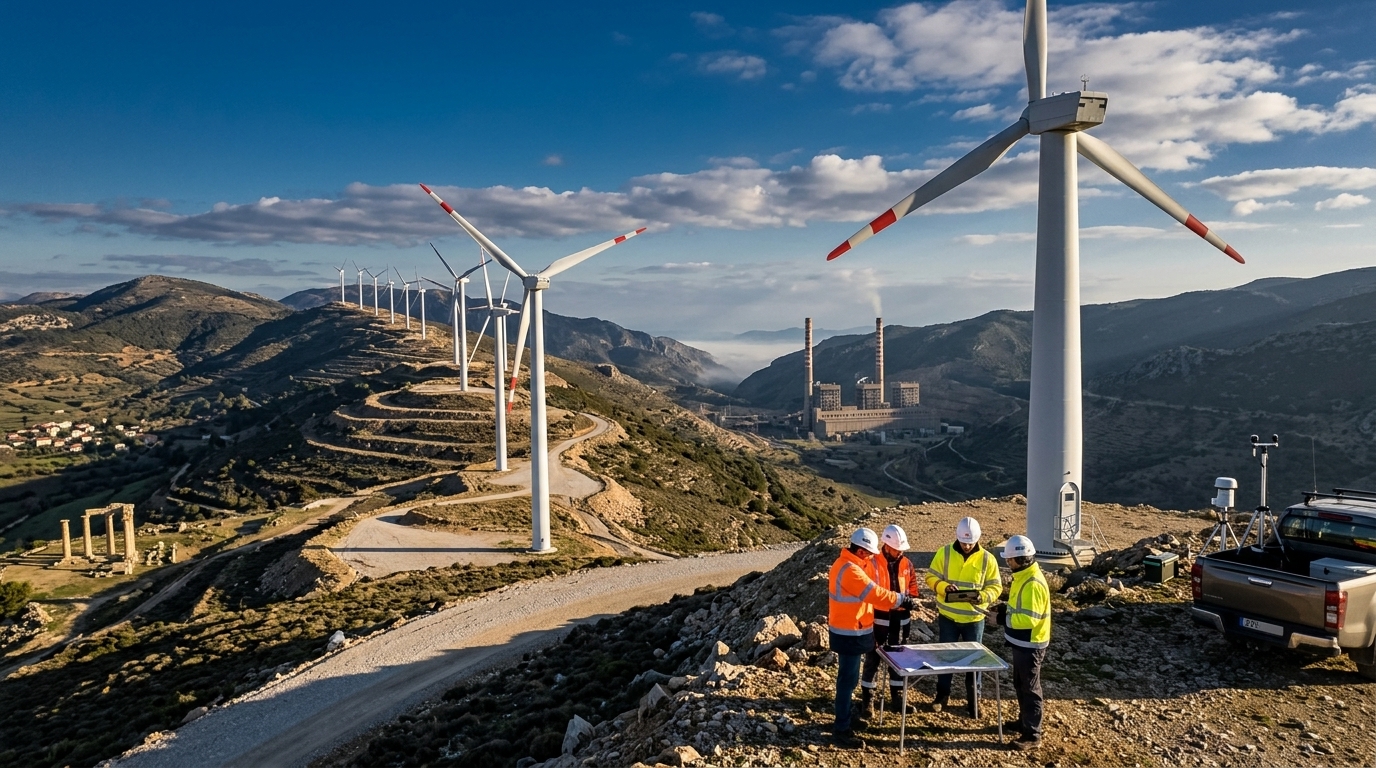
Greece stands at a critical crossroads regarding its energy identity. While the need for rapid decarbonization is urgent, the uncontrolled expansion of Renewable Energy Sources (RES) has sparked intense backlash from local communities and environmental organizations. The new Special Spatial Framework for RES, spearheaded by the Ministry of Environment and Energy, aims to serve as the definitive roadmap to end uncertainty by clearly defining where wind turbines and solar panels can and cannot be installed.
Ending the 'Wild West' of Licensing
For over a decade, RES zoning in Greece relied on an obsolete 2008 framework, which had been overtaken by technological advancements and modern environmental standards. The lack of clear rules led to a deluge of appeals to the Council of State (StE), freezing billions in investments and fostering a climate of suspicion. The new spatial plan seeks to remedy these chronic issues, operating in tandem with strategic frameworks for Tourism and Industry.
The core philosophy of the new plan is 'zonation.' The national territory is divided into priority areas, suitability areas, and, most importantly, exclusion zones. This way, investors know in advance where their applications will be accepted, reducing risk and licensing time, while local communities gain a shield against projects that might alter the character of their regions.
'Red Zones' and Prohibitions
One of the most significant innovations of the new framework is the tightening of criteria for protected areas. Although EU directives allow RES installations in Natura 2000 zones under certain conditions, the Greek Ministry is introducing the concept of 'Untrodden Mountains' (Apatita Vouna) and areas of absolute nature protection, where wind farm installation is now prohibited. Furthermore, strict distance requirements are established from archaeological sites, UNESCO World Heritage monuments, and traditional settlements.
Particular emphasis is placed on protecting high-productivity agricultural land. In the past, thousands of acres of fertile soil were covered by solar panels, raising concerns about food security and the survival of the primary sector. The new spatial plan sets a cap on the coverage percentage for each regional unit and promotes 'agrivoltaics'—systems that allow for simultaneous land cultivation and energy production.
Tourism vs. Energy: The Battle for the Landscape
Perhaps the most thorny issue is the interaction between RES and the country's tourism product. In areas with high tourism development, such as the Cyclades and parts of Crete, the new framework introduces the concept of 'visual nuisance.' It is no longer enough for a project to be far from a hotel; it must not mar the horizon line or the aesthetic of the landscape that serves as the primary attraction for visitors.
On the islands, restrictions are even more stringent. The preferred solution is offshore wind farms, which, although more expensive to construct, move the visual burden away from the coastlines. Simultaneously, incentives are provided for installing RES in degraded areas, such as old quarries or mining zones (e.g., Western Macedonia), to breathe new life into lands that have no other productive use.
Conclusions and Challenges
The new spatial plan for RES is an ambitious undertaking that attempts to square the circle. Its success will be judged in practice, particularly by the speed at which it is integrated into local urban plans. Critics argue that the new restrictions might make it difficult to reach the targets set by the National Energy and Climate Plan (NECP) by 2030. However, the government counters that 'green' growth cannot be sustainable if it is not socially acceptable and environmentally compatible with the unique Greek geography.
- Protection of 'Untrodden Mountains' from wind turbine installations.
- Restriction of solar parks on high-productivity agricultural land.
- Alignment with the Tourism Spatial Plan to prevent visual blight.
- Establishment of clear buffer zones from settlements and heritage sites.
Ultimately, the challenge for Greece is to prove that it can become energy independent without sacrificing its comparative advantage: its unique natural and cultural landscape.