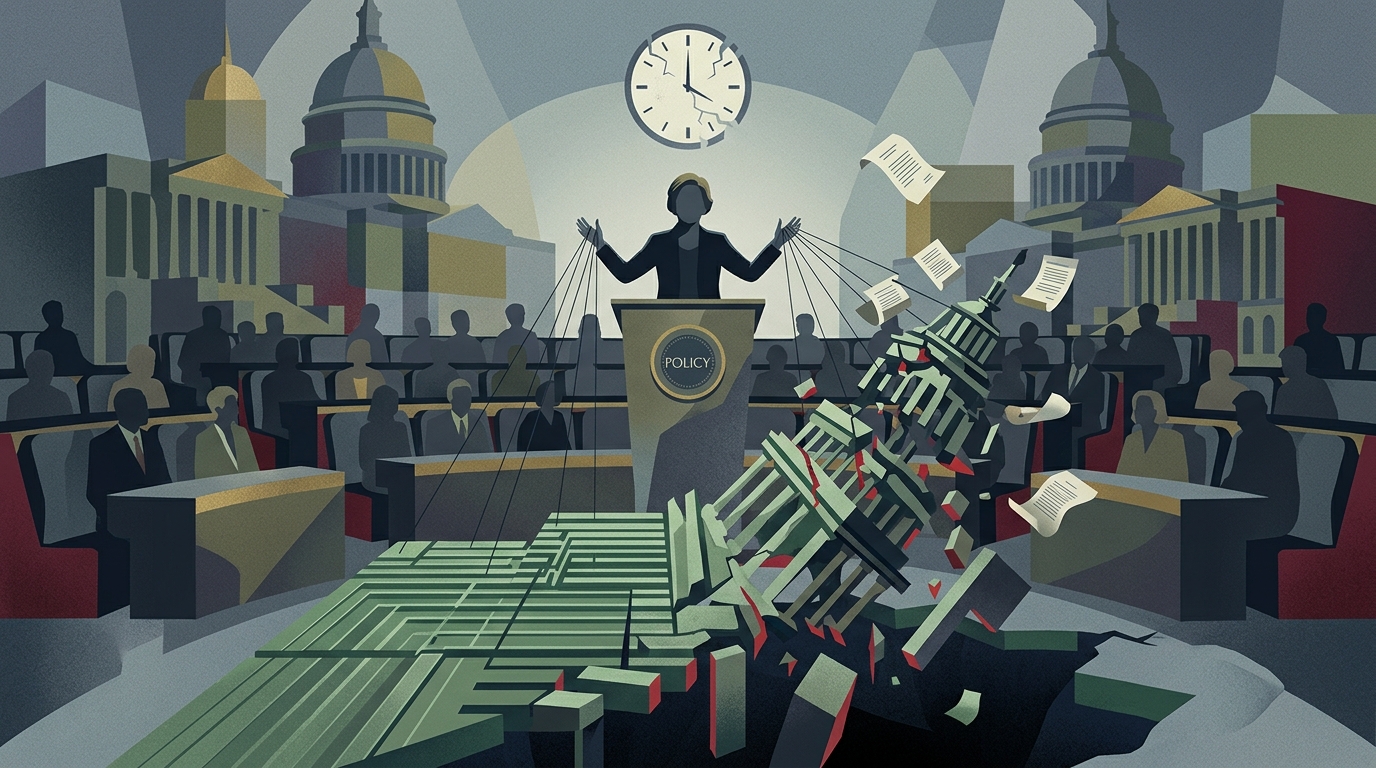
In a speech that sent ripples through Washington’s policy circles, Senator Elizabeth Warren delivered a stark warning: Artificial Intelligence (AI) could be the catalyst for the next global financial meltdown. Speaking at a Vanderbilt Policy Accelerator event on Wednesday, Warren, a longtime critic of corporate consolidation and financial deregulation, drew direct parallels between the current AI frenzy and the lead-up to the 2008 subprime mortgage crisis.
“I know a bubble when I see one,” Warren told the crowd, emphasizing that the “striking similarities” between the pre-2008 era and today's AI market should give everyone pause. Her concerns go beyond simple market speculation; they touch upon the structural integrity of the global financial system and the dangerous concentration of power within a few tech behemoths.
The Anatomy of an AI-Driven Crisis
Warren’s primary thesis is that the financial sector’s rapid and often blind adoption of AI models creates systemic fragility. In 2008, the world was brought to its knees by complex financial instruments—collateralized debt obligations (CDOs)—that were poorly understood and incorrectly rated for risk. Today, Warren argues, the “black box” nature of AI algorithms serves as the modern equivalent of those toxic assets.
Financial institutions are increasingly relying on AI for credit scoring, fraud detection, and high-frequency trading. When these models are trained on biased data or lack transparency, they can create feedback loops that amplify market volatility. If a major AI model fails or exhibits unexpected behavior during a period of stress, it could trigger a synchronized sell-off or a credit freeze, much like the collapse of Lehman Brothers did nearly two decades ago. The lack of accountability in algorithmic decision-making means that when things go wrong, there is no clear entity to hold responsible.
Monopoly Power as a Single Point of Failure
A significant portion of Warren’s critique focused on the concentration of the AI “stack.” A handful of companies—namely Microsoft, Google, Amazon, and Nvidia—control the essential components of AI: the massive datasets, the specialized chips, and the cloud computing infrastructure. This vertical integration allows these giants to act as gatekeepers, potentially stifling innovation while creating massive systemic risks.
- Cloud dependency: If one of the major cloud providers experiences a catastrophic failure, the AI-driven services of thousands of financial firms could vanish instantly.
- Compute scarcity: The reliance on a single hardware provider (Nvidia) creates a bottleneck that makes the entire industry vulnerable to supply chain shocks.
- Data moats: Large incumbents use their access to consumer data to cement their dominance, preventing smaller, potentially more stable competitors from entering the market.
Warren argued that this oligopoly doesn't just harm consumers through higher prices; it creates a “too big to fail” scenario for tech companies. If the infrastructure supporting the AI economy is concentrated in so few hands, a failure at any of these companies becomes a national security and economic emergency.
Regulating the New Frontier
The Senator’s proposed solution is a return to robust antitrust enforcement and the implementation of new consumer protections specifically designed for the AI era. She called for a clear separation between the companies that own the platforms and the companies that operate the services on those platforms—a modern-day Glass-Steagall Act for the tech industry.
“We cannot wait for the crash to happen before we start writing the rules,” Warren asserted. She criticized the “wait and see” approach of some regulators, arguing that by the time the harms of AI are fully realized, the damage to the middle class and the broader economy will be irreversible. Her vision includes mandatory audits of AI models used in finance and strict limits on how big tech companies can leverage their cloud dominance to favor their own AI products.
A Call to Action
As we navigate through 2026, the integration of AI into the fabric of daily life has reached an inflection point. Warren’s intervention is a timely reminder that technological progress is not a substitute for economic stability. While AI offers the potential for immense productivity gains, those gains are hollow if they come at the cost of a fragile financial system that could collapse under its own weight.
“AI holds great promise, but if we leave it in the hands of the few and the unregulated, it will become the tool for the next great economic heist.”
The debate sparked by Warren is likely to intensify as the 2026 election cycle approaches. For now, her message is clear: the lessons of 2008 must not be forgotten. The allure of the new must be balanced with the wisdom of the past, ensuring that the AI revolution builds a more resilient economy, rather than a more efficient house of cards.