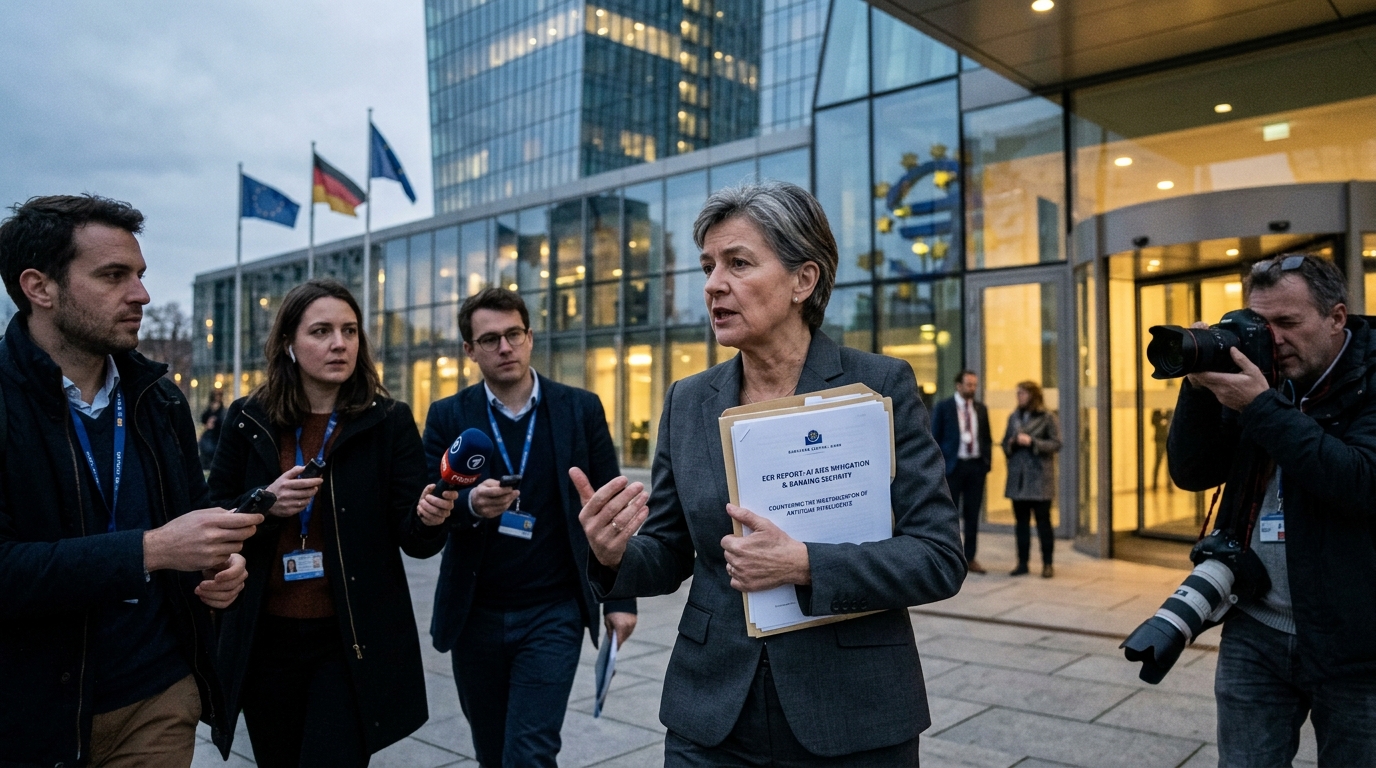
In an era where digital innovation moves at a pace that often outstrips regulatory capacity, the European Central Bank (ECB) has issued a stern warning to the Eurozone’s banking sector. The message is clear: Artificial Intelligence (AI) is no longer merely a productivity tool; it is a potentially devastating weapon in the hands of cybercriminals and state actors with malicious intent. Frankfurt is calling on banks to accelerate their investments in cyber defense before systemic vulnerabilities escalate into a full-blown financial crisis.
The New Generation of Cyber Threats
The ECB’s concern is far from theoretical. The bank’s analysts point out that Large Language Models (LLMs) and Generative AI technologies have dramatically lowered the cost and complexity of launching sophisticated attacks. In the past, a high-level phishing operation required significant time and linguistic precision. Today, AI can generate thousands of personalized, perfectly written messages in any language, making detection by human users nearly impossible.
- Deepfakes and Social Engineering: The use of voice cloning and video manipulation to deceive bank executives into authorizing fraudulent transfers is now a daily reality.
- Automated Vulnerability Research: AI can scan the source code of banking applications for security flaws much faster than any human researcher or traditional scanner.
- Data Poisoning: Malicious data injected into a bank's machine learning models can distort credit scoring, fraud detection, and risk assessment algorithms.
According to the ECB, the velocity at which these threats evolve necessitates a radical rethink of how banks perceive data security. It is no longer a back-office technicality; it is a matter of strategic survival in a hostile digital landscape.
DORA and the ECB's Regulatory Push
The ECB’s warning arrives at a pivotal moment as the EU prepares for the full implementation of the Digital Operational Resilience Act (DORA). DORA mandates strict standards for IT security and incident reporting across the financial sector. However, the ECB argues that mere compliance with regulations is insufficient. Banks must adopt a "proactive stance," utilizing AI defensively to counter AI-driven offenses.
"Technological superiority is no longer optional. Banks that fail to integrate AI into their defensive strategies will soon find themselves at the mercy of attacks they cannot even perceive," a senior supervisory official noted.
The ECB plans to integrate "cyber resilience stress tests" into its regular supervisory cycles. These tests will simulate extreme AI-driven attack scenarios to determine whether a bank can maintain critical operations and protect depositor funds under intense digital duress.
The Legacy System Challenge
One of the most significant hurdles facing European banks is their reliance on legacy IT systems. Many of these infrastructures were designed decades ago, and integrating modern AI security layers is both complex and prohibitively expensive. The ECB is pushing for a faster modernization of this infrastructure, warning that security "patches" will not suffice against algorithmic onslaughts.
Furthermore, there is the issue of third-party concentration risk. As banks migrate to the cloud to access AI capabilities, they become dependent on a handful of global technology giants. A successful breach at one of these providers could potentially paralyze the entire European financial ecosystem, creating a single point of failure that keeps regulators awake at night.
Conclusion: A Perpetual Arms Race
The battle for cybersecurity in the banking sector has transformed into a perpetual technological arms race. While AI offers immense opportunities for enhancing customer experience and operational efficiency, its dark side is equally potent. The ECB’s intervention underscores that trust—the very bedrock of the banking system—now rests on lines of code and the ability of algorithms to distinguish friend from foe in milliseconds. Bolstering Europe’s digital shield is no longer a matter of budget; it is a matter of sovereignty and systemic stability.