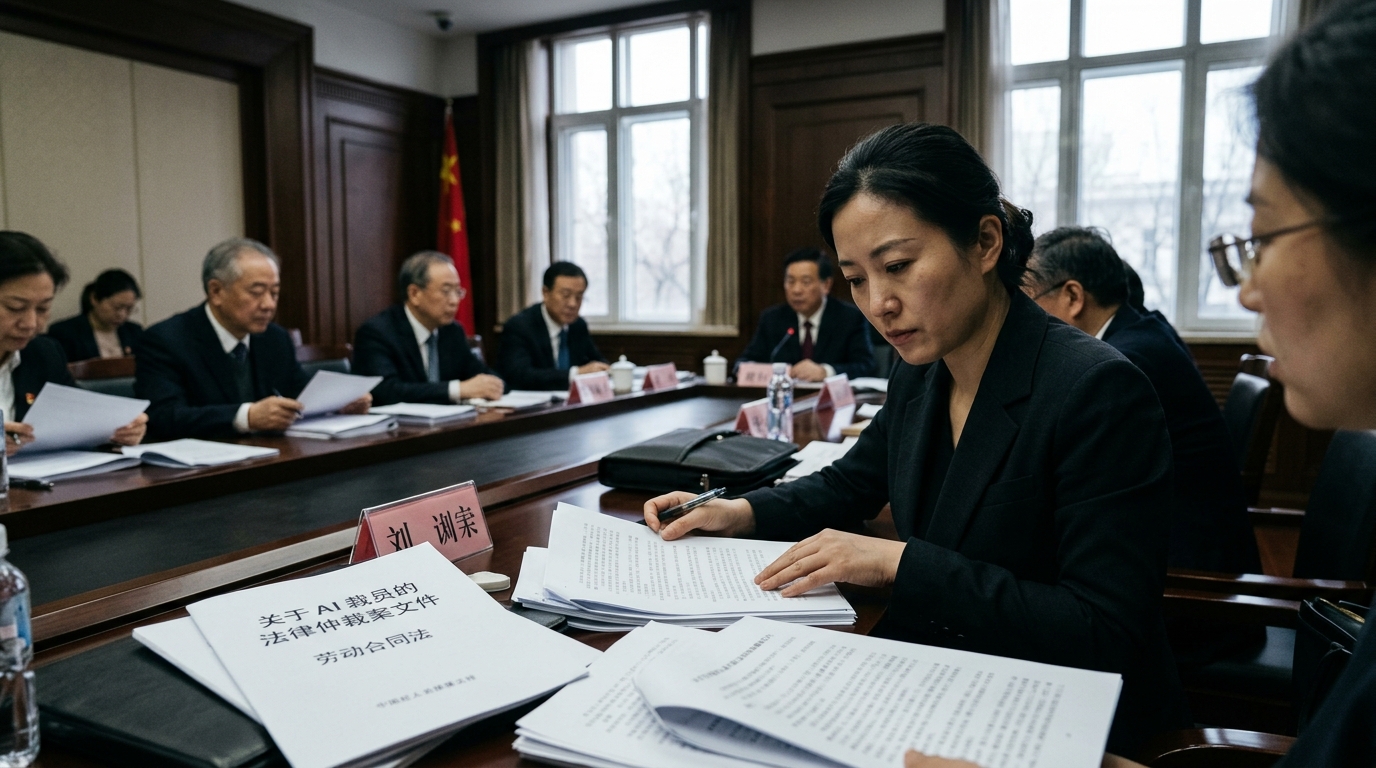
In a sleek office within China’s sprawling tech hubs, a layoff notice arrived not because of a worker’s poor performance or a company’s financial distress, but because of an algorithm’s perceived superiority. The case, recently highlighted by NPR, involves a seasoned tech professional who was let go after his firm determined that his responsibilities could be handled faster and more cost-effectively by Artificial Intelligence. The central question now facing courts, regulators, and labor unions worldwide is both simple and chilling: Is it legal to fire a human being simply because AI can do their job better?
The Legal Grey Zone: 'Objective Circumstances'
China’s Labor Contract Law is generally viewed as worker-friendly, requiring employers to provide specific justifications for termination. Companies can legally dismiss staff due to bankruptcy, major restructuring, or a "major change in the objective circumstances" under which the original contract was signed. The legal battleground is whether the sudden advent of high-functioning Generative AI qualifies as such a "major change."
Legal analysts warn that if courts accept AI as a valid reason for dismissal, it could set a dangerous precedent. "If every technological iteration is viewed as an objective change in circumstances, then no job is safe from summary termination," notes a Beijing-based labor law expert. Conversely, corporations argue that failing to integrate AI would render them uncompetitive, eventually leading to total insolvency and the loss of all remaining jobs.
"This is no longer a theoretical threat of the distant future. It is a reality hitting the middle class—those who believed their education and specialized skills would insulate them from the tides of automation."
China's Tightrope: Innovation vs. Social Stability
The Chinese government is navigating a delicate paradox. On one hand, Beijing is determined to become the world’s preeminent AI superpower by 2030. On the other, the Communist Party is hyper-aware of the social instability that mass unemployment among the educated "white-collar" class could trigger. While China’s 2023 and 2024 AI regulations have focused heavily on content control and ideological alignment, they have remained conspicuously vague regarding labor protections.
- Pressure for extreme efficiency is prompting tech giants to gut departments focused on coding, translation, and graphic design.
- The infamous '996' culture (working 9 am to 9 pm, 6 days a week) is being superseded by a '24/7 AI' paradigm, where humans are viewed as the bottleneck in the production cycle.
- Courts are being asked to determine if employers have a legal mandate to retrain workers before dismissing them—a requirement often bypassed in the rush for digital transformation.
A Global Warning Signal
While this specific legal drama is playing out in Chinese courts, its implications are universal. In the United States, the prevalence of 'at-will' employment makes AI-driven layoffs relatively straightforward, albeit socially contentious. In the European Union, the AI Act attempts to establish ethical guardrails but does not explicitly prohibit the replacement of human staff with automated systems. China, in this instance, serves as the "canary in the coal mine" for the global economy.
The future of work will not only be decided in the R&D labs of Silicon Valley or Shenzhen but in the courtrooms where labor laws are interpreted. If AI is recognized as a legitimate substitute for human labor without significant compensatory frameworks or transition programs, the social contract that governed 20th-century capitalism will effectively dissolve. The urgency for a new framework of "digital labor rights" has never been more pressing.