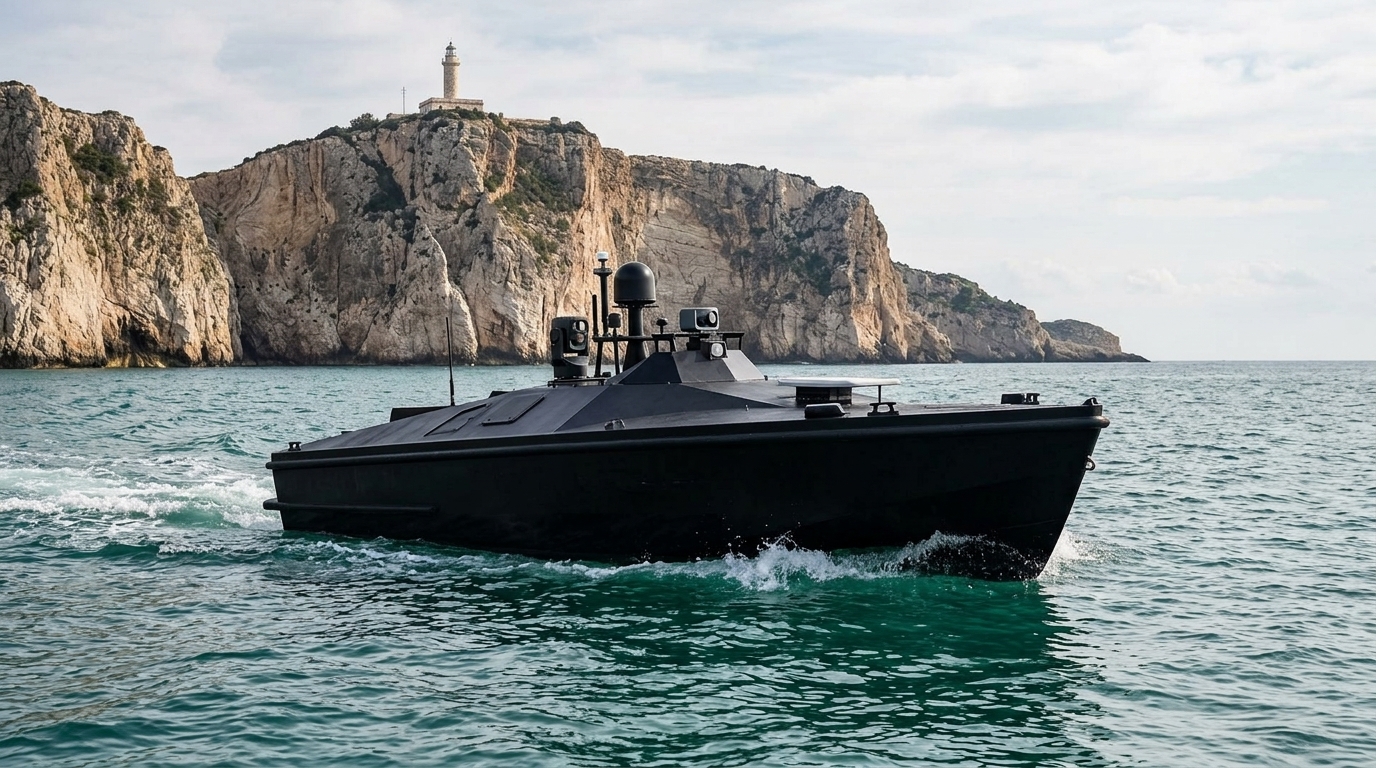
The tranquility of the Ionian Sea was abruptly shattered last week when a discovery reminiscent of a spy thriller came to light at Cape Doukato in Lefkada. A black, high-speed vessel with a futuristic design and no trace of a crew was found hidden inside a sea cave. The fact that its engine was still running while the boat remained stationary and 'deserted' added an eerie dimension to the incident, prompting immediate mobilization of the Coast Guard and security services.
This incident is not merely a piece of local news but a loud reminder that Unmanned Surface Vessel (USV) technology has escaped the narrow confines of battlefields like the Black Sea and is now roaming freely across the Mediterranean's tourist and commercial routes. The appearance of such a 'ghost drone' in a strategically important area like the Ionian opens a Pandora's box regarding its origin, purpose, and, most importantly, the ability of national authorities to detect and intercept such threats.
Technical Characteristics and Potential Origin
Initial reports describe a low-profile vessel designed with stealth technology to evade radar detection. Its black color and aerodynamic lines point directly to the sea drones used in modern conflicts for reconnaissance or suicide missions. However, the absence of markings or serial numbers makes identification extremely difficult.
Experts are considering three main scenarios. The first involves its use by criminal organizations. With advancements in AI and autonomous navigation, drug cartels or human trafficking networks can now use USVs to transport cargo without risking the arrest of their members. The second scenario concerns a military exercise or surveillance operation by a foreign power that 'lost' control of the vessel due to technical failure or jamming. The third, and perhaps most concerning, is the possibility that the vessel is part of a broader 'grey' surveillance network operating in Greek territorial waters without authorization.
The Challenge to National Security
The discovery in Lefkada highlights a critical gap in the security system. If a vessel of such technology can reach the caves of Cape Doukato undetected until it is accidentally found by citizens or local authorities, what else might be moving under the radar? The Mediterranean is becoming a field where 'invisible' technology tests the limits of state mechanisms.
The use of satellite systems like Starlink to control these vessels from thousands of miles away means the operator could be anywhere in the world. This decoupling of geographical location and action makes accountability almost impossible. The Coast Guard is now called upon to evolve into a force that polices not just humans, but also algorithms navigating our seas.
Conclusion: The Need for a 'Digital Coast Guard'
The Lefkada mystery must serve as the catalyst for a radical overhaul of maritime surveillance. Traditional radar and patrols are no longer enough. The integration of counter-drone systems (C-UAS) and the use of AI to analyze anomalies in maritime traffic are required. The 'quiet' of the Ionian is no longer guaranteed. As autonomous systems become more accessible and sophisticated, the protection of national sovereignty will increasingly be decided on the digital horizon, where the 'ghost' of Lefkada left its mark.