May 1, 2026, marks the official start of a fire season that finds Greece at a critical crossroads. After years of painful lessons from devastating wildfires, this year's strategy no longer relies solely on the heroic efforts of firefighters on the ground but on a digital safety net aiming to minimize response times. The government and the Ministry of Climate Crisis and Civil Protection are fully operationalizing the "Aegis" program, integrating cutting-edge technologies that radically change the firefighting doctrine.
The Digital Shield: 100 Drones in Constant Surveillance
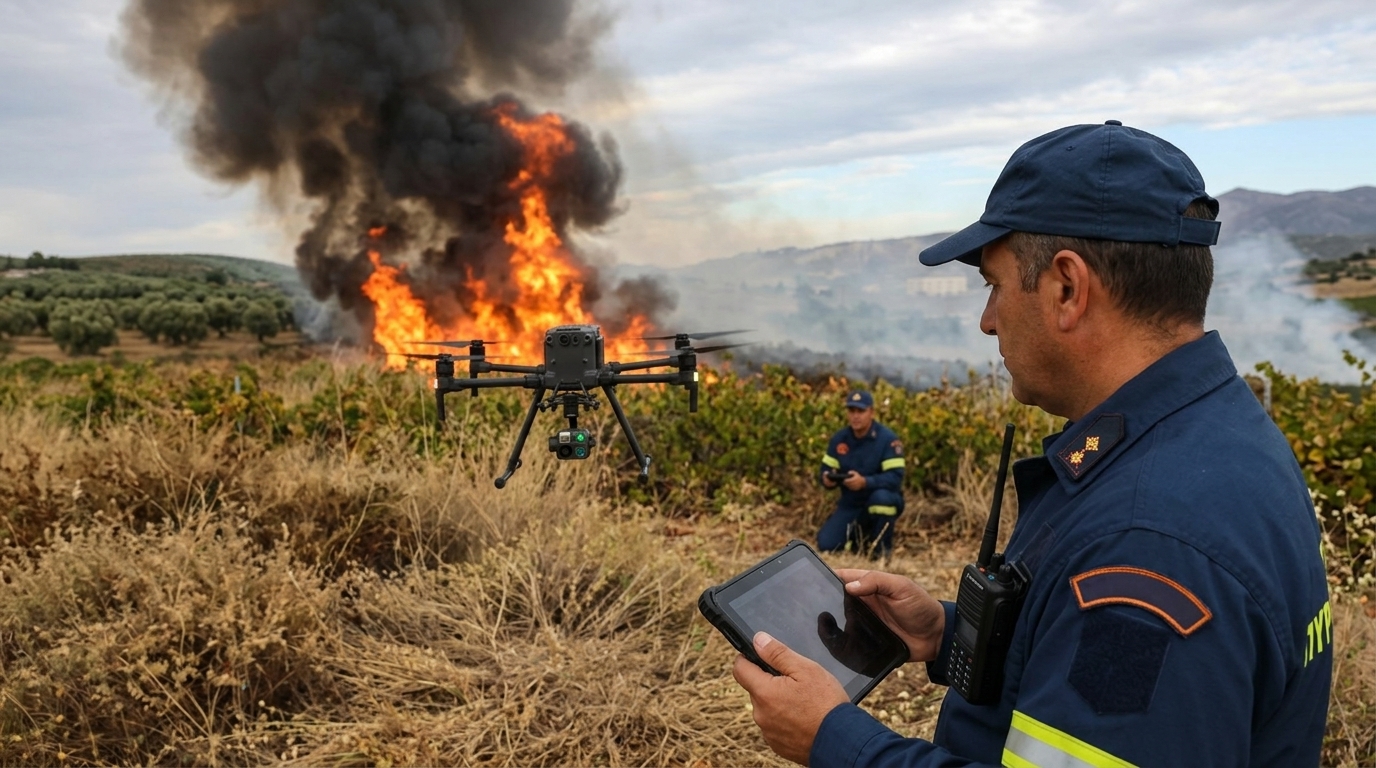
The most significant innovation for 2026 is the deployment of a fleet of 100 state-of-the-art drones, which will patrol the country's most dangerous forest areas, focusing on Attica, Evia, and the Peloponnese. These unmanned aerial vehicles are not just cameras in the sky; they are equipped with thermal sensors and Artificial Intelligence (AI) systems capable of detecting a smoke plume or a sharp rise in temperature within a radius of several kilometers, even during the night.
- Real-time Transmission: Images are transmitted instantly to the Unified Coordination Center for Operations and Crisis Management (ESKEDIK).
- Autonomous Flight: Drones perform pre-programmed routes based on risk indices.
- Data Analysis: Specialized algorithms predict fire direction based on wind and fuel load.
"Technology allows us to see the invisible. Our goal for 2026 is to detect a fire within the first five minutes, when suppression is still feasible with limited resources," sources from Civil Protection state.
Risk Mapping and Prevention
Beyond suppression, this year's season places an unprecedented emphasis on prevention through detailed risk mapping. Using satellite data from the Copernicus system and historical data from the last 20 years, "dynamic maps" have been created that are updated hourly. These maps take into account vegetation moisture, local microclimatic conditions, and topography, allowing forces to be pre-positioned in high-risk areas before the first spark even occurs.
At the same time, the mandatory clearing of private plots has reached a new level of strictness. The digital platform for declaring plot cleaning, linked to the Land Registry (Ktimatologio), allows for automatic monitoring and the imposition of fines on those who neglect their obligations. Inspections this year will be intensive, with the assistance of local authorities and the use of aerial photography to verify declarations.
The Challenge of Climate Crisis and Human Capital
Despite the technological superiority, the challenges remains immense. The Mediterranean is considered "ground zero" for climate change in Europe, with drought periods lengthening and heatwaves becoming more frequent and intense. Technology is the force multiplier, but the backbone of the operation remains human. For 2026, the Fire Service has been reinforced with new hires of forest firefighters and specialized units (EMODE), while cooperation with volunteers has been standardized through new training protocols.
The success of this year's season will be judged by speed and coordination. The integration of 100 drones is just the beginning of a new era where information is as vital as water in the battle against forest fires. Society, for its part, is called upon to demonstrate individual responsibility, as the majority of fires are still caused by human negligence or arson.