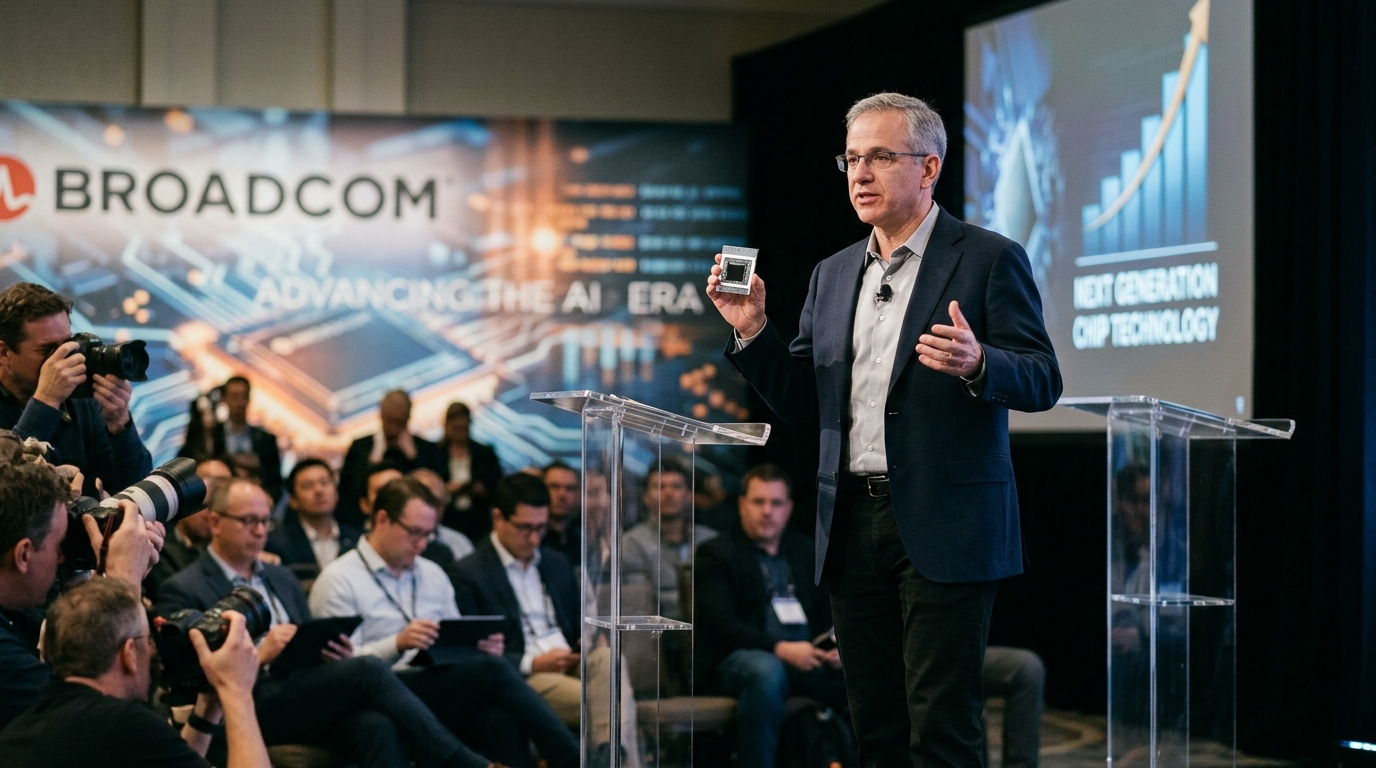
In today's global technological landscape, the term "semiconductors" no longer refers merely to computer components, but to the "digital fuel" powering the Artificial Intelligence (AI) revolution. As we move through the first half of 2026, the attention of investors and analysts has shifted from the undisputed leader, Nvidia, to the next candidate poised to break the one-trillion-dollar market capitalization barrier. All signs point to a "quiet giant": Broadcom (AVGO).
Broadcom is not a new player on the stage, but the way it has restructured its portfolio makes it unique. While Nvidia dominates Graphics Processing Units (GPUs), Broadcom has managed to become the indispensable partner for "Hyperscalers"—giants like Google, Meta, and Amazon—who wish to design their own custom AI chips (ASICs). This shift toward custom silicon is the key to its stock's explosive rise.
The Custom Silicon Strategy (ASICs)
Broadcom's dominance is built on its ability to turn its customers' visions into reality. As the cost of Nvidia's GPUs remains sky-high, big tech companies are looking for ways to reduce dependency and optimize energy consumption in their data centers. This is where Broadcom steps in, providing the intellectual property and expertise to create specialized AI accelerators.
According to recent analyses, the company's AI-related revenue is expected to exceed $12 billion this year, a surge fueled by the demand for custom XPUs. Broadcom does not compete directly with Nvidia for the general public; instead, it builds deep, long-term relationships with the few players who control 80% of the world's cloud infrastructure.
Networking: The Invisible Backbone of AI
Many overlook the fact that AI requires not just raw processing power, but also lightning-fast data transfer. Without advanced networking, thousands of GPUs in a data center cannot collaborate effectively. Broadcom holds a leading position in Ethernet switches with its Tomahawk and Jericho series, which are essential for interconnecting AI clusters.
The transition to 800G and soon 1.6T networking gives Broadcom a technological lead that its competitors struggle to follow. The integration of optical interconnects directly onto the chips (co-packaged optics) is the next big goal, and Broadcom is already at the forefront of this innovation, drastically reducing energy consumption in data centers.
The VMware Acquisition and Software Synergy
Another pillar pushing Broadcom toward the trillion-dollar mark is the successful integration of VMware. Despite initial concerns regarding the acquisition cost, Broadcom has managed to transition VMware's model to a subscription-based one, ensuring steady and predictable revenue streams. This blend of hardware and software creates a business with profit margins envied even by the most successful Silicon Valley firms.
CEO Hock Tan's strategy of focusing on critical infrastructure that customers cannot easily abandon is paying off. VMware provides the operating system for the hybrid cloud, allowing businesses to run AI workloads both on-premise and in the cloud, utilizing Broadcom technology at every level of the stack.
Challenges and Geopolitical Risks
Of course, the road to a trillion is not without obstacles. The reliance on TSMC for chip manufacturing remains a significant risk, given the geopolitical tensions in Taiwan. Furthermore, competition from Marvell Technology and Nvidia's own attempts to enter the custom chip market could pressure profit margins.
However, Broadcom's financial discipline and its ability to generate massive free cash flow allow it to continuously invest in R&D, staying one step ahead. For Wall Street analysts, it is no longer a matter of "if," but "when" Broadcom will join the elite of the global economy.