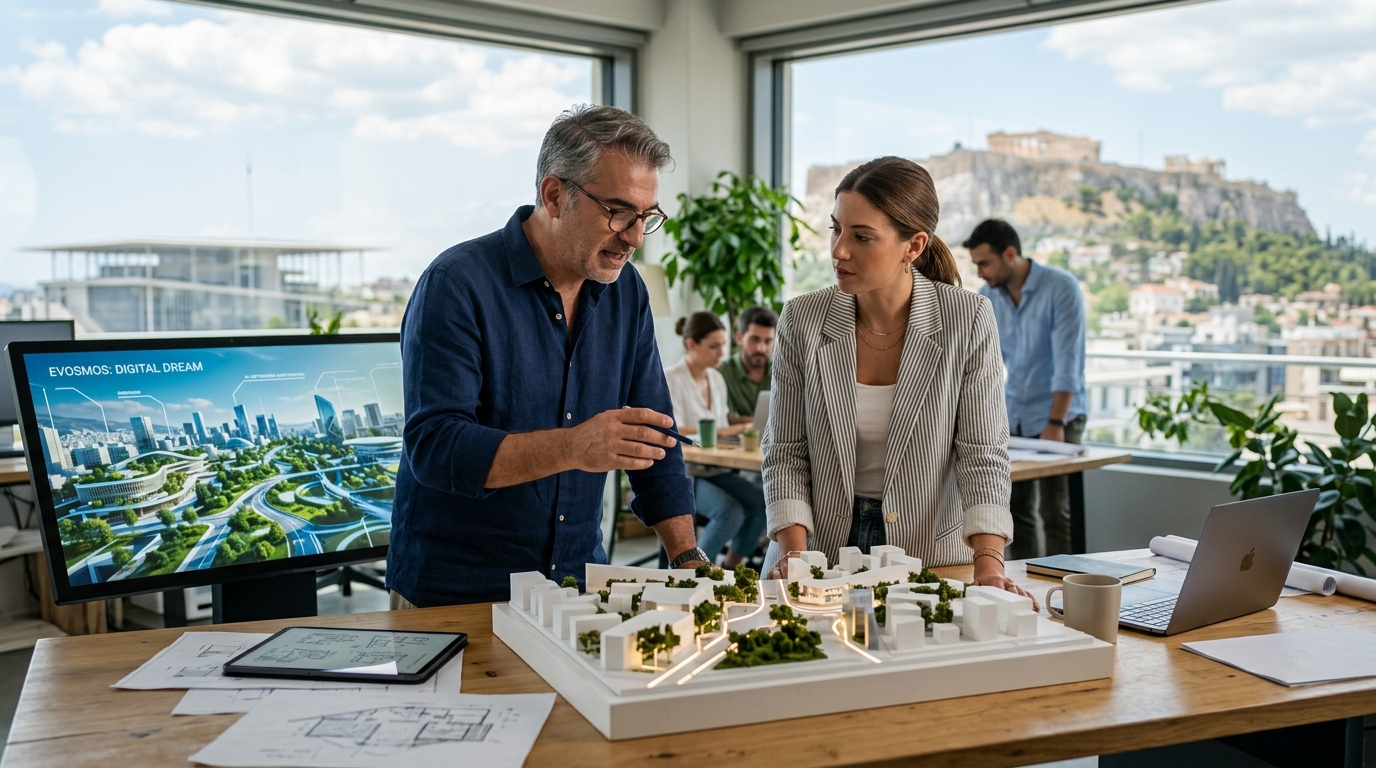
In the heart of Western Thessaloniki, where urban density meets industrial heritage, a new digital narrative is beginning to take shape. Evosmos, an area traditionally associated with the challenges of unplanned construction and a lack of green spaces, recently became the subject of an impressive visualization experiment using Artificial Intelligence. The images released by ERT are not merely 'photographs from the future'; they represent a challenge to our collective imagination and a testament to the power of Generative AI tools to redefine our relationship with public space.
The Aesthetics of Change: From Concrete to Greenery
The use of Artificial Intelligence for urban planning and regeneration is no longer a science fiction scenario. In the case of Evosmos, algorithms were fed data from the current state of the district and asked to 'imagine' a version of the city dominated by bioclimatic design. The result is striking: streets currently choked by exhaust fumes are transformed into lush pedestrian walkways, apartment facades are covered in vertical gardens, and squares take on a futuristic yet human-friendly form.
This visualization process serves a dual purpose. First, it acts as a powerful communication tool for local government, allowing citizens to 'see' the vision before construction even begins. Second, AI can analyze environmental data—such as wind patterns and solar radiation—to suggest optimal solutions that mitigate the urban heat island effect, a problem particularly acute in Thessaloniki's western districts.
Western Thessaloniki and the Digital Divide
For decades, Evosmos and Kordelio have lived in the shadow of the development seen in Eastern Thessaloniki. Introducing AI into the public discourse regarding the future of these areas is a symbolic move toward modernization. However, any analysis must go deeper than the surface. Residents of Evosmos, facing daily issues such as industrial odors from nearby refineries and inadequate public transport, approach these images with a mix of hope and skepticism.
- AI visualization helps in understanding the scale of necessary interventions.
- It enhances participatory democracy, as citizens can comment on specific visual scenarios.
- It highlights the urgent need for action regarding tree planting and open spaces.
AI does not just design buildings; it designs expectations. When a resident sees their neighborhood transformed into a 'smart city,' the pressure on political leadership to deliver projects increases. This is the so-called 'democratic advantage' of technology: its ability to make an invisible future visible and demandable.
From Pixels to Pavement: The Implementation Challenges
Despite the beauty of AI renders, the transition from a digital model to actual asphalt remains a labyrinthine process. Urban studies, land expropriations, and securing funding from the Recovery and Resilience Facility (RRF) or NSRF are the real hurdles. AI can suggest the demolition of a block to create a park in seconds, but bureaucracy and property rights require years of consultation.
"Artificial Intelligence is the mirror of what we could be if we had the courage to redesign our cities from scratch," say experts in the field of Smart City planning.
In conclusion, the initiative to visualize the future of Evosmos through AI is a reminder that technology is not just about data centers and code, but about the quality of our lives. If we manage to bridge the gap between digital utopia and urban reality, then Western Thessaloniki could become the blueprint for the 21st-century Greek city.