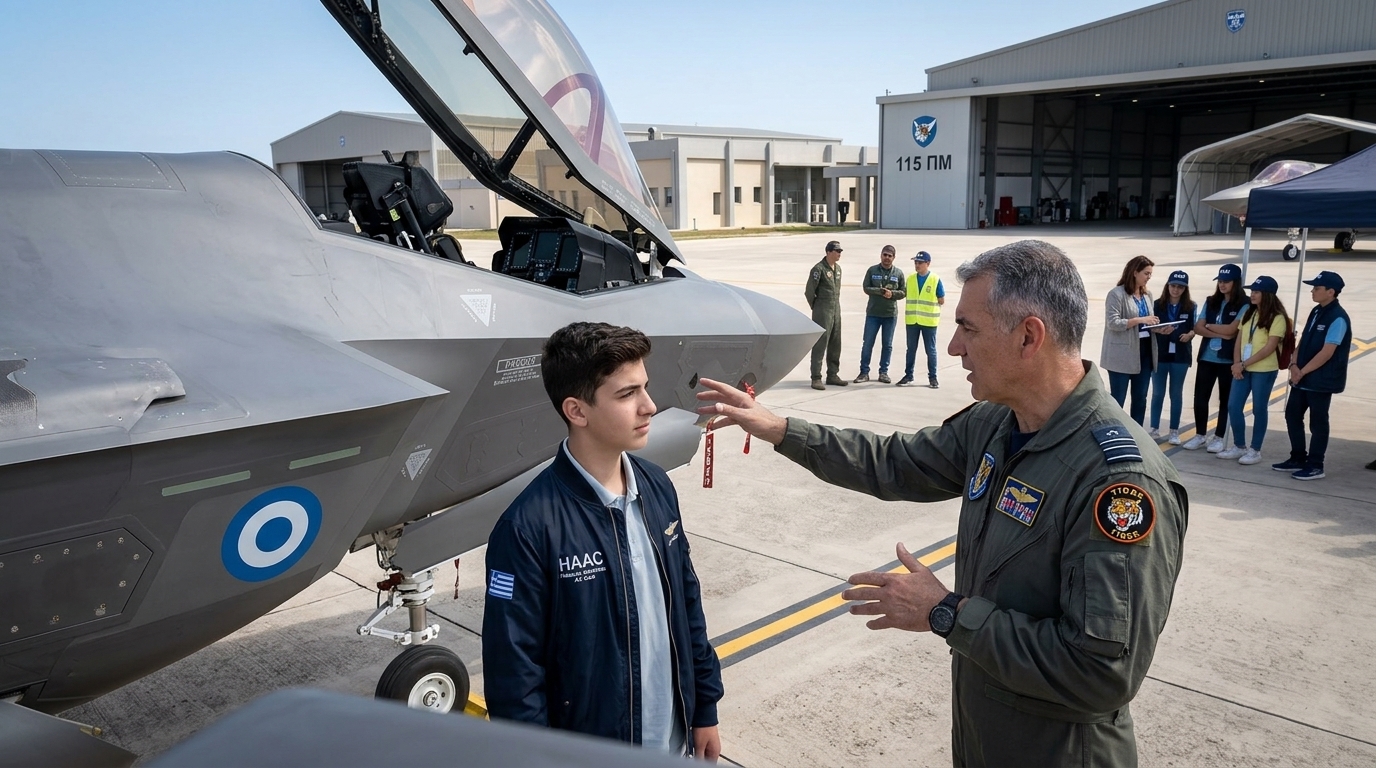
In the heart of Crete, where the strategic importance of the Mediterranean meets the historic tradition of Greek aviation, a new initiative by the Hellenic Air Force (HAF) General Staff is attempting to reshape the relationship between citizens—and especially the youth—and the armed forces. The 'We Come to You!' program, hosted in Chania, is far more than a public relations event. It is a deeply symbolic and technologically advanced effort to transfer the complexity and prestige of modern aviation from the closed hangars of military bases into the daily lives of children.
Technology as a Bridge: From the F-16 to the F-35
The initiative focuses on the use of flight simulators and virtual reality (VR) technologies, allowing students and young people to sit in the 'digital cockpit' of the fighter jets that form the backbone of Greek deterrence. The choice of Chania is no coincidence. The 115 Combat Wing, based there, is one of the most critical formations of the Hellenic Air Force, hosting the advanced F-16 Block 52+ and preparing the ground for the future arrival of the F-35 Lightning II.
Young visitors have the opportunity to experience flying fifth-generation aircraft. The F-35, a jet that currently defines global aerial warfare, is presented to children not as a cold instrument of war, but as a marvel of engineering and computer science. Through the simulators, teenagers understand that a modern pilot is simultaneously a data manager and a high-performance athlete. This process helps demystify military technology, making it accessible and attractive as a potential career path.
The Strategy of 'Soft Power' and Souda Bay
The 'We Come to You!' program is part of a broader strategy of extroversion. In an era where geopolitical challenges in the Eastern Mediterranean are mounting, the Air Force seeks to strengthen its social foundations. Souda Bay and Chania are at the epicenter of Greece-US defense cooperation, and the contact of the local community with air force activities acts as a catalyst for the acceptance and support of national defense planning.
- Boosting interest in STEM fields (Science, Technology, Engineering, Mathematics).
- Promoting aviation ideals and national awareness.
- Providing information on career prospects within the armed forces beyond the cockpit (technicians, programmers, analysts).
The participation of children in such activities also serves as an informal vocational guidance program. The Hellenic Air Force, recognizing the need for specialized personnel to handle the systems of the future, is investing in 'sowing' interest from a school age. As HAF officials note, technological superiority is not ensured solely by metal and software, but by the quality and passion of the people who will man them.
The Challenge of the Digital Age
In the past, public contact with the air force was limited to parades or the celebrations of the Patron Saint of the Air Force, Archangel Michael. Today, the use of social media and interactive applications is changing the game. The children who today 'fly' digitally over the Aegean in Chania are the generation that will be called upon to manage artificial intelligence and unmanned aerial vehicles (UAVs) in a decade. The Air Force is aware of this and is adapting its language accordingly.
"Aviation is not just about flying; it is about science, discipline, and, above all, service to the country," stated one of the instructors participating in the program.
In conclusion, the initiative in Chania is a successful example of how a traditionally conservative institution, such as the armed forces, can use cutting-edge technology to communicate with the younger generation. In a city that lives and breathes with the sound of jet engines, allowing children to become 'pilots for a day' is a move that builds trust, dreams, and ultimately, a stronger national defense based on knowledge.