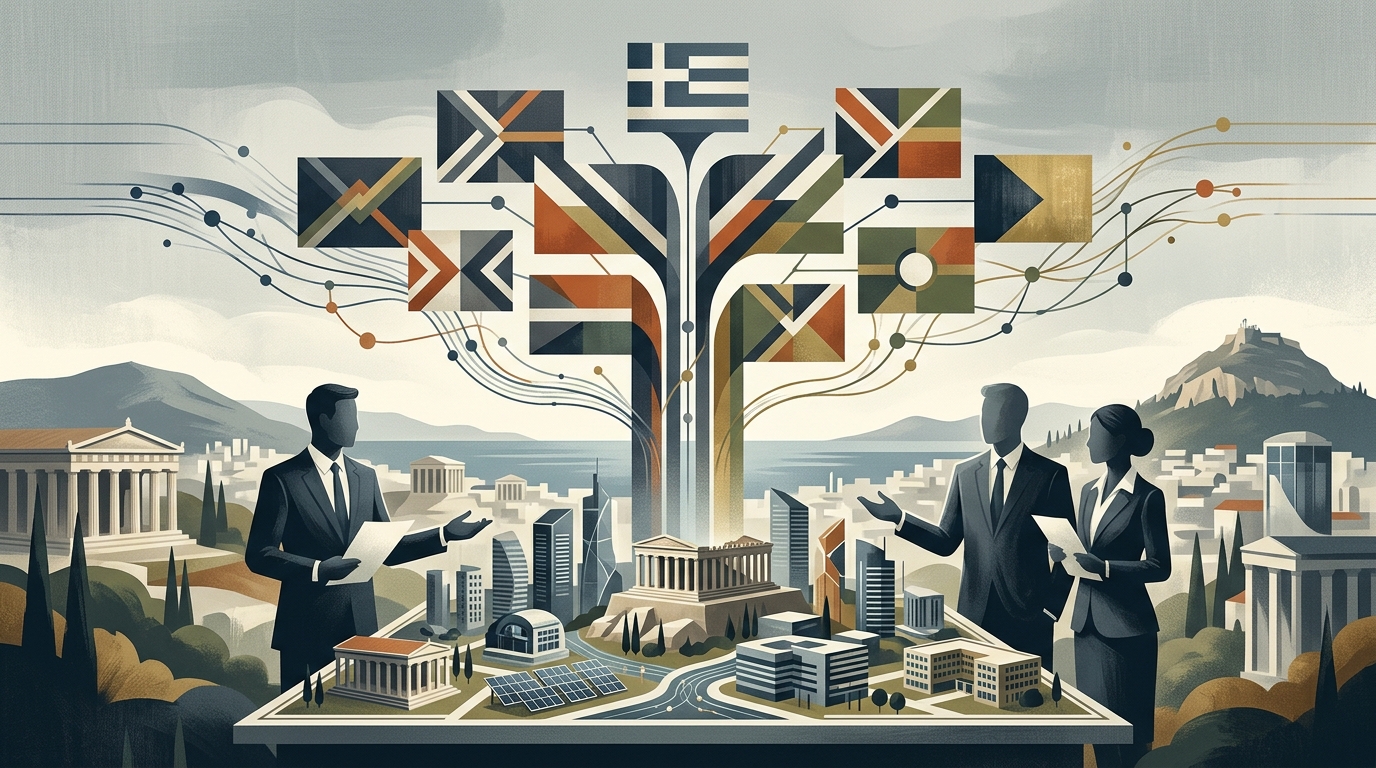
The Greek political landscape stands at a critical juncture, as recent analyses from international media outlets, most notably Bloomberg, highlight a structural shift threatening to overturn the status quo of the last few years. The traditional pursuit of a "single-party majority" (autodynamia), which has been the cornerstone of the New Democracy government, appears to be receding in the face of a highly fragmented political environment where at least 12 parties are making significant claims on public discourse and the ballot box.
Fragmentation as the New Normal
According to Bloomberg's report, Greece is entering a phase of "political liquidity" that strongly echoes the crisis years, albeit with different qualitative characteristics. The emergence of new formations is not merely a reaction to economic pressure but a manifestation of deeper dissatisfaction and a search for new representatives. The article emphasizes that the existence of 12 parties makes forming a single-party government nearly impossible under current polling data, forcing the political system to confront the prospect of coalitions—a culture that has historically struggled to take root in Greece.
The analysis focuses on the fact that Kyriakos Mitsotakis's dominance, while still strong in terms of personal popularity compared to his rivals, is being eroded by daily struggles, inflation, and unresolved judicial issues. The splintering of votes to both the right and left of New Democracy creates a "political minefield" for the next electoral cycle.
The Tsipras Factor and Center-Left Realignment
Special mention is made of Alexis Tsipras's return through a new political vehicle. Bloomberg notes that the former Prime Minister is attempting to capitalize on the leadership vacuum in the broader left and SYRIZA's inability to recover following its internal upheavals. Tsipras's move is described as a gamble on the "return of the mature leader," seeking to represent a progressive front against the conservative establishment.
However, the analysis points out that competition with PASOK remains a major obstacle. PASOK, under Nikos Androulakis, is trying to establish itself as the main opposition pole, but the entry of Tsipras's new party complicates the mathematical calculations for the center-left, leading to further division of the forces that could potentially challenge New Democracy.
Maria Karystianou: The Moral Variable
One of the most intriguing aspects of Bloomberg's analysis is the reference to Maria Karystianou. Her presence on the political stage, though she has not expressed traditional partisan ambitions in the usual sense, acts as a catalyst. The report highlights that the Tempi train tragedy remains an "open wound" for Greek society, and Karystianou has managed to transform personal grief into a political movement for transparency and justice.
Her influence on undecided voters and her ability to mobilize citizens across party lines is considered an "unpredictable factor" that could boost smaller parties or lead to high abstention rates from traditional players. For Bloomberg, the Karystianou case symbolizes the demand for a "different kind of politics," more human-centric and less transactional.
Implications for Markets and the Economy
As a financial news outlet, Bloomberg does not fail to examine the implications of this political instability on the Greek economy. Greece, having recently regained its investment-grade status, relies on political stability to continue attracting foreign capital. The prospect of prolonged negotiations for government formation or, worse, repeat elections, is causing jitters among investors.
- Uncertainty could lead to an increase in borrowing costs.
- Reforms required by the Recovery and Resilience Fund may be delayed.
- Market confidence in Greek fiscal discipline is being put to the test.
In conclusion, Bloomberg's analysis sounds the alarm for the end of the "golden era" of single-party governments in Greece. The day after the elections appears set to demand compromise, maturity, and a new approach to governance in an environment where the plurality of 12 parties will be the new reality.