The history of technology is often depicted as a linear progression from primitive stone tools to the complex digital ecosystems of the 21st century. However, one object exists that shatters this narrative, reminding us that humanity reached a pinnacle of scientific sophistication far earlier than we once dared to imagine. The Antikythera Mechanism, the world's oldest analog computer, is no longer just a corroded relic behind glass. Thanks to the Kotsanas Museum of Ancient Greek Technology, this marvel has been brought back to life through a fully functional, handmade replica that reveals the true genius of Hellenistic engineering.
Engineering the Impossible: The Revival of a Masterpiece
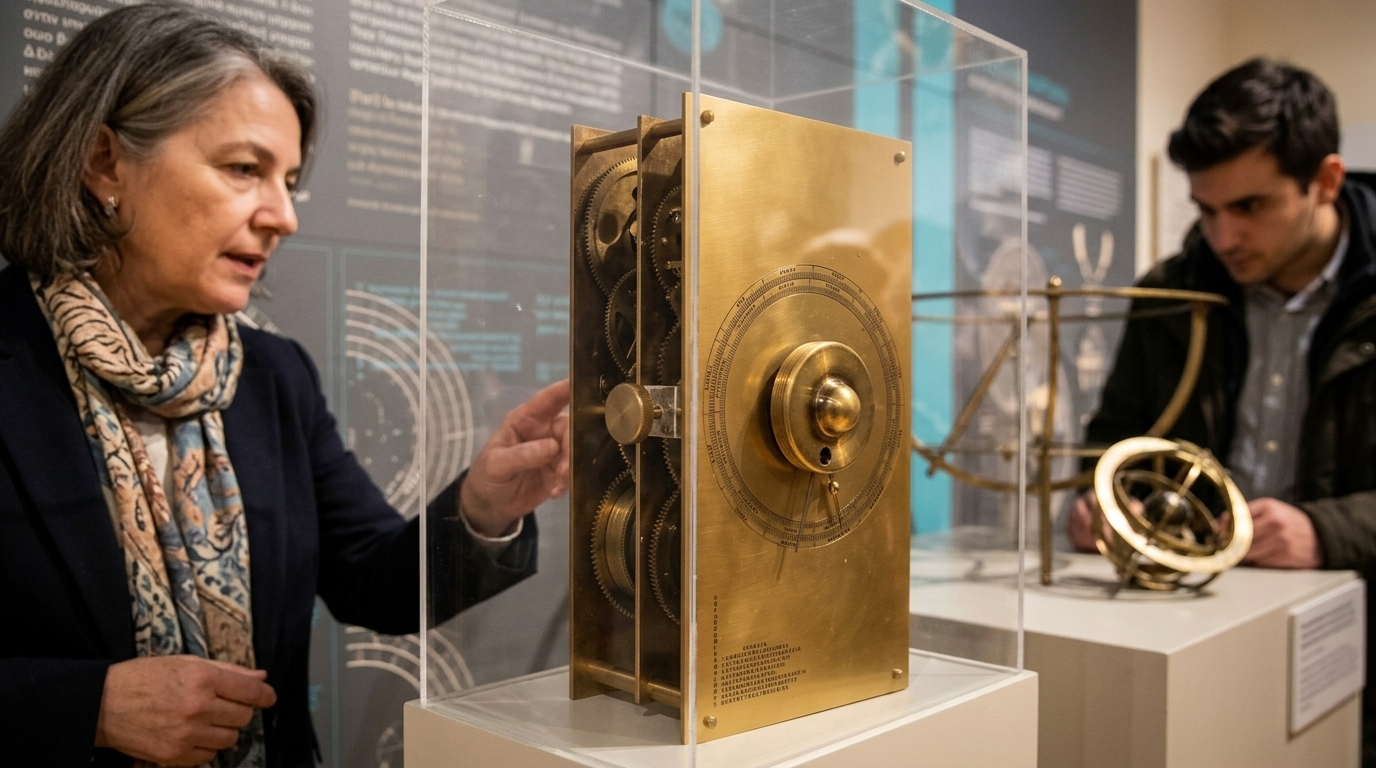
The project undertaken by the Kotsanas Museum is far more than a mere visual reconstruction; it is an act of historical and mechanical justice. For decades, the Antikythera Mechanism remained an enigma locked within oxidized fragments of bronze. Creating a fully functional replica required a profound synthesis of ancient astronomy, mathematics, and metallurgy. The replica now on display—and available for the public to acquire—allows visitors to witness how over 30 interlocking gears worked with split-second precision to predict solar and lunar eclipses, planetary movements, and the dates of the Panhellenic Games.
The construction of this replica was guided by the latest tomographic research and data gathered by the international scientific community. Using bronze and traditional engraving techniques for the scales, the museum has recreated the tactile reality of an instrument that, 2,100 years ago, represented the cutting edge of global technology. It serves as a potent reminder that the ancient Greeks were not only masters of philosophy and art but also peerless engineers capable of encapsulating the cosmos within a portable wooden case.
The First Analog Computer: A Tool for Society
The Antikythera Mechanism was not a mere curiosity for the elite; it was a sophisticated social tool. By tracking the Metonic and Saros cycles, the mechanism could synchronize solar and lunar calendars, enabling city-states to schedule agricultural cycles, religious festivals, and political assemblies with unprecedented accuracy. Its ability to predict eclipses with such precision gave science a near-divine authority, while the inclusion of the Olympic Games cycle highlights the device's role in the social and cultural cohesion of the Greek world.
At the Kotsanas Museum, this functionality is presented with educational clarity. Visitors can observe the differential motion of the pointers—a technological feat that was effectively 'lost' for over 1,500 years, only reappearing in Western Europe during the 16th century with the advent of complex astronomical clocks. This technological 'gap' remains one of history's greatest mysteries. One cannot help but wonder how the trajectory of human civilization might have changed had the knowledge embedded in the Antikythera Mechanism not been lost to the depths of the Aegean for two millennia.
Cultural Heritage as a Driver of Innovation
Kostas Kotsanas’s initiative to establish a museum dedicated solely to ancient Greek technology is a benchmark for cultural heritage management. At a time when Greece is seeking to diversify its tourism sector, highlighting the nation's scientific legacy offers a fresh and compelling perspective. The Antikythera Mechanism stands as the ultimate symbol of this endeavor.
- Promoting scientific literacy through archaeological discovery.
- Enhancing cultural tourism by focusing on innovation and STEM history.
- Highlighting the continuity of Greek intellectual inquiry from antiquity to the present.
The availability of a fully functional replica for acquisition opens new avenues for disseminating this knowledge globally. It is not merely a souvenir; it is a piece of living history suitable for universities, libraries, or private collections, carrying the message of Greek ingenuity to every corner of the world. It bridges the gap between the 'abstract' beauty of ancient ruins and the 'practical' brilliance of ancient machines.
The Future of Discovery
While the Kotsanas Museum’s replica represents a milestone, the research into the Antikythera Mechanism is far from over. Ongoing underwater excavations at the original shipwreck site continue to yield fragments that may one day complete our understanding of the device's full structure. However, the functional recreation allows us to grasp the 'why' behind its creation: humanity's relentless drive to understand the universe and master it through logic and mathematics. The Antikythera Mechanism remains the eternal ambassador of an era where science and art were inextricably linked, a testament to the fact that the digital age has deep, bronze roots.