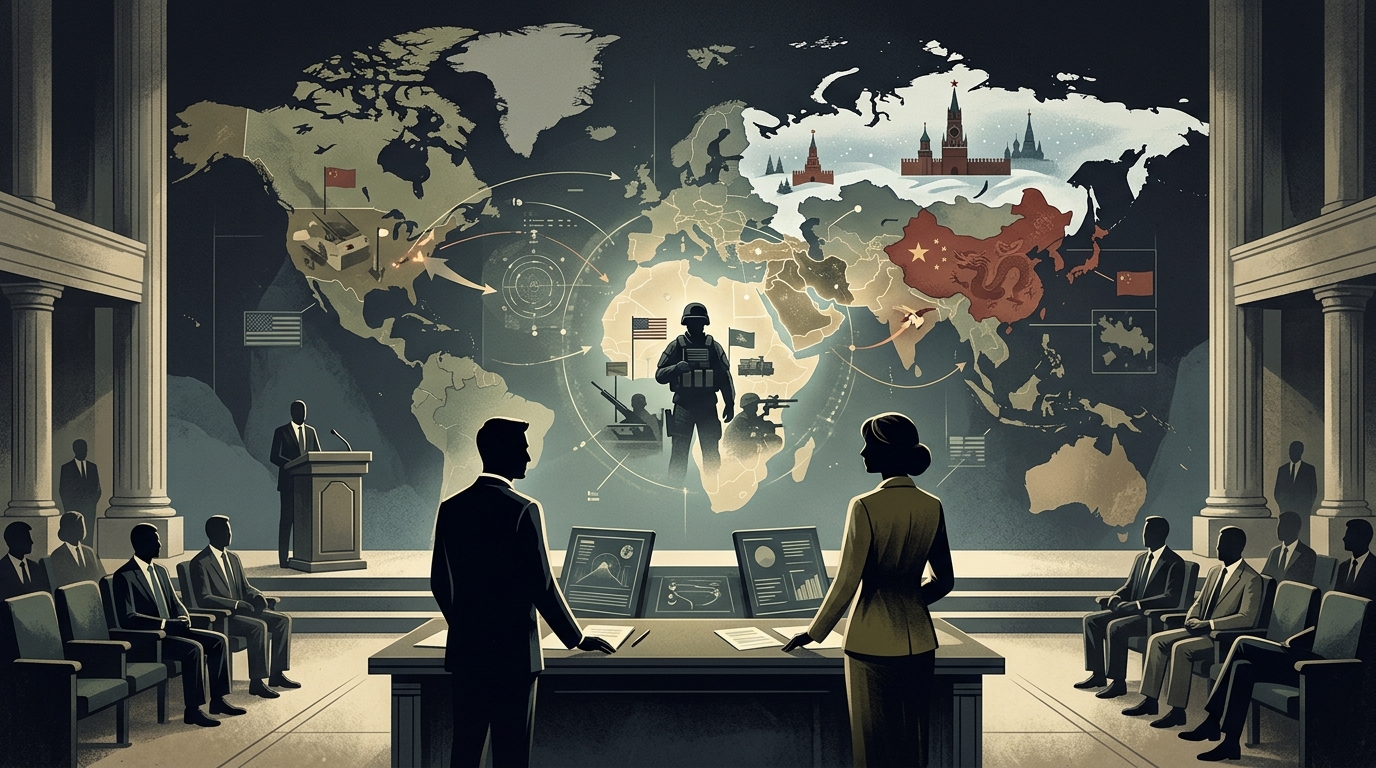
The Middle East, a region that has served as the epicenter of geopolitical turbulence for decades, has evolved into an unexpected intelligence goldmine for the United States' strategic adversaries. According to a recent report by the Wall Street Journal, the ongoing proxy wars and direct confrontations involving Iran are providing China, Russia, and North Korea with a rare and exceptionally valuable opportunity: to observe the American military machine operating under conditions of high-intensity, real-world pressure.
Battlefield Intelligence: A Digital Goldmine
For Beijing and Moscow, every interception of an Iranian drone by a U.S. destroyer in the Red Sea is more than just a headline; it is a massive data set. These nations are deploying advanced sensors, satellite surveillance, and signals intelligence (SIGINT) platforms to record U.S. radar frequencies, the reaction times of air defense systems, and the real-world hit rates of Patriot and SM-6 missiles. This 'real-time study' allows adversaries to identify 'blind spots' or vulnerabilities in how the United States protects its allies and vital maritime corridors.
The WSJ analysis highlights that Russia, in particular, benefits significantly from its burgeoning military partnership with Tehran. Through information sharing, Moscow gains access to data on how U.S. electronic warfare (EW) systems respond to Shahed-class drones. This knowledge is immediately funneled back to the front lines in Ukraine, creating a feedback loop where Western technological innovations are being neutralized at an unprecedented pace.
The Economic Paradox of Asymmetric Threats
One of the most concerning takeaways from the report involves the sheer cost of defense. China is observing with keen interest the economic exhaustion caused by the U.S. use of multi-million dollar missiles to down cheap, mass-produced drones. When a $2 million interceptor is used to neutralize a drone costing a mere $20,000, the mathematical equation of the conflict shifts heavily in favor of the aggressor.
- The 'Saturation' Strategy: How many simultaneous targets can the Aegis Combat System effectively manage?
- Stockpile Resilience: How quickly can the U.S. replenish its inventory of precision munitions?
- Personnel Fatigue: How does the readiness of crews decline after months of sustained high-alert operations?
These questions are central to Chinese military doctrine as Beijing prepares for potential future conflicts in the Indo-Pacific, such as a crisis in the Taiwan Strait. The ability to witness the U.S. 'playbook' without being a direct participant in the conflict is a strategic advantage that cannot be overstated.
Geopolitical Erosion of Deterrence
The exposure of American tactics diminishes the element of surprise. Historically, the U.S. maintained a veil of ambiguity regarding the full spectrum of its weapons' capabilities. However, the necessity of public displays of force and the continuous use of these systems in the Middle East have effectively 'stripped' the technology bare. Analysts warn that if China and Russia successfully develop countermeasures based on these observations, traditional American military superiority could be fundamentally compromised.
Furthermore, North Korea appears to be using these conflicts as a 'test lab' for ballistic missiles that eventually end up in Russian hands or serve as blueprints for Iranian designs. This web of technological exchange creates a unified front that learns collectively from every American move. Washington now faces a critical dilemma: continue defending in a traditional manner—thereby revealing its secrets—or seek radically new security paradigms that remain opaque to hostile surveillance.
Conclusion: The Need for a New Offset Strategy
The situation described by the WSJ underscores that future warfare will not only be decided by who possesses the most hardware, but by who can best protect their data. For the U.S., the challenge is now twofold: it must maintain stability in the Middle East while ensuring it doesn't provide 'free lessons' to its greatest rivals. The era of undisputed technological hegemony is giving way to an age of constant espionage and rapid adaptation, where the battlefield is simultaneously a global classroom for those who wish to dismantle the existing international order.