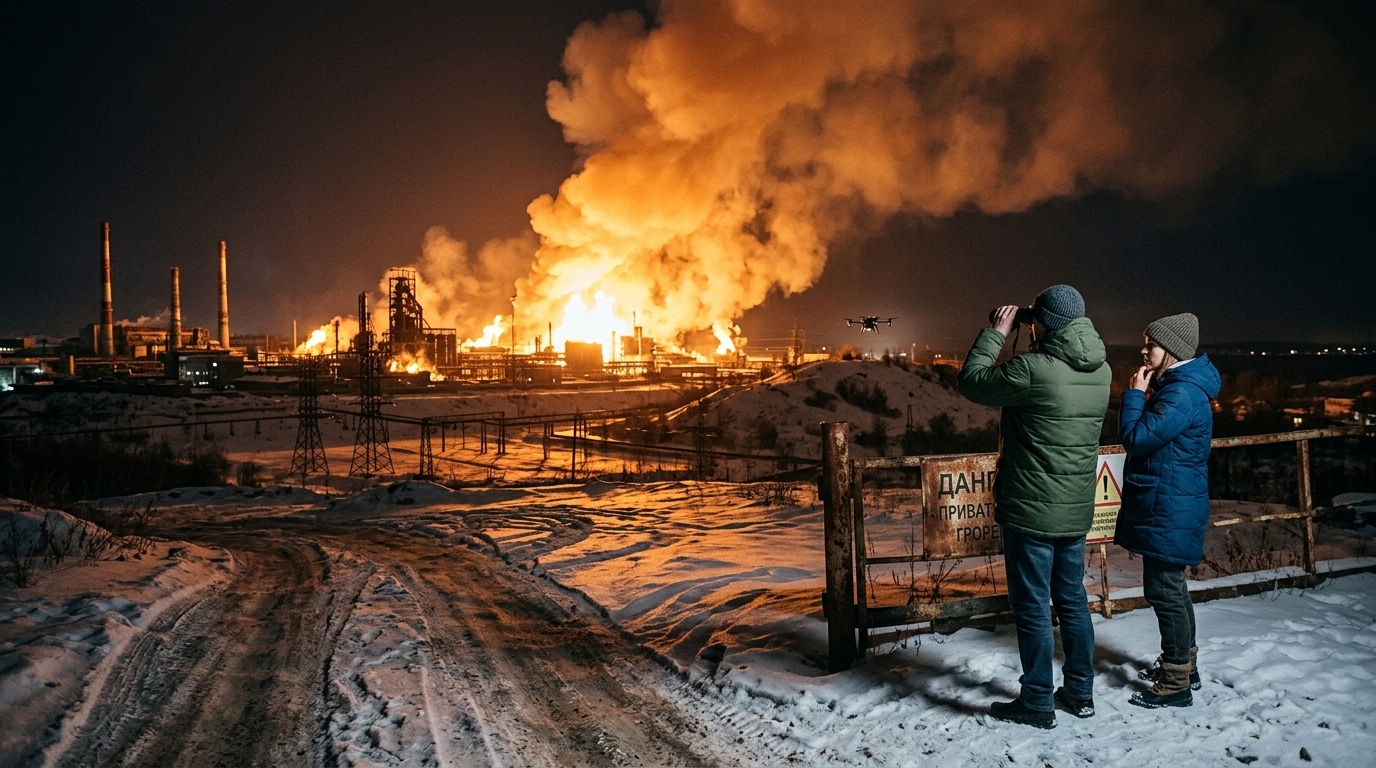
The news that a Ukrainian drone struck a residential complex in Yekaterinburg, the historic capital of the Urals, is not just another war dispatch. It represents a geographical and strategic shift that redefines the boundaries of the conflict. For the first time since the start of the Russian invasion in 2022, the war has 'knocked on the door' of a city located over 1,500 kilometers from the front line, shattering the sense of security that had prevailed in the Russian heartland.
Technological Breakthrough: The 1,500-Kilometer Threshold
The attack on Yekaterinburg highlights the rapid evolution of the Ukrainian drone program. While at the beginning of the war Kyiv's capabilities were limited to short-range tactical strikes, we are now seeing the deployment of long-range strategic drones, such as the 'Liutyi,' which integrate advanced artificial intelligence for navigation. The ability of a drone to traverse hundreds of kilometers of Russian airspace while evading electronic warfare (EW) systems and air defenses suggests the use of autonomous target recognition systems.
According to military analysts, these drones do not rely solely on GPS, which is frequently jammed by Russian forces, but instead utilize 'visual navigation' or Digital Scene Matching (DSM). This technology allows the aircraft to compare real-time ground imagery with a pre-loaded digital map, making it practically immune to electronic countermeasures. The fact that the strike occurred in a key industrial city like Yekaterinburg sends a clear message: no part of Russian territory is inaccessible anymore.
The Strategic Importance of the Urals
Yekaterinburg is not an arbitrary target. It is Russia's industrial 'soft underbelly,' housing massive defense production facilities, steel mills, and logistics centers. The Urals region has historically served as a sanctuary for Russian industry, most notably during World War II, due to its vast distance from European borders. The collapse of this geographical advantage creates severe headaches for Russian military planners.
While this specific strike was reported to have hit a residential complex—a fact the Russian side uses to denounce 'terrorist acts' against civilians—the Ukrainian side often targets infrastructure supporting the war machine. The psychological impact on the residents of the Urals is profound. For millions of Russians living deep in the interior, the war was previously something seen only on television. Now, the reality of explosions and sirens is being brought to their own streets, undermining the Kremlin's narrative of a 'controlled special military operation.'
The Challenge for Russian Air Defenses
The attack also raises critical questions about the effectiveness of Russian air defenses. How is it possible for a drone to fly for hours over Russian territory without being detected? The answer lies in Russia's sheer size and the impossibility of covering every square kilometer with radar. Ukrainian drones fly at very low altitudes, utilizing terrain masking to hide from enemy radar systems.
Furthermore, Russia's need to deploy its best systems (such as S-400s and Pantsirs) at the front lines and around Moscow leaves other major cities exposed. Ukraine appears to be exploiting these gaps, forcing Moscow into a difficult choice: will it withdraw air defense systems from the front to protect its rear cities, or will it leave its industrial heartland vulnerable to continuous strikes? This dilemma is exactly what Kyiv seeks to exploit in a war of attrition.
Conclusions and Outlook
The strike on Yekaterinburg is not an isolated incident but the beginning of a new phase. The use of AI in drone navigation and the increase in their range means that Ukraine can now conduct a large-scale asymmetric war. As technology evolves, the concept of a 'front line' is blurring. The war is no longer fought only in the trenches of the Donbas but also in the skies above Russian metropolises, dramatically altering the political and military balance in the region.