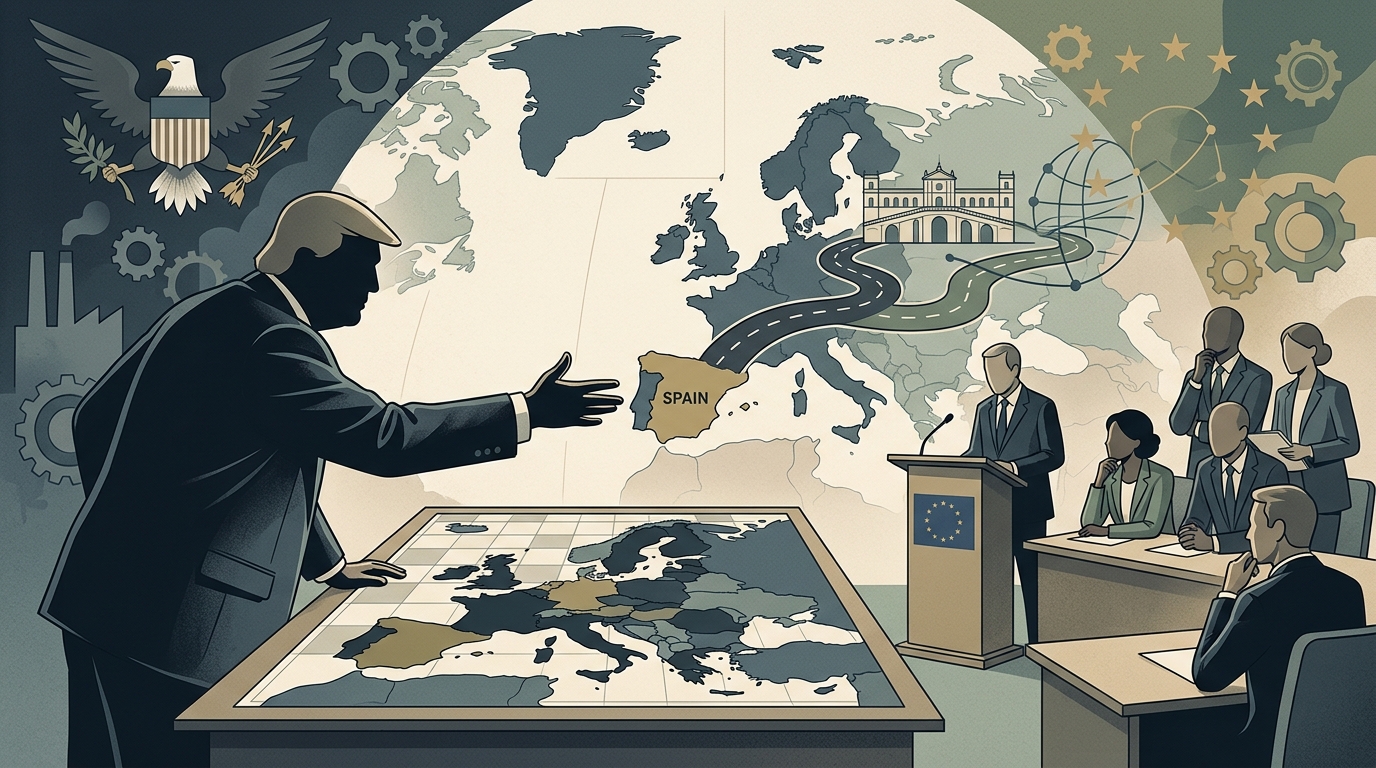
The potential return of Donald Trump to the epicenter of global politics is accompanied, as expected, by the revival of his signature rhetoric regarding "unpaid bills." This time, the former U.S. President has set his sights on Spain—a country that has traditionally served as a strategic Mediterranean partner but remains a perennial fixture on the list of nations failing to meet their financial commitments to the North Atlantic Alliance. Trump’s recent social media broadside was not merely a casual observation; it was a calculated warning shot highlighting the deepening fissures in transatlantic relations.
The Economic Critique: Perception vs. Reality
In his recent commentary, Trump did not limit himself to defense expenditures; he expanded his critique to the overall management of the Spanish economy under Prime Minister Pedro Sánchez. Trump painted a picture of economic stagnation, focusing heavily on Spain’s high unemployment rates—particularly among the youth—and its significant public debt. To Trump, Spain epitomizes the "free rider" model: a nation enjoying the security umbrella provided by the United States without contributing its fair share, all while failing to implement necessary fiscal reforms at home.
However, the reality of the Spanish economy is far more nuanced than Trump’s social media simplified narrative suggests. Despite systemic challenges, Spain has actually outpaced the Eurozone average in terms of GDP growth throughout 2023 and 2024, driven by a robust tourism sector and a surge in service exports. Trump’s critique, therefore, appears to be less about economic data and more about a political narrative designed for domestic American consumption, positioning himself as the only leader willing to hold European allies accountable.
The 2% Friction and NATO’s Strategic Future
The core of the dispute remains the 2014 Wales Pledge, which mandates that NATO member states spend at least 2% of their GDP on defense. Spain consistently ranks near the bottom of this list, with spending hovering around 1.2% to 1.3%. For a politician with Trump’s worldview—one that views international alliances through the lens of transactional diplomacy—this shortfall is unacceptable. He views NATO not as a collective security pact based on shared values, but as a protection service where the fees must be paid in full.
Madrid argues that its contribution should not be measured solely in currency, but in operational commitment. Spain is an active participant in numerous NATO missions and hosts vital strategic assets, such as the Rota Naval Base. Nevertheless, Trump’s pressure creates a suffocating environment for the Sánchez government, which must balance the social spending that sustains its electoral base with the massive capital investment required for military modernization to appease Washington.
Geopolitical Implications and the Ideological Clash
Beneath the surface of budget disputes lies a profound ideological confrontation. Pedro Sánchez represents the progressive, multilateralist wing of Europe, while Trump is the primary exponent of nationalistic populism. The attack on Spain is no accident; it is a signal to the entire European Union. Should Trump return to the White House, Spain could face punitive tariffs on key exports like olive oil and wine as a means of coercion to force defense budget increases.
Furthermore, Spain’s foreign policy—particularly its stance on the conflict in Gaza and its diplomatic ties with Latin America—often diverges from the hardline Republican platform. Trump’s criticism functions as a lever to bring Madrid back into alignment with U.S. priorities, using economic vulnerability as an entry point. Europe is watching closely, as the "Spain model" of criticism could be a precursor for how other nations, including Italy or even Germany, might be treated in a potential second Trump administration.
Conclusion: The Case for European Strategic Autonomy
Trump’s offensive against Spain underscores the urgent need for Europe to re-evaluate its reliance on the American security umbrella. Whether his remarks are viewed as legitimate criticism or political blackmail, the underlying fact remains: the era where security was taken for granted and provided for free has ended. Spain, and by extension the EU, must develop a strategy that allows them to negotiate from a position of strength, rather than remaining easy targets on a global chessboard that is becoming increasingly ruthless.