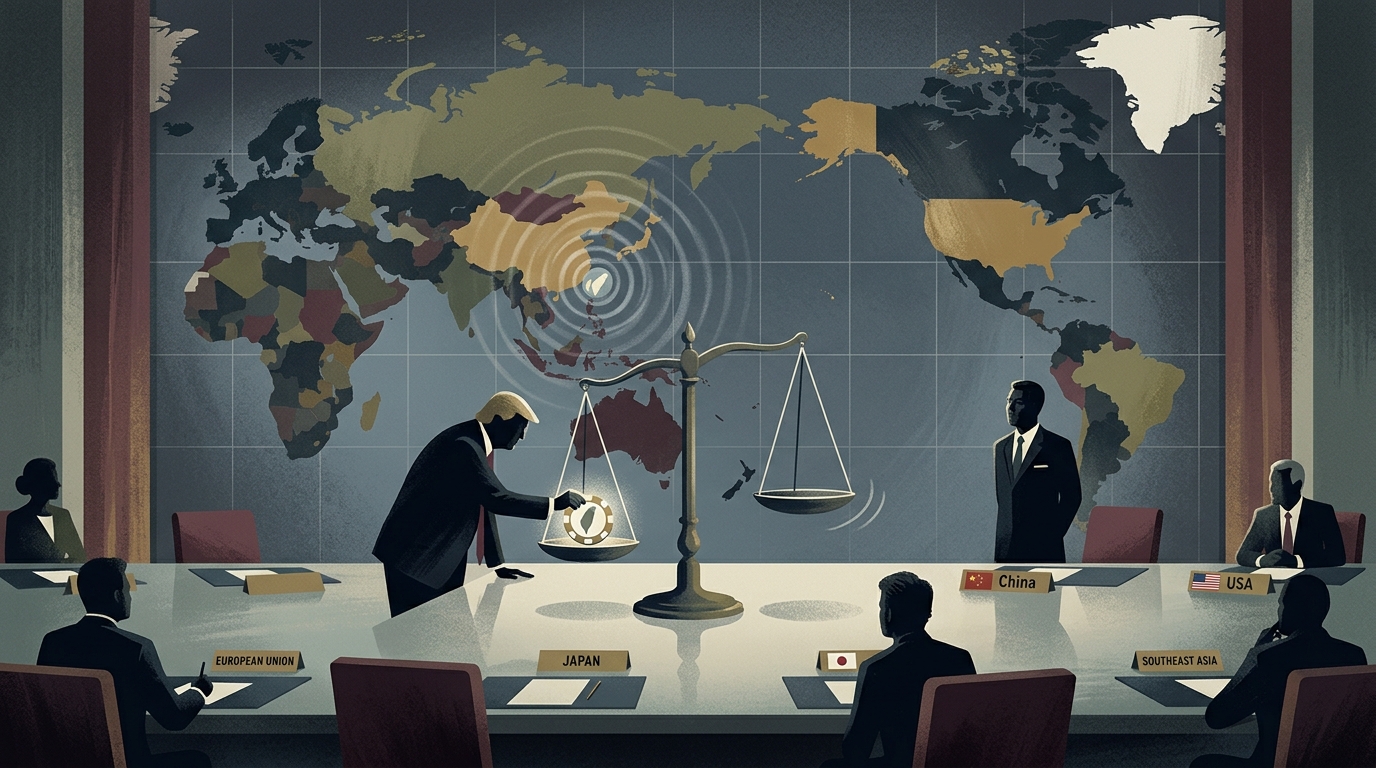
The geopolitical chessboard of the 21st century appears to be transforming into a high-stakes poker table, as Donald Trump has once again signaled his intention to treat international alliances not as principled commitments, but as assets to be bartered. In recent statements to Fox News, the former president and current contender for power characterized Taiwan as a “very good negotiating chip” in US relations with China, casting a long shadow of doubt over the stability of American support for the democratic island.
This approach is not merely a rhetorical flourish; it represents a radical re-evaluation of US strategy in the Indo-Pacific. For decades, Washington has maintained a policy of “strategic ambiguity,” supporting Taiwan’s ability to defend itself without explicitly committing to military intervention, but always within the framework of protecting a democracy and a critical partner. Trump, however, introduces a raw transactional logic: Taiwan's security and arms sales are now contingent upon Beijing’s behavior on other fronts, such as trade and economic policy.
The Erosion of the ‘Silicon Shield’
Taiwan is not an incidental geographic entity. It is the global hub of semiconductors, with TSMC producing the vast majority of advanced chips that power everything from iPhones to AI-driven weapons systems. This “silicon shield” was previously considered the ultimate guarantee that the West would never allow the island to fall into Chinese hands.
When Trump states that he is “holding in abeyance” arms sales depending on China’s actions, he sends a signal of profound instability to markets and allies alike. If Taiwan is a “chip,” it is by definition something that can be spent or traded away. For Beijing, this rhetoric is a golden opportunity. The Chinese leadership under Xi Jinping has made the “reunification” with Taiwan a central pillar of its national rejuvenation. The prospect of a US administration that views Taipei as a tradable commodity weakens American deterrence and emboldens Chinese assertiveness.
Taipei’s Reaction and the Fear of Abandonment
In Taipei, these statements are met with public composure but intense private concern. The Taiwanese government has invested billions in American defense technology, seeking to turn the island into a “porcupine” to deter a potential invasion. The notion that these arms sales could be used as leverage for Washington to secure better tariffs from China is sending shivers through the region.
- US credibility as a security guarantor in Asia is being called into question.
- Regional allies, such as Japan and South Korea, may reconsider their own defense dependencies.
- The global technology supply chain faces the prospect of a sudden geopolitical shift that could paralyze semiconductor production.
Trump argues that this uncertainty is his greatest weapon. In his view, predictability is a weakness. However, in international diplomacy, predictability is the foundation of war prevention. If Beijing comes to believe that the price for Taiwan is merely financial, the risk of a military miscalculation increases exponentially.
A New Era of Realpolitik
Trump’s stance reflects a broader trend in American politics: exhaustion with international commitments and a return to hard-nosed Realpolitik. This is no longer about the spread of democracy or the containment of authoritarianism; it is “America First” in its purest, most cynical form. In this context, values take a backseat to trade deficit figures.
The remaining question is whether Congress, which has historically shown strong bipartisan support for Taiwan, would permit such a shift. US law, specifically the Taiwan Relations Act, mandates the provision of defensive means to the island. However, the executive branch’s control over foreign policy is extensive, and a president determined to “make deals” could alter the balance of power in the Pacific overnight.
Ultimately, treating a nation of 23 million people and the world’s most critical technology hub as a “chip” risks more than just a bad deal; it risks a global conflagration that no amount of negotiating can resolve.