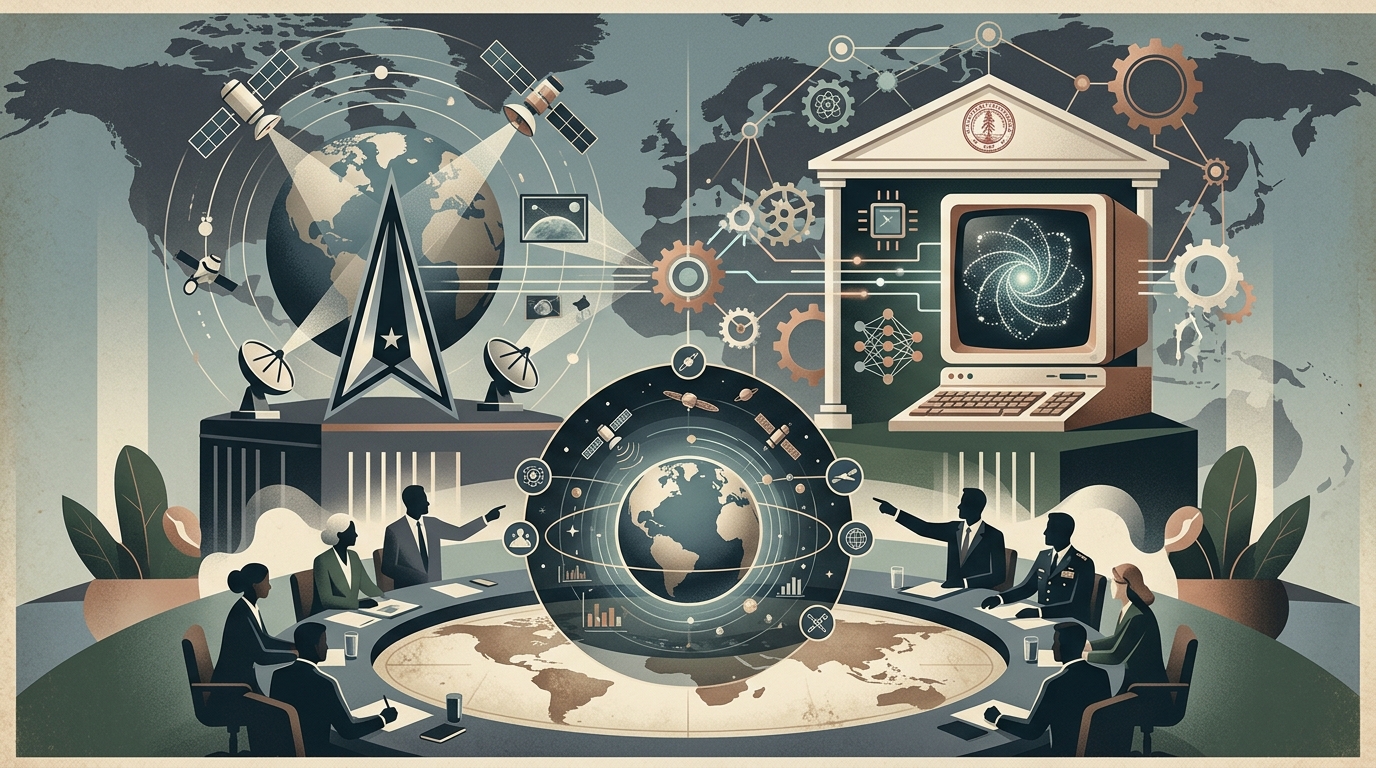
In a move that highlights the growing convergence between cutting-edge academic research and national defense, the United States Space Force (USSF) has announced the creation of an AI Accelerator in partnership with Stanford University. This initiative, to be housed within Stanford’s Institute for Human-Centered AI (HAI), is not merely a research collaboration but a strategic necessity in a geopolitical environment where space is increasingly viewed as the "ultimate high ground" and a potential battleground.
The Space Force, the youngest branch of the U.S. military, faces an unprecedented challenge: the sheer volume of data. With thousands of satellites, millions of pieces of orbital debris, and constant threats from near-peer competitors like China and Russia, traditional human-centric analysis is no longer sufficient. The accelerator’s goal is to develop algorithms capable of processing this data in real-time, enabling the USSF to make split-second decisions in a domain where speed is everything.
The Convergence of Academia and Defense Power
The choice of Stanford is deliberate. Situated in the heart of Silicon Valley, the university serves as a bridge between technological innovation and public policy. The AI Accelerator will focus on several key areas, including machine learning for Space Domain Awareness (SDA), autonomous satellite navigation, and the protection of space-based assets from sophisticated cyberattacks.
According to General B. Chance Saltzman, Chief of Space Operations, the Space Force must evolve into a "data-driven organization." This transformation requires that every sensor—from ground-based radars to orbital telescopes—be interconnected through an intelligent network. The partnership with Stanford HAI aims to integrate ethical frameworks into the development of these systems, ensuring that AI remains under human oversight even during high-stakes operations.
Geopolitical Competition and the Space Race 2.0
This initiative unfolds against a backdrop of intense concern regarding the space capabilities of U.S. adversaries. China has made rapid strides in anti-satellite (ASAT) technologies and orbital maneuvering capabilities, while Russia continues to test weapon systems that could jeopardize the global GPS network and critical telecommunications. Space is no longer a peaceful vacuum; it is a vital infrastructure for the global economy and military power.
The Stanford-based AI Accelerator will function as a "testbed" for new strategies. For instance, using AI to predict the trajectories of space debris is critical. A single collision in orbit could trigger the "Kessler Syndrome"—a cascading series of impacts that could render certain orbits unusable for decades. AI offers the computational power needed to avoid such catastrophic scenarios while simultaneously safeguarding American strategic interests.
Challenges and Ethical Dilemmas
Despite the promise of AI, the militarization of these technologies in space raises profound questions. How much autonomy should an armed spacecraft possess? What happens if an algorithm misinterprets the natural movement of a foreign satellite as a hostile act? The collaboration with an academic institution like Stanford HAI is intended to mitigate these risks through "transparent and responsible AI" development.
However, critics argue that the deep involvement of universities in military programs blurs the line between open academic inquiry and war preparation. The Space Force maintains that these technologies are defensive in nature and essential for maintaining global stability. The ability of AI to detect patterns that the human mind might miss is seen as the key to deterring conflict before it even begins.
The Future of Space Operations
Looking ahead, the Stanford accelerator is likely just the beginning. Similar initiatives are expected to emerge at other top-tier institutions, creating an ecosystem where technology, policy, and strategy intersect. The Space Force is not just looking for the best hardware; it is seeking the superior "software" to command the heavens.
In a world where information is the new currency and processing speed is the new power, this partnership places the United States in a leading position. The success of this venture will determine whether space remains a domain of international cooperation or evolves into an arena of perpetual digital and physical confrontation. AI is no longer a support tool; it is the central pillar of 21st-century space strategy.