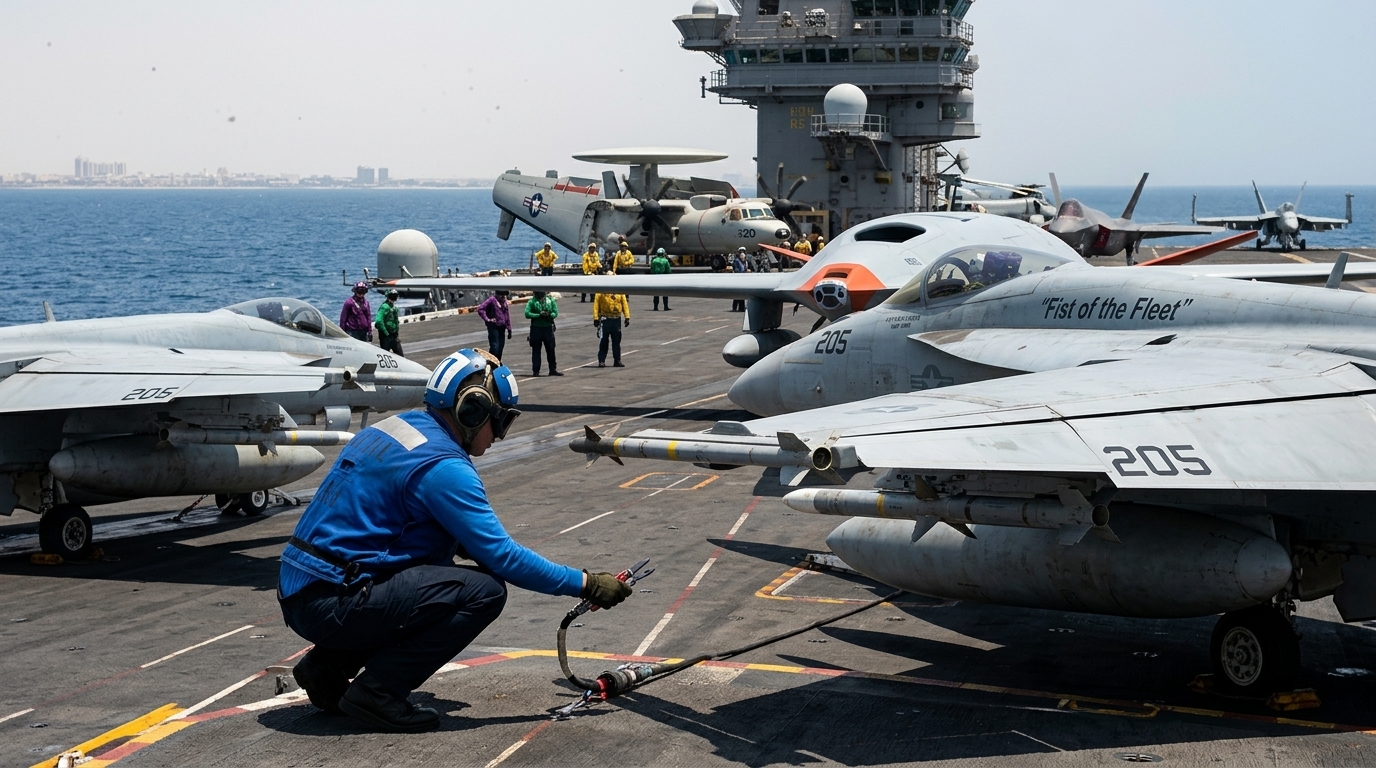
At the heart of the global energy chessboard, the Strait of Hormuz remains the most critical and simultaneously the most fragile transit point. The recent announcement by U.S. Central Command (CENTCOM) regarding the shoot-down of Iranian unmanned aerial vehicles (UAVs) threatening commercial shipping is not merely another episode in the long-standing tension between Washington and Tehran. It represents a transition into a new form of 'naval overwatch,' where cutting-edge technology and artificial intelligence assume the role of guardian of international waters.
The Strategy of 'Naval Overwatch'
The term 'naval overwatch,' used by Pentagon officials, describes a multi-layered network of sensors, satellites, and autonomous systems that monitor every movement in the Strait in real-time. Unlike traditional patrols, this new approach relies on 'intelligent' detection. Artificial Intelligence analyzes vast amounts of data from radar and optical sensors to distinguish between commercial vessels, fishing boats, and hostile drones within seconds.
The effectiveness of this strategy was evident in the recent engagement, where Iranian drones were neutralized before they could even approach their targets. CENTCOM emphasized that the threat was 'immediate,' yet the response was surgical. This suggests that the U.S. has deployed counter-drone systems (C-UAS) capable of operating with minimal human intervention, reducing reaction time and the risk of collateral damage.
Asymmetric Warfare and the Drone Challenge
Iran has invested billions in developing cheap but effective loitering munitions (suicide drones). This tactic aims to saturate the defensive systems of adversaries through 'swarms.' The challenge for the U.S. Navy and its allies is both economic and technological: how do you neutralize a drone costing $20,000 without spending an interceptor missile worth $2 million?
- Utilization of electronic warfare systems to jam control signals.
- Deployment of directed-energy weapons (lasers) for low-cost shoot-downs.
- Integration of data from unmanned surface vessels (USVs) acting as forward outposts.
The 'open' nature of the Strait, despite the threats, is due to this technological superiority. Shipping companies, while remaining vigilant, now seem to place more trust in security assurances, as data shows that oil flow remains stable despite harassment attempts.
Geopolitical and Economic Implications
The security of the Strait of Hormuz is inextricably linked to the global economy. Approximately 20% of global oil consumption passes through this narrow passage. Any prolonged disruption could skyrocket energy prices and trigger an inflationary shock in Europe and Asia. The presence of 'naval overwatch' acts as a deterrent, sending the message that the cost of an attack will be disproportionately high for the aggressor.
"Freedom of navigation is non-negotiable. Technology now allows us to protect it in ways that were unthinkable a decade ago," stated a senior defense analyst.
In conclusion, the Strait of Hormuz remains a powder keg, but the 'smart' eyes of the West have made the fuse much harder to ignite. The battle for control of sea lanes is moving into the digital realm and algorithms, making artificial intelligence the new admiral of the oceans.