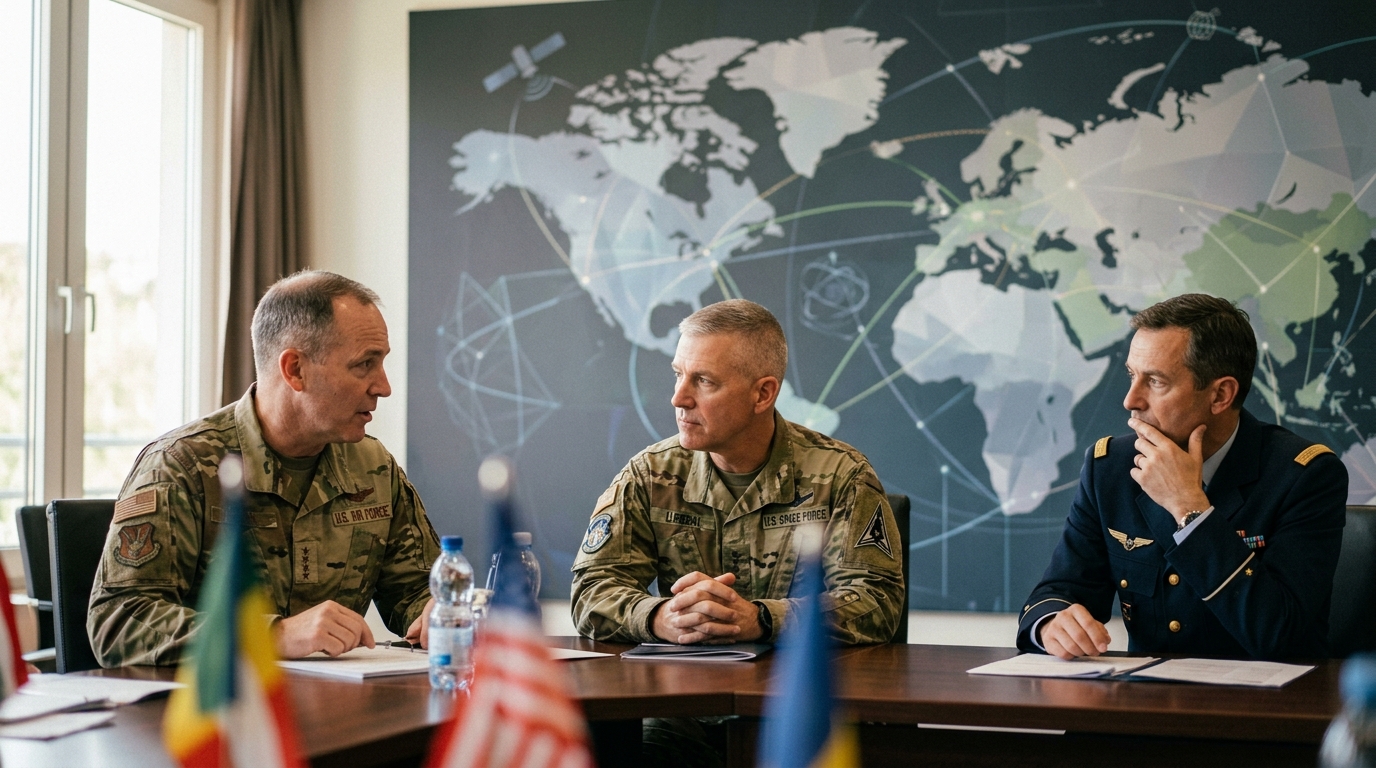
As of June 30, 2026, the geopolitical chessboard is no longer confined to national borders or the Earth's oceans. It is moving at breakneck speed into the exosphere. The recent announcement regarding the intensified collaboration between the U.S. Space Force (USSF) and the Air Force (USAF) through a rapid Artificial Intelligence integration program, dubbed the "AI Sprint," marks a fundamental shift in how major powers perceive security and deterrence. This move is not merely about a software upgrade; it is about redefining the doctrine of "mission dominance" in an environment where seconds of delay can lead to strategic defeat.
The Imperative for Speed and Automation
Space has become an extraordinarily crowded and contested domain. With thousands of active satellites, increasing space debris, and the threat of anti-satellite weapons from rival powers such as China and Russia, data management has surpassed human capabilities. The "convergence" now being undertaken aims to leverage machine learning algorithms capable of processing petabytes of telemetry data in real-time.
According to Pentagon sources, the AI Sprint focuses on three pillars: predictive maintenance of space infrastructure, automated threat recognition, and optimization of orbital maneuvers. Integration with the Air Force is critical, as the latter possesses the logistical infrastructure and decades of experience in managing aerial operations, which must now interface seamlessly with space operations under the JADC2 (Joint All-Domain Command and Control) framework.
Geopolitical Implications and Great Power Competition
This move does not occur in a vacuum. China has invested billions in "intelligentized warfare," seeking to use AI to bypass traditional American hardware superiority. The U.S. response through the Space Force is an effort to maintain the "High Ground." Dominance in space means control over global communications, navigation (GPS), and surveillance. If AI can predict an attack on a satellite before it happens, or autonomously redirect a swarm of microsatellites to fill a gap in communications, the strategic advantage is incalculable.
- Operational Tempo: AI enables millisecond decision-making, essential for countering hypersonic weapons.
- Infrastructure Resilience: The ability of satellite networks to self-heal via algorithms.
- Data Interconnectivity: Unifying sensors from ground, air, and space into a single intelligence web.
Ethical Dilemmas and the Future of the 'Black Box'
Despite the advantages, integrating AI into military operations raises serious questions. Reliance on "black box" algorithms—where the reasoning behind a decision is not always clear to human operators—poses a risk of unintended escalation. What happens if an AI misinterprets an orbital correction of a foreign satellite as a hostile act? The Space Force maintains that a human will always remain "in-the-loop," but the very nature of the AI Sprint suggests that the speed of developments may soon render human intervention a mere formality.
"Artificial Intelligence is no longer an auxiliary tool; it is the battlefield itself. Whoever controls the algorithms controls the future of global security," says a senior USSF official.
In conclusion, the convergence of the Space Force and Air Force through AI represents the culmination of a decade of technological preparation. As we move into the latter half of the 2020s, the concept of national sovereignty will increasingly depend on a state's ability to protect its assets above the atmosphere, utilizing intelligence that transcends human biology.