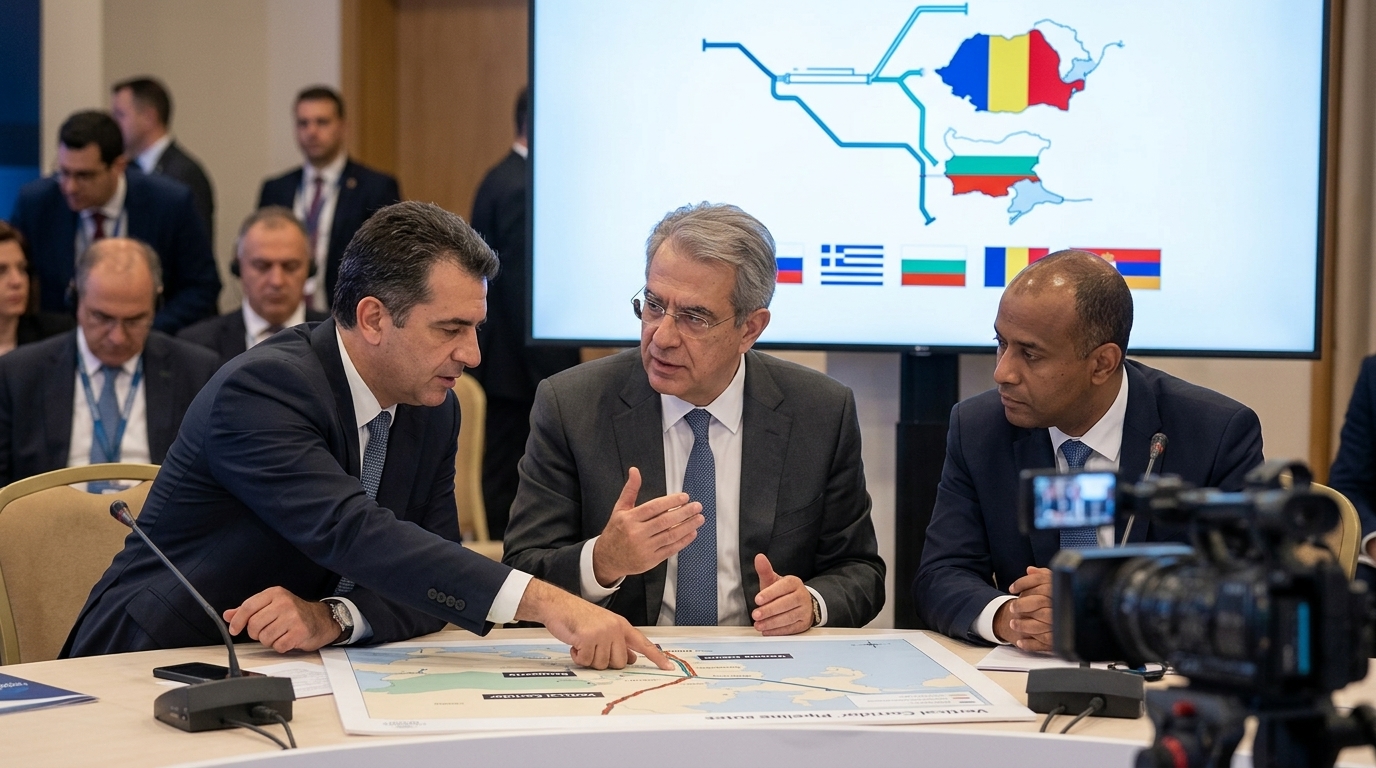
At the heart of shifting global geopolitics, Greece is emerging as a pivotal player in the energy security of the European continent. During the Delphi Economic Forum, Alexandros Exarchou, Chairman and CEO of the Intrakat Group (Aktor), outlined the framework of a new era where the "Vertical Corridor" is not merely a technical infrastructure project, but the master key to Europe's definitive decoupling from Russian natural gas.
This initiative, connecting the gas transmission networks of Greece, Bulgaria, Romania, Hungary, Slovakia, Moldova, and Ukraine, creates an alternative South-to-North route. At a time when the European Union is desperately seeking ways to sever ties with Gazprom, the Vertical Corridor offers the necessary flexibility and security of supply, leveraging Greek LNG infrastructure and interconnecting pipelines.
The Strategic Importance of Infrastructure and Greece’s Role
Mr. Exarchou emphasized that Greece now holds the advantage of geographical position and ready-to-use infrastructure. With the FSRU terminal in Alexandroupoli and the upgrading of the National Natural Gas System (ESFA), the country is transforming from a simple consumer into a critical transit hub. "The Vertical Corridor allows the transport of gas from Greece all the way to Ukraine, reversing the traditional East-to-West flow," he noted significantly.
Exarchou's analysis focused on the need for speed in implementing interconnections. Intrakat, as a leading force in the construction sector, recognizes that energy security is inextricably linked to a nation's ability to develop networks capable of withstanding geopolitical crises. The Vertical Corridor is not just a response to the war in Ukraine, but a long-term investment in the stability of the Balkans and Central Europe.
From LNG to Energy Sovereignty
One of the most important points of his presentation was the emphasis on Liquefied Natural Gas (LNG). The ability to import LNG from the US, Qatar, and other sources through Greek ports gives Europe the ability to choose its suppliers based on interest and stability, rather than under the shadow of extortion. The Vertical Corridor acts as the "freedom pipeline" that will carry this gas to the markets that need it most.
Furthermore, Mr. Exarchou referred to the synergies required between the public and private sectors. Funding such projects requires the support of the European Commission, as energy convergence is a European priority. Greece, through the Aktor group, demonstrates that it possesses the technical expertise to lead major projects that transcend national borders.
Challenges and the Future of the Energy Map
Despite the optimism, challenges remain. Bureaucracy in cross-border agreements and the need for technical harmonization of the networks of the participating countries are issues that require political will. However, as highlighted in Delphi, the geopolitical context leaves no room for delay. Europe must be fortified before the next winter, and the Vertical Corridor is the most realistic solution.
In conclusion, Alexandros Exarchou’s stance highlights a Greece that is no longer the "problem child" of Europe, but a strategic partner offering solutions to existential EU problems. Energy becomes the vehicle for upgrading national power and establishing a new role in the broader region of Southeast Europe.