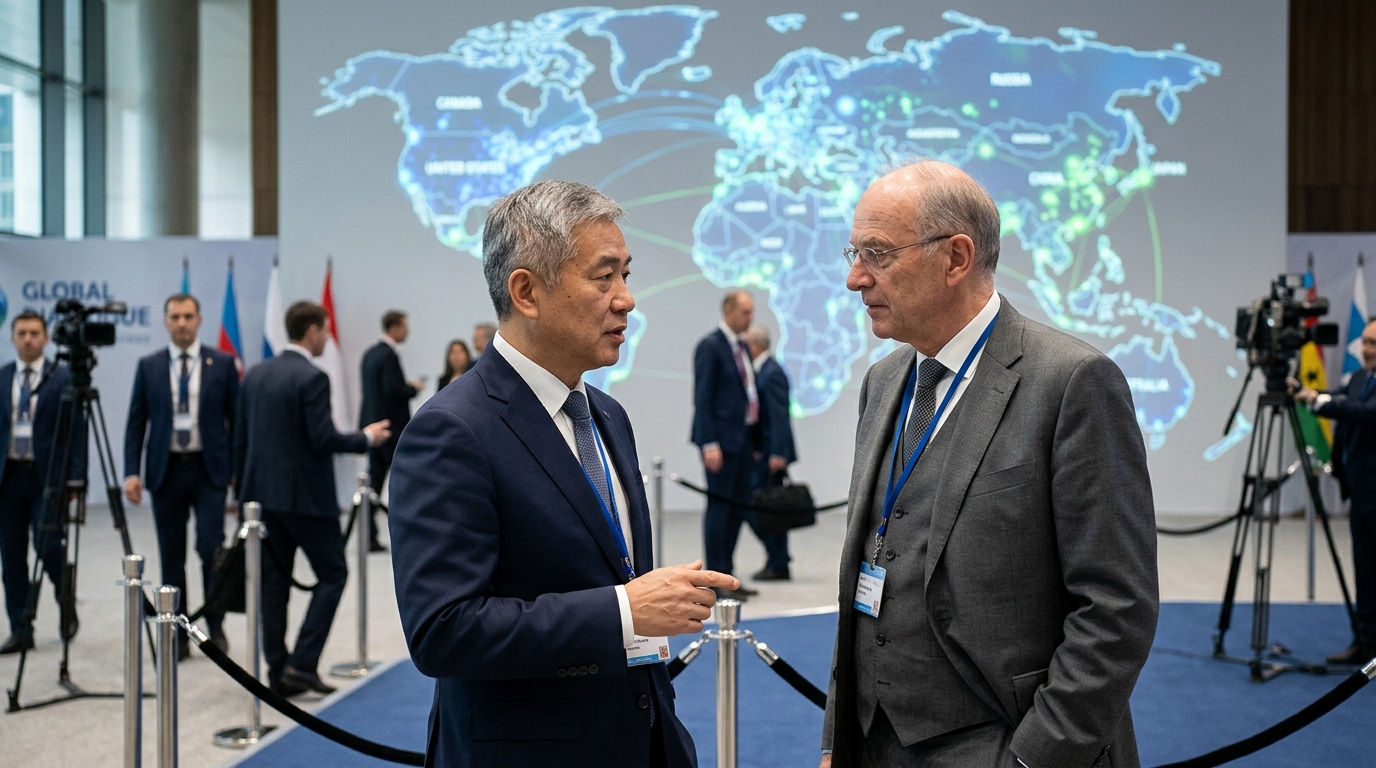
The global geopolitical landscape of technology is undergoing one of its most significant shifts in a decade. As the United States consistently tightens export controls on advanced semiconductors, China is no longer merely reacting. According to recent reports, including those from the New York Times, DeepSeek—the Chinese firm that stunned the world with its model efficiency—is now decisively pivoting toward Huawei. This move is not just a workaround; it is a strategic choice that threatens Nvidia's global hegemony.
The Strategy of Autonomy: Why DeepSeek is Choosing Huawei
For years, Nvidia has been the "gold standard" for training artificial intelligence models. Their H100 processors and their successors were considered indispensable for any serious endeavor in the field of Large Language Models (LLMs). However, Washington's sanctions have forced Chinese companies to seek alternatives. DeepSeek, which has earned global respect for its ability to produce high-performance models at a fraction of the cost of its American competitors, seems to have found an ideal partner in Huawei.
Huawei, despite being barred from many Western markets, has invested billions in its Ascend chip series. The Ascend 910B and the upcoming 910C are not mere clones of Nvidia products. They are part of a comprehensive ecosystem that includes hardware, software, and interconnect fabrics. By optimizing its algorithms specifically for Huawei hardware, DeepSeek is proving that Chinese technology can stand on its own without the need for American imports.
The Software Wall and the CANN Bridge
The greatest obstacle to replacing Nvidia was never just the hardware; it was the software. Nvidia's CUDA platform is the bedrock upon which almost all modern AI has been built. Transitioning to another architecture requires an immense reprogramming effort. This is where the DeepSeek case becomes particularly interesting. Instead of trying to mimic Nvidia, the company is working closely with Huawei to refine the CANN (Compute Architecture for Neural Networks) platform.
- Low-Level Optimization: DeepSeek engineers are working directly on the code that controls the Ascend chip cores, squeezing out every bit of performance.
- Resource Efficiency: Utilizing techniques like Mixture-of-Experts (MoE), DeepSeek manages to maximize Huawei's hardware capabilities, bridging the raw power gap compared to Nvidia's top-tier chips.
- Community Building: DeepSeek's success serves as a lighthouse for other Chinese startups, creating critical momentum for the domestic ecosystem.
This process is effectively creating a "Silicon Curtain." On one side, we have the Western ecosystem (Nvidia, CUDA, Microsoft, OpenAI), and on the other, the emerging Chinese one (Huawei, CANN, DeepSeek, Baidu). This bifurcation has profound implications for global supply chains and the pace of innovation.
The Geopolitical Chessboard and Washington's Response
This shift is a clear indication that American restrictions have had the opposite effect of what was intended. Rather than stifling Chinese AI, they acted as the ultimate catalyst for domestic innovation. Chinese firms, knowing that access to Nvidia could be severed at any moment, have no choice but to make domestic hardware work.
"DeepSeek is no longer just a software company. It is the architect of a new technological reality where China is no longer dependent," industry analysts noted.
Washington now faces a dilemma. If it tightens sanctions further, it risks accelerating Huawei's R&D. If it relaxes them, it allows China to gain advanced capabilities. The rise of DeepSeek combined with Huawei hardware shows that the battle for AI supremacy will be decided not just in labs, but in the ability to adapt to a fragmented world.
Conclusions for the Future
The future of AI in China appears to be autonomous. While Nvidia remains the global leader, the creation of a parallel, equally capable ecosystem in the East is now a reality. DeepSeek has proven that software intelligence can compensate for hardware shortcomings. As Huawei continues to iterate on its chips, dependence on the West will dwindle, creating a bipolar technological world that will define the 21st century.